



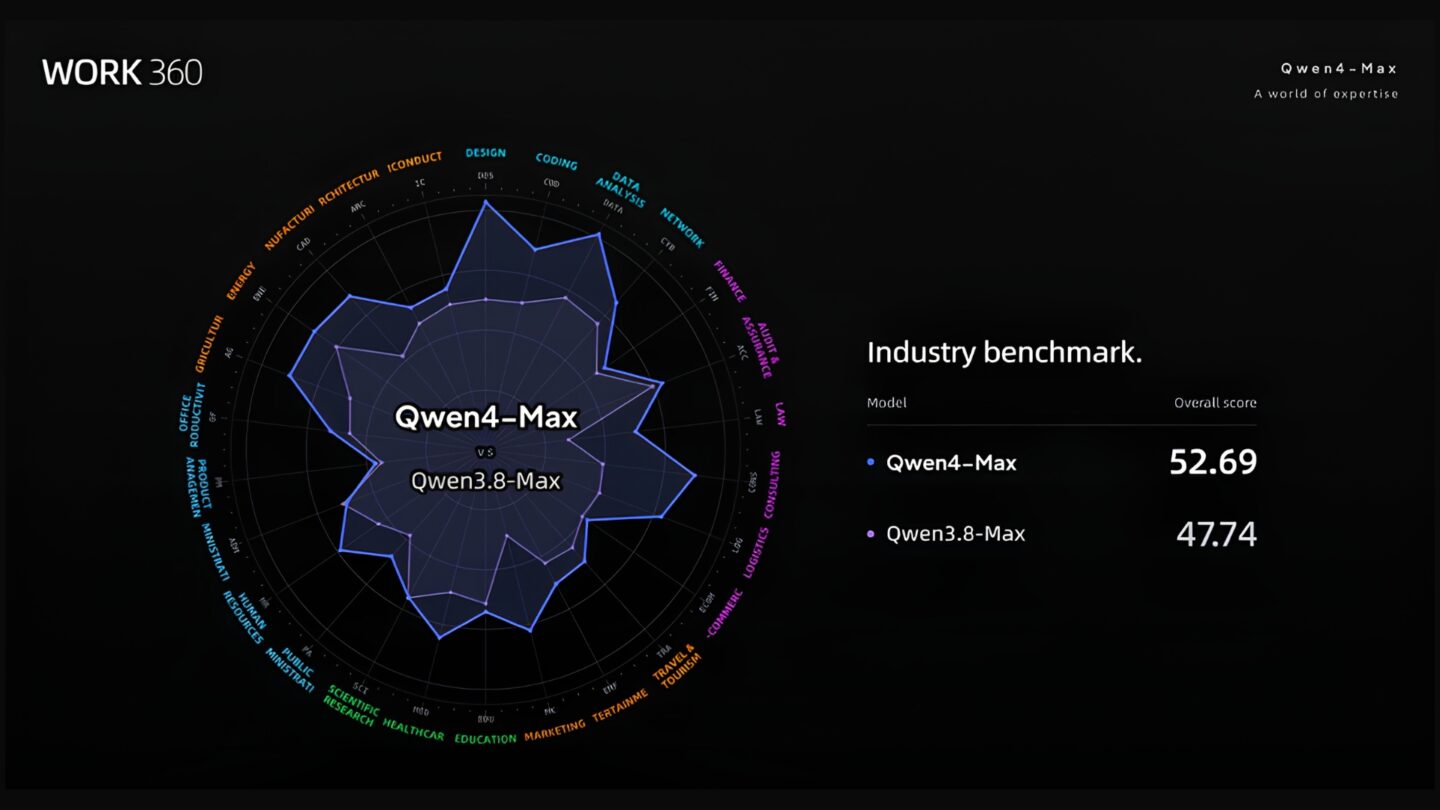
Alibaba has released Qwen4-Max, its most capable Qwen model to date, combining 2.4 trillion total parameters with native vision capabilities and a one-million-token context window. Built on the updated Qwen4 architecture, the model targets complex coding, professional workflows and autonomous tasks, with Alibaba reporting stronger performance and lower operating costs than its predecessor, Qwen3.8-Max.
Beyond general reasoning, the release extends the Qwen family into cloud resource scheduling, industrial engineering and scientific research. Alibaba has demonstrated uses ranging from automated manufacturing processes to molecular design, supported by architectural updates intended to reduce computing requirements during operation.
Updated architecture reduces computing requirements and task costs
Although Qwen4-Max contains 2.4 trillion parameters in total, its sparse Mixture-of-Experts (MoE) architecture activates 71 billion parameters per token, 25% fewer than Qwen3.8-Max at the same overall parameter scale. Alongside that sparsity, the updated design modifies attention mechanisms, residual connections and embeddings, changes that Alibaba credits for gains in both reasoning performance and computational efficiency.
Those architectural adjustments are reflected in Alibaba’s internal evaluations. On Work360, the company’s proprietary benchmark covering challenging industry tasks across 721 specialised fields, Qwen4-Max recorded an overall score of 52.69, up from 47.74 for Qwen3.8-Max. Under Alibaba’s benchmark testing conditions in High effort reasoning mode, the newer model also used 35% fewer tokens and cut average task costs by approximately 60% compared with its predecessor.
Coding performance also improved, with Qwen4-Max ranking sixth on the Code Arena WebDev leaderboard in its xHigh configuration at a score of 1,750. Alibaba additionally reported strong results across Agents’ Last Exam, Vals Index, JobBench and Chartography, covering capabilities that include agent workflows, workplace productivity and visual reasoning.
Cloud scheduling and manufacturing applications
Within cloud infrastructure, Qwen4-Max introduces Cloud Resource Scheduling capabilities built to automate resource management. The model runs a closed-loop process that adjusts scheduling workflows through feedback, an approach that reduced data-annotation model call costs by an average of 9% and increased offline CPU rescheduling speeds by more than 14 times in benchmark testing.
Alibaba has also demonstrated the model in automotive manufacturing across production-line planning, component design and machining verification. In one demonstration, Qwen4-Max cut manual workpiece programming time by 95%, bringing it down from approximately 475 minutes to 24 minutes. That workflow relied on feedback-driven iterations to detect machining issues such as overcuts and insufficient material removal before machining started, enabling the model to refine its programming output against verification results.
Beyond cloud infrastructure and factory floors, the model supports 3D modelling, game development and agentic video creation. Alibaba also pointed to broader opportunities in forward-deployed engineering across sectors including finance, law and healthcare.
Long-running agents support scientific research
Alibaba has also demonstrated extended autonomous execution in scientific research workflows spanning molecular design, experimentation and computational evaluation. In these trials, Qwen4 and Qwen4-Max coordinated multiple research stages and used intermediate findings to guide subsequent tasks.
One experiment focused on next-generation chip-cooling challenges saw Qwen4 complete a continuous 48-hour agent run across four iterations of a closed-loop research process. By combining molecular design, synthesis, testing and active learning, the workflow linked computational research with physical experimentation so that test results could inform further molecular design, culminating in the discovery of an experimentally validated coolant molecule.
In a separate Alzheimer’s research experiment, Qwen4-Max handled target research, molecular design and computational evaluation. Over the course of that workflow, the model autonomously executed 454 tool calls and 3,239 metric evaluations while designing and optimising 24 candidate molecules.
Availability, pricing and model safeguards
Qwen4-Max is available through QwenCloud via the Token Plan and API, with access also provided through Alibaba’s QwenWork and QwenStudio platforms. Input tokens served through an implicit cache hit are priced at US$0.075 per million tokens, and Alibaba plans to release smaller-scale, open-weight models from the Qwen4 series to developers worldwide.
The company has also incorporated safety measures throughout model development, pairing code security checks with functionality testing during software engineering training. Alibaba reported that these measures significantly reduced vulnerabilities involving injection, memory safety and broken access control. Alongside those checks, cybersecurity training data was filtered according to task intent, retaining defensive material for vulnerability detection and remediation while removing offensive attack content.
Dedicated safety datasets and additional post-training measures were also incorporated to strengthen protections against chemical, biological, radiological and nuclear risks, forming part of Alibaba’s model governance approach across training and post-training development.


