


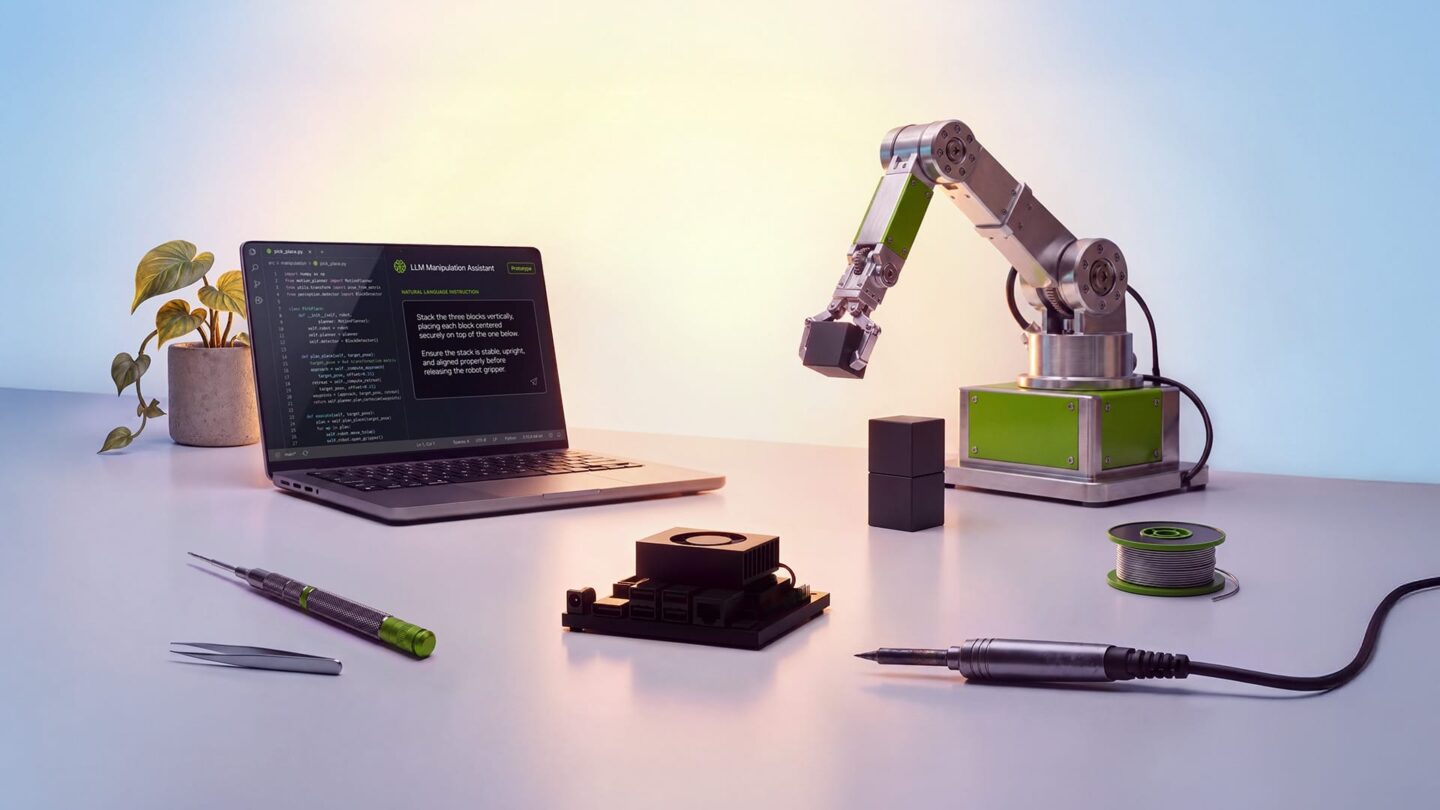
NVIDIA has introduced the Jetson Orin Nano 2, a compact robotics computer designed for developers building robots, drones and computer vision systems that run artificial intelligence workloads at the edge. The upgraded module delivers twice the inference performance of the Jetson Orin Nano Super while retaining the exact same form factor.
According to NVIDIA, the hardware consumes 40% less power in 15-watt mode when matching the performance of its predecessor. It provides 78 trillion operations per second of AI processing, supported by 8GB of memory and an eight-core Arm processor. The company attributes this significant performance uplift to improved Tensor Cores alongside higher memory bandwidth.
More AI models can run on compact devices
NVIDIA is targeting applications that need to interpret language and images to respond in real time, including robots, delivery and inspection drones, and computer vision systems. Smaller and more efficient artificial intelligence architectures are expected to expand the range of workloads that can operate on compact edge hardware. To facilitate this, Jetson Orin Nano 2 supports large language models and vision-language models optimised for memory-efficient edge inference, with open models cited by NVIDIA including Cosmos, Nemotron, Gemma 4 and Qwen 3. Developers can also take advantage of NVIDIA’s software stack and Jetson agent skills when creating applications around the hardware.
“Today’s small and medium frontier models have reached the accuracy of last year’s largest frontier models, unlocking real-time intelligence for edge devices,” said Deepu Talla, vice president of robotics and edge AI at NVIDIA. “The Jetson Orin Nano 2 computer puts that breakthrough within reach of millions of developers, delivering the performance and energy efficiency needed for real-time reasoning at the edge.”
Robotics companies begin adopting and evaluating the platform
More than 3 million developers are currently building on NVIDIA’s robotics stack. Cognex, Doosan Bobcat and Matic are among the first organisations adopting or exploring the Jetson Orin Nano 2 platform. Matic Robotics is integrating the module into its home cleaning robots, using the hardware for conversational AI, gesture detection, precision mapping, understanding objects and spaces within a household, and autonomous cleaning.
“Home robots need to understand people, map spaces precisely, understand the layout of objects and spaces, and clean autonomously in dynamic and constantly changing environments,” said Navneet Dalal, cofounder and CEO of Matic Robotics. “With Jetson Orin Nano 2, Matic can run state-of-the-art AI models at the edge in a compact home robotics platform built for real-time perception, interaction and navigation.”
Wing, Alphabet’s drone delivery subsidiary, currently deploys the Jetson Orin Nano Super alongside NVIDIA software across its delivery drone fleet. The organisation plans to evaluate the Jetson Orin Nano 2 to support real-time AI perception and reasoning throughout its delivery operations.
NVIDIA is also collaborating with an extensive hardware ecosystem around the new module. Partners including AAEON, ADLINK, Advantech, Aetina, Antmicro, Aptiv, Auvidea, AVerMedia, Chuanglebo, Connect Tech, ForeCR, JWIPC, Neurealm, Plink, Realtimes, RidgeRun, RS, Seeed Studio, Tauro Tech, Twowin, TZTEK and YUAN are developing carrier boards, hardware systems, customised AI software and reference solutions. Both the NVIDIA Jetson Orin Nano 2 module and developer kit are expected to become available in the first half of 2027.