



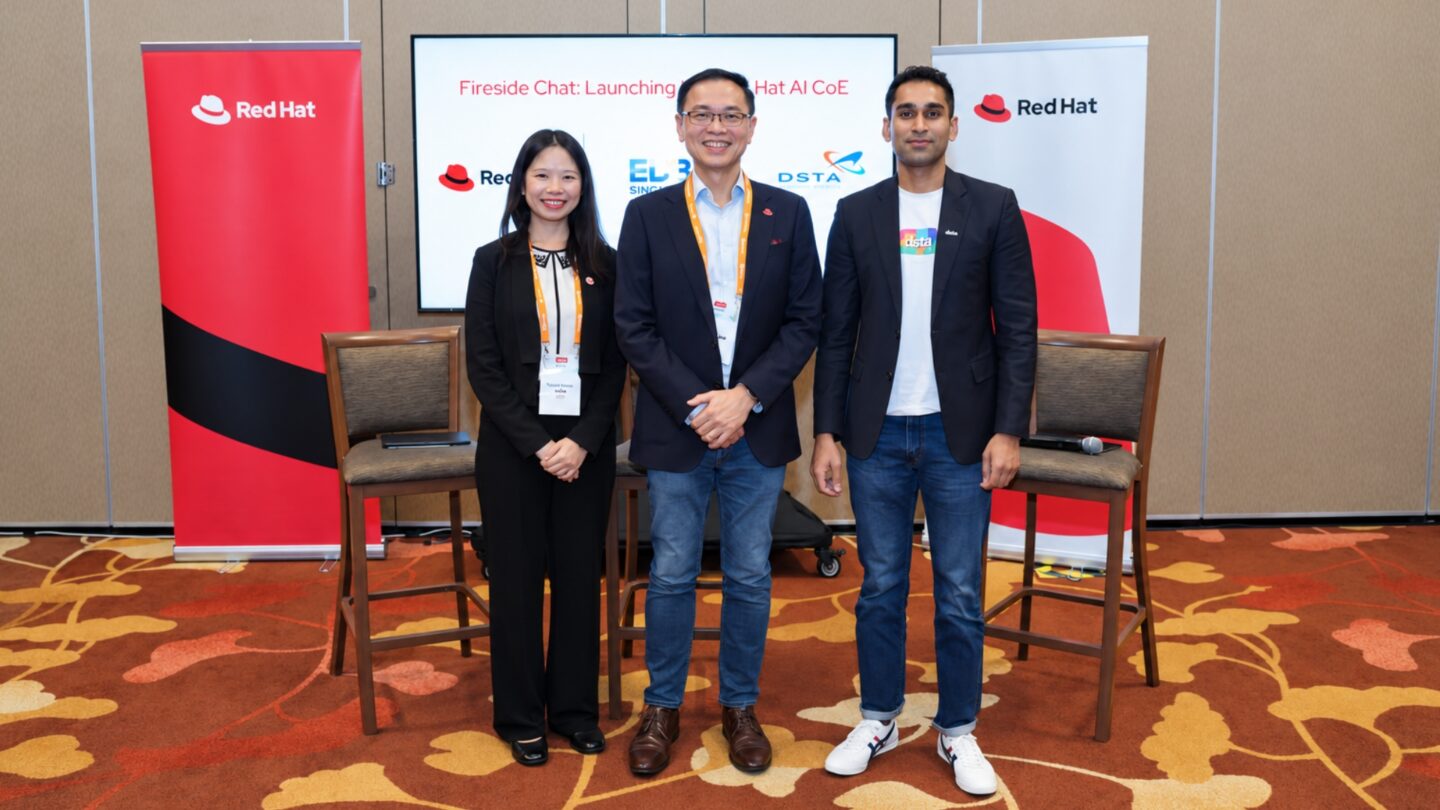
Red Hat has established its APAC AI Centre of Excellence in Singapore, supported by the Singapore Economic Development Board (EDB), to help organisations move artificial intelligence workloads from experimentation into production. The Centre will provide engineering expertise, develop reusable software architectures and contribute directly to open-source projects supporting enterprise AI deployments across the Asia Pacific region.
Alongside its broader commercial remit, the initiative includes a collaboration with Singapore’s Defence Science and Technology Agency (DSTA), which will work with Red Hat to explore and co-develop AI and cloud-native solutions for defence applications. The Centre is also intended to strengthen local engineering capabilities and connect regional customer requirements more closely with Red Hat’s product development teams.
Engineering support for production AI
To address enterprise AI deployment requirements, the Centre will pursue two distinct engineering approaches. One involves developing reusable software architectures for technical challenges shared across industries, while the other focuses on contributing code directly to upstream open-source projects. These contributions will tackle technical requirements involving system deployment, runtime optimisation and platform management.
Locating these engineering capabilities in Singapore will allow regional customers and partners to collaborate more closely with Red Hat’s core product teams. The company expects this arrangement to shorten feedback cycles, improve alignment between product development and customer requirements, and accelerate solution delivery.
A dedicated innovation team comprising engineers, forward-deployed engineers, architects and project managers will support AI and machine learning deployments in customer environments. Beyond providing direct access to Red Hat’s expertise in AI, hybrid cloud and platform engineering, the initiative will help customers and partners develop their internal technical capabilities. This skills development will focus on software engineering, automation, cloud-native development and DevSecOps, supporting organisations seeking to strengthen their own technical expertise.
The Centre also aligns with Singapore’s National AI Strategy. Yueh Chinn Seah, Vice President, Digital Industry Singapore, described it as an opportunity to strengthen Singapore’s open-source engineering expertise and support regional AI development: “Red Hat’s APAC AI Centre of Excellence deepens Singapore’s capabilities in open source enterprise AI. The Centre bolsters Singapore’s position as a key AI hub creating opportunities for local talent to deepen their engineering capabilities. We are excited to work with Red Hat to scale AI solutions across Southeast Asia and beyond.”
DSTA collaboration focuses on AI and cloud operations
DSTA’s collaboration with Red Hat will explore how AI and cloud-native technologies can support Singapore’s defence requirements. The organisations plan to combine Red Hat’s open-source expertise with DSTA’s engineering capabilities and defence domain knowledge to develop solutions that can operate at scale. Their joint work will cover AI, cloud computing, application modernisation and edge computing, with an emphasis on supporting multi-cloud operations.
The organisations will also establish architectures and operational practices for DevSecOps, which integrates development, security and operations, alongside Day 2 operations for managing AI and cloud systems at scale. Addressing systems operating across on-premise and off-premise environments, the collaboration aims to accelerate AI development and deployment while giving DSTA greater flexibility to anticipate and address evolving defence requirements.
Gayle Chan, Deputy Chief Executive (Information), Defence Science and Technology Agency, outlined how the collaboration would contribute to DSTA’s engineering work: “DSTA continually explores new approaches to strengthen the capabilities we deliver for Singapore’s defence. Through our collaboration with Red Hat under the AI Centre of Excellence, we look forward to co-engineering and scaling AI and cloud-native solutions relevant to our technology needs for cloud and on-premise environments. As threats become more complex, it is important that we continue to push the boundaries of technology and innovation to stay ahead of the curve.”
MAS and Singtel recognised for open-source deployments
Red Hat has also recognised the Monetary Authority of Singapore (MAS) and Singtel at its Red Hat APAC Innovation Awards 2026 for Singapore. The awards programme recognised 32 winners across the region, with Red Hat citing its wider collaboration with enterprises across 13 Asia Pacific countries.
MAS received recognition in the Digital Transformation and Cloud-Native Development category for modernising MEPS+, a critical financial infrastructure system supporting interbank transactions in Singapore. Having faced challenges involving ageing technology, complex maintenance and dependencies on proprietary systems, the regulator adopted Red Hat OpenShift, Red Hat Ansible Automation Platform, Red Hat Enterprise Linux and Red Hat JBoss Enterprise Application Platform. The migration moved MEPS+ from a monolithic legacy environment towards an open, automated and containerised architecture.
According to Red Hat, the modernised platform strengthens system availability and business continuity, while automation reduces manual operational work, errors and compliance risks. The changes also provide a more scalable foundation for application development and deployment, supporting future digital financial services and the resilience of Singapore’s financial infrastructure.
Singtel received recognition in the AI category for consolidating AI capabilities across its organisation. As adoption expanded across its networks, IT operations and other business units, the telecommunications group sought to bring capabilities developed by separate teams into a centralised platform. The resulting environment supports AI development and deployment while providing consistent security controls, greater oversight of data and AI operations, and more efficient management of GPU resources.
Red Hat reported that the implementation reduced the time required to create clusters from weeks to less than a day, while application deployment times fell from days to hours. The consolidated platform is intended to improve resource efficiency and provide a more secure, resilient and cost-efficient foundation for Singtel’s expanding use of AI.