


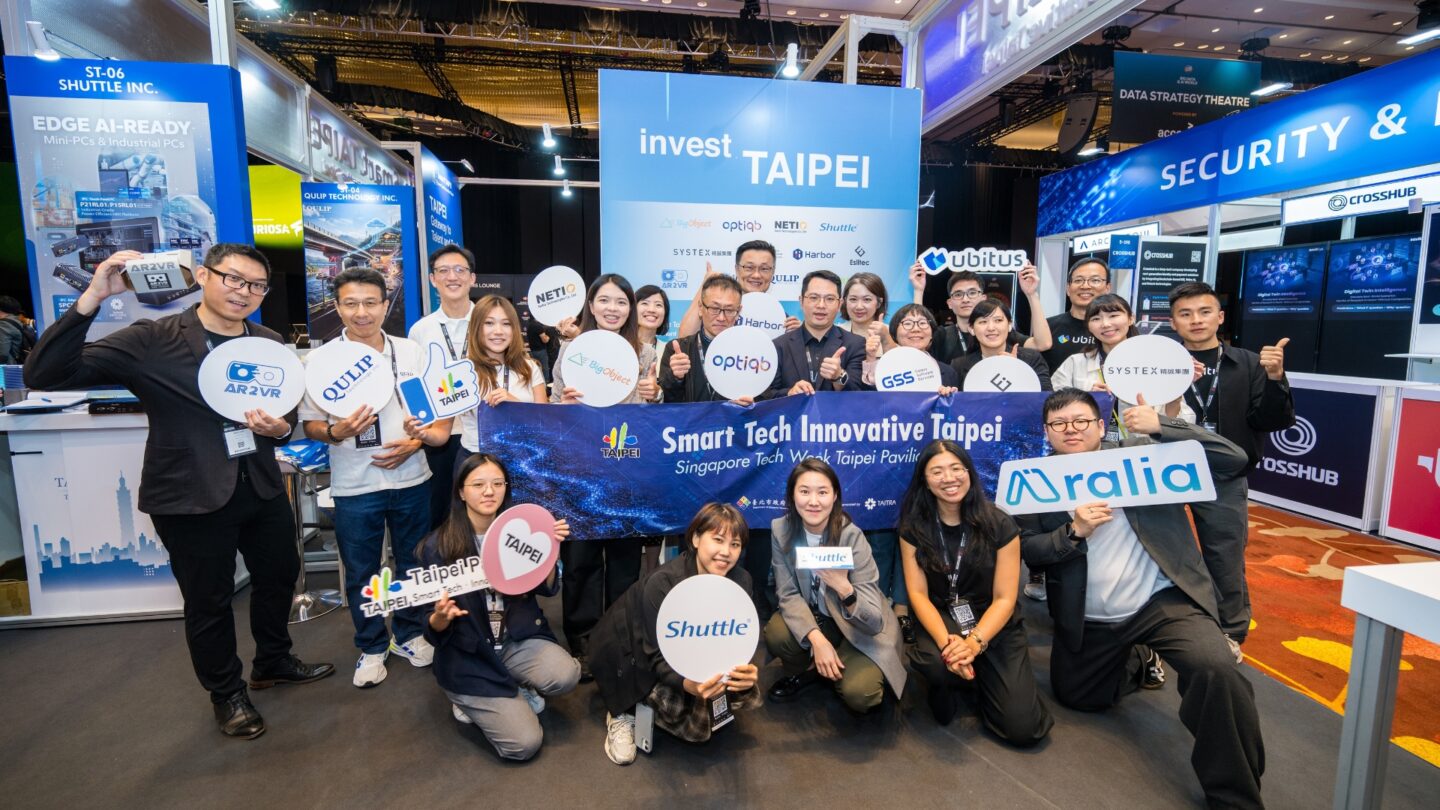
The Taiwan Artificial Intelligence Association (TAIA) and the Singapore AI Association have signed a memorandum of understanding at Tech Week Singapore 2026 to strengthen AI cooperation, identify opportunities for joint projects and support small and medium-sized enterprise (SME) expansion. The agreement was a key outcome of the Taipei Pavilion, where Taipei City and the Taiwan External Trade Development Council (TAITRA) brought together 12 Taipei-based technology companies. Held from 29 to 30 September at the Sands Expo and Convention Centre, the pavilion featured technologies covering enterprise AI, industrial edge computing, cybersecurity, multilingual communication and smart-city applications.
AI agreement targets advisory services and SME expansion
Under the agreement, the two associations will cooperate on AI advisory services, exchange technical and market intelligence, and facilitate enterprise and trade exchanges, with the framework also intended to strengthen connections between Taiwan’s technology companies and Singapore’s enterprise and innovation community. Through both the pavilion and the agreement, Taipei City and TAITRA aim to support business matchmaking, technology exchanges and potential co-development between Taiwanese and Singaporean organisations, focusing on translating AI development into measurable outcomes for enterprises, public-sector organisations and communities across Singapore and the wider region.
Jules Shih, Manager at TAITRA, described the complementary capabilities of Singapore and Taipei as a foundation for cooperation on AI adoption. “Singapore provides a trusted environment for enterprise deployment and a gateway to ASEAN, while Taipei contributes deep capabilities across AI infrastructure, semiconductors, hardware, edge computing and systems integration.”
Taipei companies present AI infrastructure and industrial applications
The Taipei Pavilion operated under the theme “Smart Tech, Innovative Taipei” as part of Tech Week Singapore’s wider focus on “The Infrastructure Era”. Across the event, participating companies presented technologies covering enterprise data preparation, industrial computing, security management and business applications. In data infrastructure, BigObject Inc. showcased platforms designed to turn fragmented enterprise information into governed, interoperable data assets, intended to help organisations prepare their existing data for use with AI systems and AI agents. For real-time operational environments, NETIO Technologies Co., Ltd. and Shuttle Inc. demonstrated industrial edge-computing platforms, local AI processing and secure hardware.
Security management and operational governance were also prominent across the showcase. SYSTEX Corporation presented capabilities covering cybersecurity visibility, Shadow AI management and risk-driven exposure management, while Harbor Technology Solutions Co., Ltd. demonstrated AI-powered equipment diagnostics and decision governance using physical signals such as vibration, acoustics, electromagnetic waves and images.
Other exhibitors addressed communication, collaboration and digital experiences. IPEVO Corp. demonstrated real-time transcription and multilingual translation for cross-border communication, while Optiqb AI Technology Limited presented technology that converts 2D content into naked-eye 3D experiences in real time. Completing the pavilion’s line-up, Qulip Technology Inc., Galaxy Software Services Corporation, Eslitec Co., Ltd., AR2VR Co., Ltd. and Ubitus highlighted technologies covering wireless collaboration, carbon management, conversational commerce, AI-enabled immersive training and multilingual AI avatars.
Taiwan-Singapore trade reached S$170.3 billion in 2025
Taiwan became Singapore’s largest goods trading partner in 2025, according to figures cited by TAITRA, with bilateral trade reaching S$170.3 billion. Trade increased by 94.1% in the first half of 2026 compared with the corresponding period a year earlier.
TAITRA identified Singapore’s enterprise networks, finance sector and access to ASEAN markets as potential routes for Taiwanese companies seeking regional business opportunities. Taipei, meanwhile, provides access to Taiwan’s technology ecosystem, specialised talent, manufacturing capabilities and wider Asia-Pacific trade connections.
Alongside these commercial efforts, Taipei City is developing AI applications across smart mobility, public services, manufacturing and community life. Its wider plans involve connecting industry, research, infrastructure and responsible AI governance as part of its ambition to become an AI innovation city. TAITRA also cited Taipei’s collaboration with NVIDIA on the company’s Taiwan headquarters, alongside AI-enabled smart-city initiatives involving digital modelling and future Taipei Metro upgrades. These activities form part of the city’s efforts to apply advanced technologies to urban infrastructure and public services.