


XPENG plans to begin hardware mass production of its IRON humanoid robot in January 2027, drawing on manufacturing and artificial intelligence infrastructure developed through its automotive business. The company has established a dedicated automated production line and a 50,000 m² robot data facility to support its commercial robotics ambitions.
Table of contents
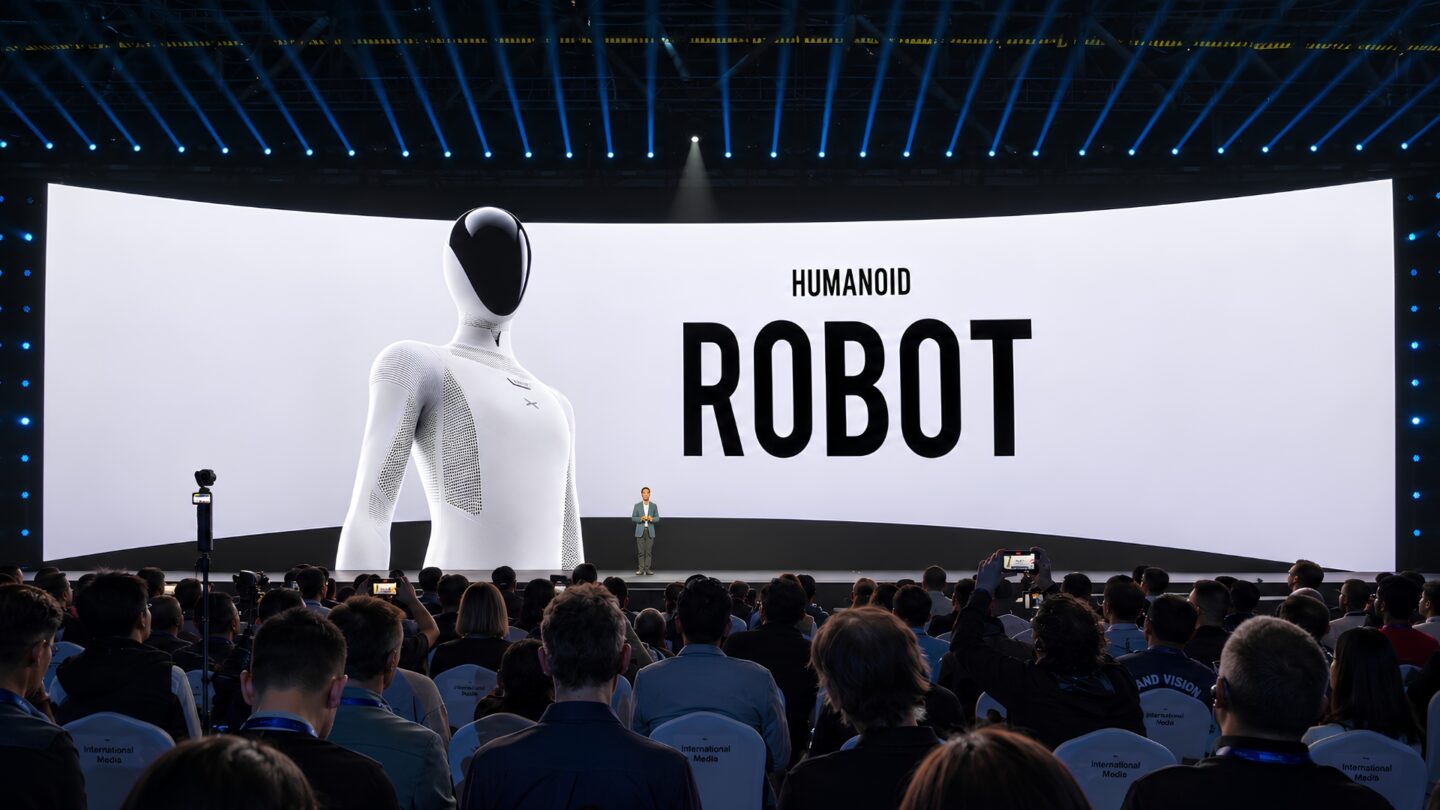
Unveiled at XPENG AI Day 2026 on 25 November in Guangzhou, IRON is an advanced general-purpose humanoid robot designed to undertake commercial tasks with greater operational autonomy. Training within XPENG’s retail stores is scheduled to begin in the first quarter of 2027, focusing on customer reception, product guidance and other service activities, with an official launch targeted for the second quarter.
Held at South China University of Technology, the alma mater of XPENG Chairman and CEO He Xiaopeng, this year’s event carried the theme of ORIGIN. The presentation outlined the company’s approach to Physical AI, bringing together developments in humanoid robotics, intelligent driving, vehicle motion control, autonomous mobility and aviation.
Underlying these developments is XPENG’s belief that improving AI models alone is insufficient to address the complexities of the physical world. Intelligence must develop through interaction, sensory feedback and experience, with the hardware capable of translating decisions into physical actions.
A shared AI architecture for vehicles and robots
The XPENG Turing Physical AI architecture (VLA 3.0) connects reasoning, real-time decision-making and physical execution. Designed to underpin both intelligent vehicles and humanoid robots, the architecture brings together AI models, computing systems, perception technology, motion control and hardware.
Three interconnected systems form the foundation of this architecture. System 2 handles higher-level reasoning, task understanding and planning, supported by VLT task planning, Agent Runtime and state-machine capabilities. System 1 uses XPENG’s VLA 2.0 model to interpret the surrounding environment and make real-time decisions, while System 0 manages high-speed responses and translates those decisions into physical movements through direct hardware control.
By developing these capabilities together, XPENG aims to allow advances in computing, control, data processing and safety engineering to benefit both its automotive and robotics operations.
IRON OS runs on three proprietary Turing AI chips, delivering what XPENG describes as 2,250 TOPS of effective computing power to support onboard AI models and whole-body motion control. The robot features 76 degrees of freedom, including a 21-degree-of-freedom dexterous hand, alongside more than 1,500 tactile sensing points, 3D vision and 360-degree environmental perception.
Combining visual perception with tactile feedback enables IRON to detect physical contact and adjust the force it applies when handling objects. Its multimodal understanding and embodied expression system, IRON VLM, integrates visual, audio and contextual information to recognise people, retain conversational context and respond appropriately during interactions.
These capabilities form part of XPENG’s five product priorities for IRON, covering foundational capabilities, safety and reliability, emotional value, round-the-clock operation and business capabilities.
Applying automotive manufacturing to humanoid robotics
XPENG’s preparations for commercial robotics extend to the infrastructure required to collect training data, validate performance and manufacture robots consistently. The company is adapting processes and technologies developed through its automotive operations for these purposes.
“Humanoid robotics is reaching the point where the industry must move beyond demonstrations and prove that robots can create value in the real world,” said Mr. He Xiaopeng, Chairman and CEO of XPENG. “That requires more than capable hardware or intelligent models. It requires reliable products, high-quality data, scalable manufacturing and continuous learning through deployment. XPENG IRON brings these capabilities together as we prepare for commercial deployment and mass production is scheduled to begin in January 2027.”
The company’s purpose-built Robot Data Factory spans 50,000 m², covering more than 250 scenarios across 15 job categories. Using data processing and evaluation tools developed through XPENG’s automotive operations, the facility collects data from real-world robot tasks to train and validate AI models, helping refine physical interactions, object manipulation and whole-body control.
The automated production line incorporates more than 600 AI-powered holographic quality inspection checkpoints, alongside over 1,000 vehicle-grade tests covering complete robots and key components. These processes are intended to support assembly consistency and operational reliability.
According to XPENG, the production line is designed to complete one IRON every 2.5 minutes when operating at full capacity.
Preparing humanoid robots to work alongside people
Safety forms a substantial part of IRON’s development as XPENG prepares the robot for environments where it will interact with customers and employees. Its physical safety architecture incorporates five layers of protection, monitoring task execution, movement trajectories and hardware constraints. Safeguards include collision detection, torque limits, emergency-stop mechanisms, redundant dual-channel communications and an independent fail-safe balance controller.
During AI Day, XPENG also detailed specific measures designed to reduce the risk of physical injury. The company said IRON can stop movement when contact force exceeds 50 N, while sensors around its soft-covered joints can detect potential pinching and halt motion within milliseconds.
Pedestrian-protection autonomous emergency braking is designed to detect adults and children in the robot’s path, with XPENG reporting braking within one second. Three independent emergency-stop methods provide additional means for people to intervene.
Operators can create task lists through voice commands or an app, with IRON designed to handle navigation, route planning and task execution autonomously. It can monitor its operating health, report abnormal conditions, recharge independently and return to assigned duties. These functions support XPENG’s target of 24-hour operational availability.
XPENG also described IRON’s ability to map an unfamiliar environment after an initial walkthrough, store that information locally and share it with other IRON robots.
The initial focus on XPENG’s own retail network provides an opportunity to develop and validate these capabilities through recurring service activities and customer interactions. Potential applications include front-desk reception, store training, educational programmes, livestream hosting, event presentation and exhibition guidance, with further opportunities being explored across commercial services and industrial operations.
Developing a subscription-based robotics ecosystem
XPENG is developing a commercial model that combines hardware sales, software subscriptions and an open robotics ecosystem. Customers would purchase IRON and access additional software capabilities, updates and services to adapt the robot to their operational requirements.
Through the open ecosystem, developers and business partners would be able to download capability packages, customise existing functions, develop new skills and validate them for specific working environments. The platform aims to simplify application development, lower barriers to deployment and support the application of skills across different operating scenarios.
XPENG said during its presentation that a two-person team could develop and deploy a new use case within 48 hours, illustrating its intended approach to expanding the robot’s occupational capabilities through third-party development.
The company is also exploring token-based subscriptions and services tailored to specific business scenarios, allowing robots to accumulate additional job-specific skills after delivery. Longer-term applications could include repetitive and higher-risk work as IRON’s capabilities develop.
Extending intelligent driving to more vehicles and markets
The automotive announcements at AI Day focused on expanding the capabilities of VLA 2.0, improving compatibility with existing vehicle hardware and integrating AI more closely with conventional driving.
Following its rollout in March, XPENG reported that driver assistance accounted for more than 50% of total mileage within the first month. Development of the model has since incorporated agent-driven autonomous closed-loop training, recursive self-improvement and model self-distillation. According to XPENG, these techniques have increased overall training speed by 10 to 12 times.
The company is also extending VLA 2.0 to older computing platforms. By re-engineering the model for vehicles equipped with dual NVIDIA Orin-X chips, XPENG reported a 40-fold improvement in inference performance, enabling its VLA 2.0 Lite model to operate on the existing hardware.
Further development covers reversing out of confined spaces, personalised driving styles and adaptation to both left- and right-hand-drive environments. XPENG has conducted generalisation tests in Germany, the Netherlands and France, examining the model’s ability to adapt to different traffic rules and road conditions without extensive retraining. Public City NGP test rides have also been introduced at its Paris showroom.
The company plans to introduce Turing AI driver assistance subscriptions for new vehicle buyers worldwide from the second quarter of 2027. Customers placing orders before the subscription programme launches would retain their existing driver assistance benefits for life without additional charges. XPENG reported that its research and development expenditure reached RMB8.67 billion during the first nine months of 2026.
Bringing AI into vehicle control, safety and charging
XPENG introduced Turing AI Co-Driving, integrating VLA 2.0 with its X-VMC 2.0 vehicle motion control system. The technology is designed to assist with acceleration, braking and steering even when drivers remain in manual control of their vehicles.
The integration also supports XPENG’s proposed 360-degree Active Hazard Avoidance system, AEX. By assessing potential hazards around the vehicle, the system is designed to adjust its trajectory through braking, steering or acceleration according to surrounding conditions.
XPENG is exploring similar integration with occupant and pedestrian protection systems, including pre-crash airbag deployment, a resettable active bonnet and active head restraints.
Software optimisation is also being applied to charging performance. XPENG announced plans to upgrade eligible 5C battery systems to 6C charging through an over-the-air software update without replacing the existing hardware. The upgrade will progressively cover eligible vehicles using lithium iron phosphate and ternary lithium batteries.
The company is expanding its charging infrastructure internationally, with its first X-Energy Megawatt Flash Charging station operating in Hong Kong and European deployment planned to begin in 2027.
Expanding Physical AI into autonomous mobility and aviation
XPENG unveiled YOYO-01, its first purpose-built Robotaxi intended for commercial deployment, with a launch planned for 2027. Built on VLA 2.0, the vehicle will incorporate higher-level task understanding and planning capabilities designed to support navigation through complex environments and the execution of multi-step tasks.
XPENG reported that its Robotaxi programme had obtained approval for Level 4 demonstration operations in Guangzhou, with driverless passenger testing underway and demonstration operations in selected areas targeted before the end of 2026. The company said it took eight months to progress from road testing with a safety driver to driver-out testing.
Its intended business model focuses on supplying vehicles and autonomous driving technology to global mobility partners, rather than directly operating Robotaxi services.
The aviation announcements centred on ARIDGE, which reported more than 10,000 real-world test flights, over 3,000 test items and 200 test aircraft across its electric vertical take-off and landing (eVTOL) validation programme.
According to the company, its piloted electric vertical take-off and landing aircraft has received Type Inspection Authorization documentation and completed certification flight testing as it progresses towards airworthiness certification. ARIDGE also announced that its full-scale A868 aircraft had successfully completed a tiltrotor transition flight, with potential future applications being explored in emergency rescue, high-rise firefighting and offshore operations.