

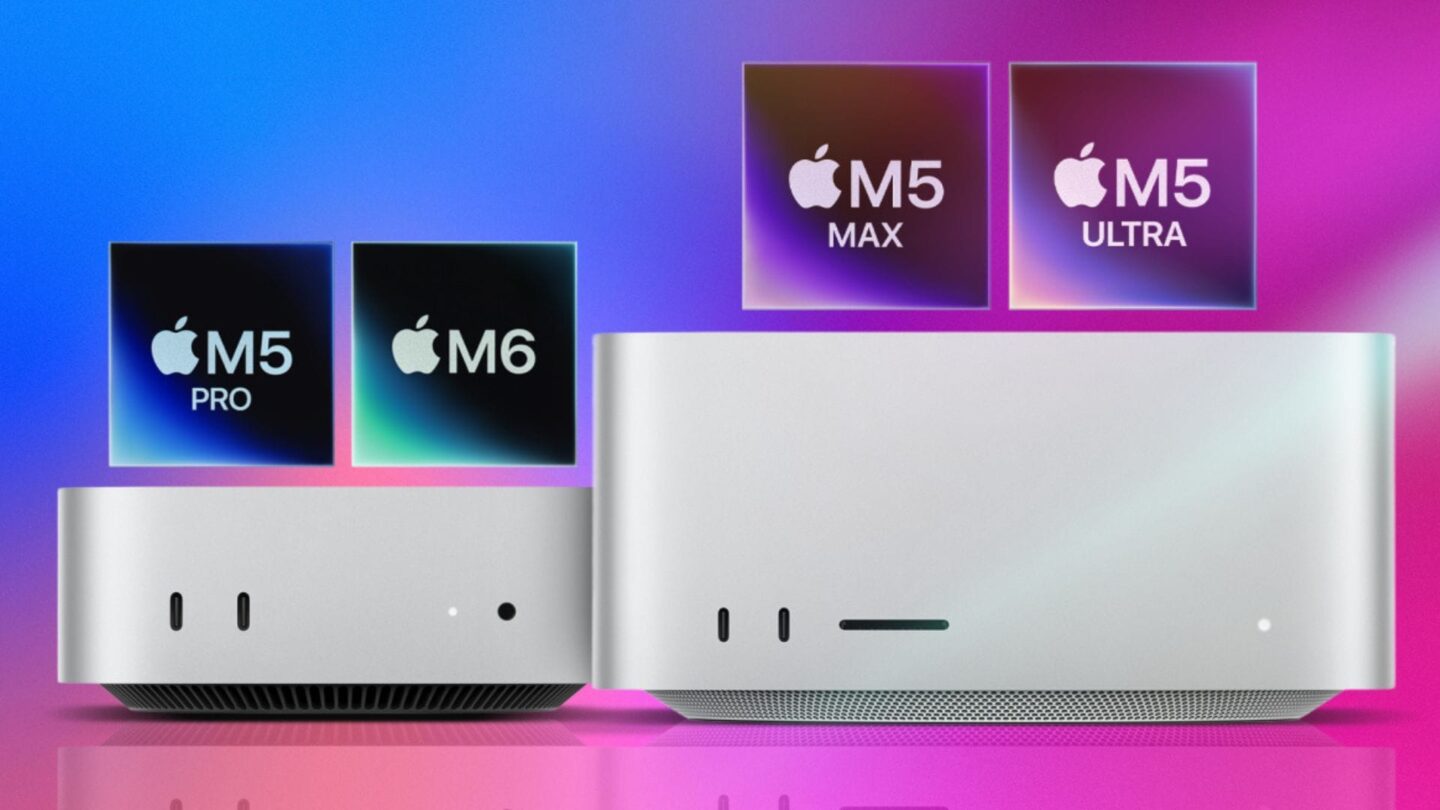
Apple has introduced two new processors aimed at different parts of its Mac range, with the M5 Ultra targeting demanding professional workloads and the M6 bringing the company’s first 2-nanometre chip to selected Mac mini models. The new processors are designed to improve performance across artificial intelligence, graphics, video production and everyday computing.
The M5 Ultra is the more powerful of the two chips and is being introduced in high-end Mac Studio systems. It uses a new quad-die design that combines four M5 processor dies into a single package. Apple describes the architecture as the first of its kind for Apple silicon, with a high-speed interconnect designed to allow the individual dies to function as a unified processor.
M5 Ultra targets AI and professional workloads
The M5 Ultra is based on an updated version of the third-generation 3nm manufacturing process used for the M5 family. Rather than moving to a smaller manufacturing node, Apple has focused on combining multiple dies to increase overall computing capacity. The processor effectively brings together two dual-die M5 Max chips through its quad-die architecture.
Apple says the interconnect between the dies can reach 4.4TB/s, helping the separate components operate as a single processor with minimal performance limitations. The chip is available with up to 36 CPU cores, consisting of 12 super cores and 24 performance cores. According to Apple, this configuration delivers up to 25 per cent higher single-threaded performance and up to 30 per cent better multi-threaded performance than the M3 Ultra.
Memory capacity is another major feature of the M5 Ultra. The chip supports up to 512GB of unified memory, with memory bandwidth reaching 1.2TB/s. Apple says this represents a 50 per cent increase in bandwidth compared with the M3 Ultra. The expanded capacity is particularly aimed at users working with large artificial intelligence models and other data-heavy applications.
Apple says the additional memory can allow users to “store huge datasets entirely in local memory, increase the tokens-per-second speed, and run huge LLMs with hundreds of billions of parameters entirely on device”. This could make the processor particularly attractive to AI developers who want to run large language models locally without relying entirely on cloud computing.
Graphics and media capabilities have also received a substantial boost. The M5 Ultra can be configured with an 80-core GPU, with each core featuring a neural accelerator. Apple claims peak AI computing performance is up to 4.5 times higher than the M3 Ultra, while graphics performance is up to 40 per cent faster.
Advanced graphics and video features
The M5 Ultra is designed to handle demanding creative workloads, including high-resolution video editing and professional content production. Its updated Media Engine includes four ProRes encode and decode engines, along with hardware acceleration for AV1, H.264, and HEVC codecs. These features are intended to reduce processing times for complex video projects and multiple high-resolution streams.
Apple is also highlighting the chip’s efficiency alongside its raw performance. The company says the M5 Ultra delivers “industry-leading energy efficiency”, allowing professional users to gain more computing capacity without relying solely on higher power consumption. For studios and professionals handling large projects, the combination of processing power, memory and media acceleration could make the chip especially useful for demanding workflows.
The performance comes at a considerable price. The Mac Studio configuration using the M5 Ultra starts at US$5,499, before additional upgrades are selected. Increasing unified memory to the maximum 512GB capacity could raise the cost significantly, putting fully configured systems into five-figure territory.
For AI researchers, developers and professional creators, however, the high price may be justified by the ability to keep extremely large workloads on the machine itself. The combination of large unified memory and high bandwidth could reduce the need to divide workloads between local hardware and external servers.
M6 brings Apple’s first 2nm Mac processor
The M6 takes a different approach, focusing on manufacturing efficiency and performance improvements for more mainstream Mac computers. The processor uses TSMC’s 2nm manufacturing technology, which allows more transistors to be placed into a smaller area. Apple says the technology delivers significant improvements in both performance and power efficiency.
The M6 features a 12-core CPU, adding two cores compared with the M5. Its configuration includes two super cores, four performance cores and six efficiency cores. Unified memory is limited to 32GB, while memory bandwidth reaches 170GB/s, representing a 10 per cent increase over the M5.
Apple says the M6 “delivers the world’s fastest single-threaded performance and up to 1.2x faster multi-threaded performance as compared to M5”. The company also claims a 30 per cent improvement in neural processing, which could benefit applications that use on-device AI features.
Graphics have also received attention, with changes to the shader core architecture, dynamic caching, and hardware-accelerated ray tracing. Apple says the improvements can support higher gaming frame rates and provide “50 per cent increased geometry rates for complex graphics”.
The M6 is expected to focus on lower-end and mainstream Macs, including selected Mac mini, iMac and MacBook models. Reports suggest Apple may not produce M6 Pro or M6 Max variants, instead moving directly to an M7 generation as early as mid-2027. If that strategy remains in place, the M6’s greatest advantage could be its balance of performance and energy efficiency rather than maximum processing power.
Together, the M5 Ultra and M6 show Apple pursuing two distinct directions with its silicon strategy. The M5 Ultra is built for users who need extreme processing, memory, and graphics capabilities, while the M6 focuses on improved efficiency and next-generation manufacturing for more accessible Mac systems.