


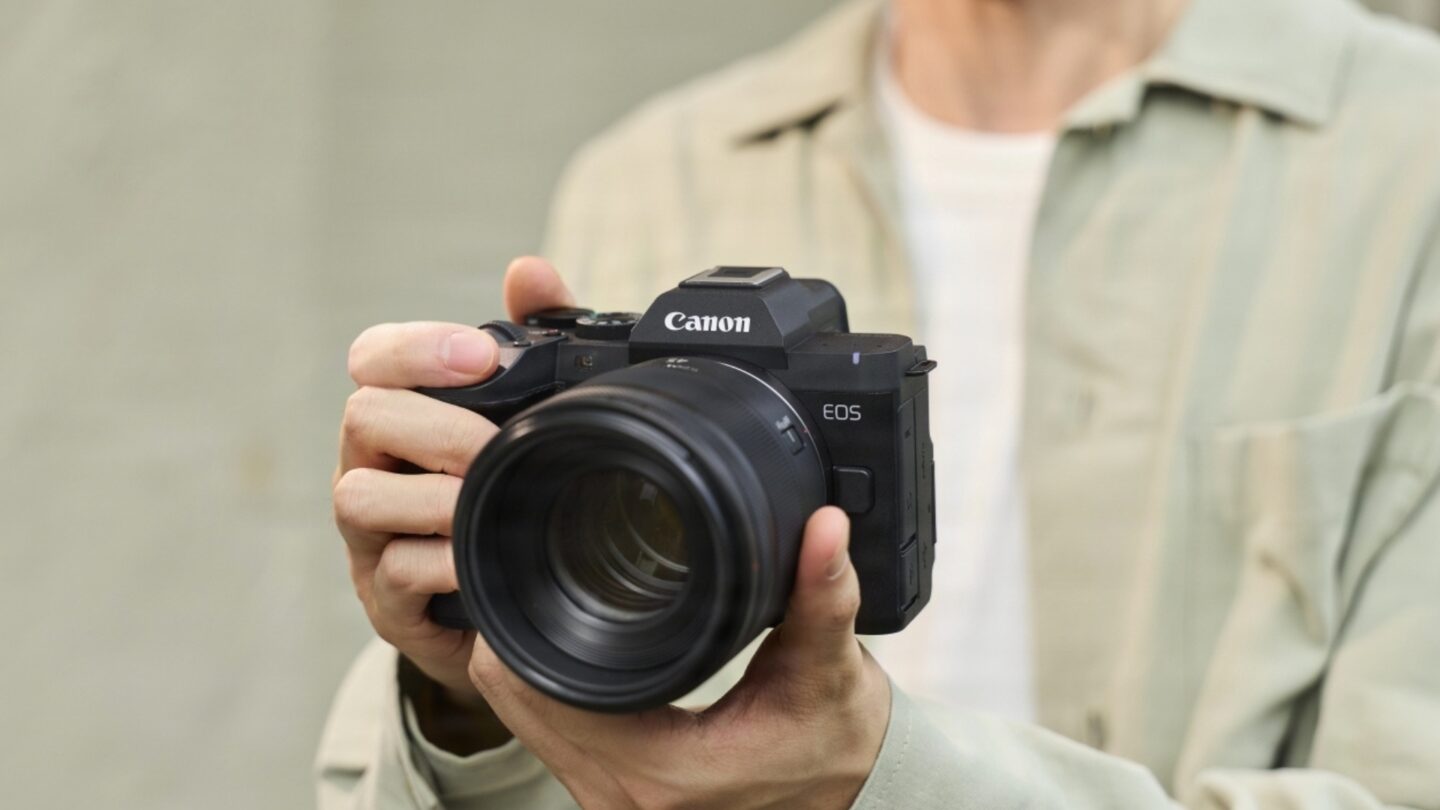
Canon has introduced the EOS R8 Mark II, updating its full-frame mirrorless range with in-body image stabilisation, accelerated continuous shooting and expanded controls for both photography and video production. Serving as the direct successor to the original EOS R8, the 24.2-megapixel camera combines Canon’s DIGIC X image processor with the Dual Pixel CMOS AF II autofocus system to drive its core imaging capabilities.
High-speed action is supported by an electronic shutter capable of reaching 40 frames per second alongside Pre-Continuous Shooting. To maintain focus in crowded environments, a Register People Priority function lets photographers specify preregistered subjects for dedicated autofocus tracking.
Built-in stabilisation comes to a compact body
Canon has designed the EOS R8 Mark II as its smallest and lightest full-frame mirrorless camera equipped with in-body image stabilisation. In physical terms, the portable body measures roughly 131.4 × 90.0 × 79.7 mm and weighs about 546g with a battery and memory card installed.
Its internal five-axis stabilisation system works to counteract unwanted camera shake during handheld captures at slower shutter speeds. When mounted with a compatible RF lens that possesses built-in optical stabilisation, the camera coordinates both mechanisms in tandem. This combined effort provides up to 7.5 stops of compensation at the centre of the image and 7.0 stops towards the edges under Canon’s official test conditions.
Sensor size plays a significant role in overall performance. According to Canon, the full-frame sensor boasts roughly 2.5 times the light-gathering area of an APS-C alternative, capturing richer detail with reduced image noise under dim illumination while preserving a wider angle of view at matching focal lengths.
Ergonomics are further refined by the multi-controller joystick familiar from Canon’s higher-tier cameras, allowing photographers to adjust autofocus points without removing their eye from the viewfinder. For those who prefer a firmer hold, the optional Extension Grip EG-E2 enlarges the grip profile while keeping battery access and tripod mounting fully functional.
More effects can be applied in camera
Internal creative options have been broadened through two new Colour Filters named NegativeFilmtone and PositiveFilmtone, bringing the total built-in selection to 16. The Handheld Night Scene Mode also gains extra versatility with the introduction of Blue, Black & Orange, Pink and Green colour options.
Time-lapse controls now offer exposure smoothing, timer priority and a delayed-start setting to grant tighter operational precision. In addition, Creative AUTO makes its debut on a full-frame EOS camera, presenting intuitive, guided adjustments through an accessible and simplified interface.
Video functionality benefits from creative additions as well, with Background Blur Creative Assist extended directly to movie capture. Operators can configure a quick shortcut that activates a chosen degree of background defocus at a preferred transition speed. The camera also incorporates Cinema View and a dedicated Slow & Fast Motion Movie mode, echoing capabilities found on recent EOS R-series cameras like the EOS R50 V.
Video recording reaches 4K at 60p
On the video front, the EOS R8 Mark II outputs 4K footage at up to 60p using 6K oversampling, alongside high-speed Full HD recording at up to 180p with accompanying sound. Canon Log 3 is incorporated to provide wide dynamic range for colour grading in post-production. Furthermore, the Custom Picture menu borrowed from Canon’s Cinema EOS line allows users to load custom lookup tables and fine-tune an array of picture parameters.
Broadcasting needs are met by four distinct wired and wireless livestreaming methods, including multi-camera streaming via the Canon Live Switcher Mobile app. Production flexibility also extends to virtual reality, with the camera supporting Canon’s full-frame and APS-C VR lenses. Footage tailored for headsets is enhanced by a new VR Clear Mode that refines contrast and visual clarity.
Spatial imaging completes the multimedia feature set through Canon’s Dual Pixel 3D Converter software. This computer utility harnesses distance measurements gathered by the Dual Pixel CMOS AF system to generate a 3D model from a single photograph.
Singapore pricing starts at S$2,519
In Singapore, the standalone EOS R8 Mark II body is priced at S$2,519, while a kit pairing the camera with an RF24-50mm IS STM lens costs S$2,859. Both configurations are scheduled to go on sale locally in October 2026.
Canon has also revealed regional availability for three accompanying accessories. The Extension Grip EG-E2 will retail at S$119, while the updated Speedlite EL-5 Ver. 2 flash costs S$469 and increases its rated wireless transmission range from about 30m to 50m. Lastly, the S$149 Tripod Grip HG-1000TBR comes supplied with the Bluetooth Remote Controller BR-E2 and will arrive slightly earlier in September 2026.