


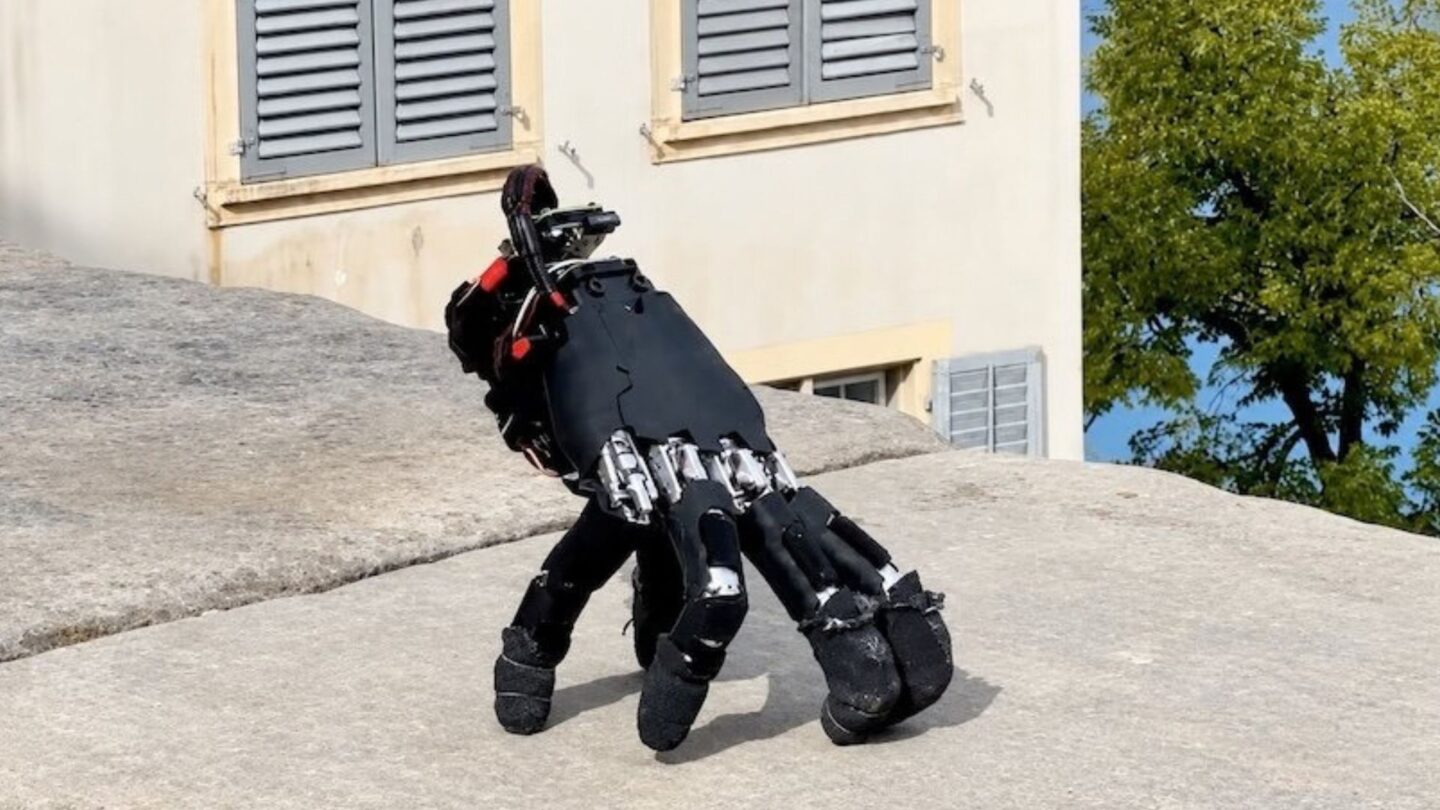
Researchers at ETH Zurich have developed an autonomous robotic hand that can move across surfaces using its fingers as legs, giving the machine an unusual ability to crawl without a conventional robotic arm. The system can move across a range of surfaces, recover after being knocked over and interact with objects in its surroundings.
Engineers at ETH Zurich’s Soft Robotics Lab carried out the work, designing the system around a conventional human-shaped hand rather than a simplified robotic design. The result resembles a mechanical version of the fictional Thing from The Addams Family, although the researchers are focused on practical robotics rather than entertainment.
Reinforcement learning teaches the hand to move
Previous research into walking robotic hands has often used symmetrical fingers because matching finger lengths can make it easier for a machine to maintain its balance. However, that design comes with a trade-off. Human hands have fingers of different lengths and an opposable thumb, features that are important for gripping and manipulating everyday objects.
The ETH Zurich team, led by Amir Kazemi, retained the shape and proportions of a human-like hand while teaching it how to move. The robotic hand was fitted with a battery, motion sensors, and a small computer, allowing it to operate without continuous control from an external system.
Researchers used reinforcement learning in a simulated environment to train the hand to develop movement and balance skills. Rather than programming every movement manually, the system learned which actions helped it remain stable and move forward.
The resulting robot could crawl across 14 different surfaces, including carpet, gravel, grass, and metal grating. It was also trained to deal with situations in which it lost its balance. When placed on its side, the hand pushed itself back upright in 21 of 25 attempts, showing it could respond to an unexpected fall rather than simply remaining where it landed.
The robotic hand can interact with objects
Mobility is only part of the system’s capabilities. The researchers also tested whether the hand could use its fingers while maintaining a stable position. In one experiment, the robotic hand balanced on four fingers while raising another finger to press keys on a keyboard.
The system selected the correct key in 29 of 32 attempts. This demonstrated that the hand could combine locomotion and manipulation rather than treating the two tasks as completely separate abilities.
The robot was also tested with a small block placed on a table. It pushed the object toward a target and positioned it within two centimetres of the intended location across 15 tests. Such demonstrations matter because practical robots need to do more than move from one point to another.
The ability to move independently could eventually allow robotic hands to operate in spaces where a conventional robotic arm would struggle. A mobile hand could potentially travel into confined areas, inspect objects and manipulate items before returning to a larger robot or another location.
Mobile hands could expand what robots can do
The researchers believe that giving robotic hands their own mobility could make them more useful in human-designed environments. A conventional robotic hand normally depends on an arm or other support structure to position it. Removing that dependency could give the hand greater freedom to explore and interact with its surroundings.
The approach also highlights the potential of combining familiar human-like hardware with machine learning. Instead of redesigning the hand to make walking easier, the researchers kept the uneven finger lengths and thumb that make a human hand useful for manipulation, then used reinforcement learning to overcome the challenges that design created.
The experiments do not mean that autonomous crawling hands are ready for widespread use. The tests were conducted under controlled conditions and focused on specific movement and manipulation tasks. Further development would be needed before such systems could reliably operate in unpredictable real-world environments.
Nevertheless, the research demonstrates how robotic mobility can be approached in unconventional ways. As engineers continue experimenting with machines that move, balance and interact more like living creatures, robotic systems are beginning to take on forms that can look as unusual as they are technically useful.