


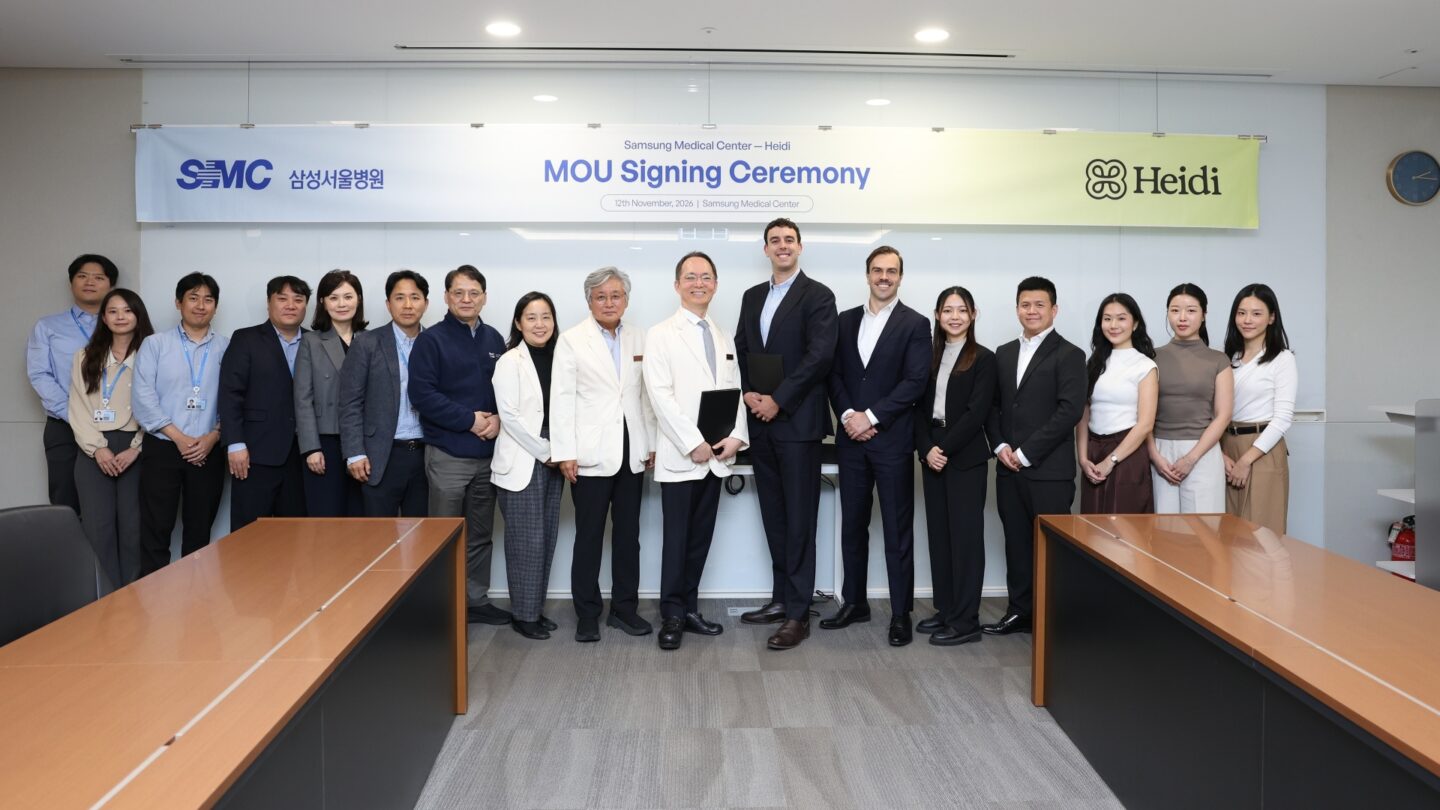
Australian healthcare AI company Heidi has signed a memorandum of understanding (MOU) with Samsung Medical Center (SMC) to test its clinical documentation software in South Korea. Marking Heidi’s first clinical partnership in the country, the agreement involves developing a locally adapted version of its platform and evaluating it within SMC’s existing hospital systems.
Running on SMC’s own infrastructure, the planned proof of concept will connect with the hospital’s electronic medical record (EMR) system. If successful, SMC will serve as a reference site for potential deployments at other healthcare organisations in South Korea.
Testing AI documentation within hospital systems
As part of the collaboration, Heidi and SMC will explore integrating the company’s speech-to-text technology with DARWIN, the hospital’s system, to support clinical documentation during routine care. Built on HL7 FHIR, a standard for exchanging healthcare information, the proof of concept will also integrate with SMC’s EMR system.
Both organisations will assess technical performance, physician acceptance and documentation quality, while SMC will serve as the first site where the platform is validated against Korean clinical, technical and regulatory requirements.
Hospitals can deploy the platform either on-premise or in the cloud, allowing them to select a model based on their infrastructure and data security requirements. Heidi’s existing product suite spans ambient clinical transcription, speciality-specific documentation templates and real-time AI assistance to support clinical decision-making, alongside its Heidi Evidence tool, which gives clinicians access to medical research at the point of care.
Adapting the platform to Korean clinical practice
To support the adaptation of Heidi’s platform to local clinical workflows and hospital systems, the collaboration includes plans to develop a Korean Clinical Documentation Standard, a Korean FHIR Implementation Guide and a Heidi Korea Reference Architecture.
The MOU was signed by Thomas Kelly, Co-founder and CEO of Heidi, and Seung Woo Park, President of Samsung Medical Center. Kelly said the collaboration would help the company develop its software around the requirements of Korean clinicians.
“Korean clinicians are among the most skilled in the world, and they manage patient volumes few of their peers elsewhere would recognise. Every minute spent on documentation comes out of time with patients. Working with SMC lets us build Heidi around the way medicine is practised in Korea, from its documentation standards to the hospital systems clinicians use every day, so the time we give back goes to patient care.”
Alongside its documentation tools, Heidi is developing AI agents intended to carry out supervised clinical actions associated with patient visits, and the two organisations plan to explore further collaboration in this area.
Samsung Medical Center’s role in wider deployment
SMC brings experience in hospital information systems to the project, having ranked fourth globally and first in South Korea in Newsweek’s World’s Best Smart Hospitals 2027 rankings, according to Heidi.
The hospital has also achieved Stage 7, the highest certification level awarded by the Healthcare Information and Management Systems Society (HIMSS), across four maturity models: Infrastructure Adoption Model (INFRAM), Electronic Medical Record Adoption Model (EMRAM), Digital Imaging Adoption Model (DIAM) and Adoption Model for Analytics Maturity (AMAM). SMC became the first healthcare institution worldwide to achieve Stage 7 in INFRAM in 2022 and DIAM in 2023.
Founded in Melbourne in 2019, Heidi says its platform supports more than 3 million patient consultations each week across 190 countries and 110 languages. Its recent financing includes a US$100 million Series C led by Blackbird and a US$240 million growth investment from General Catalyst’s Customer Value Fund.