


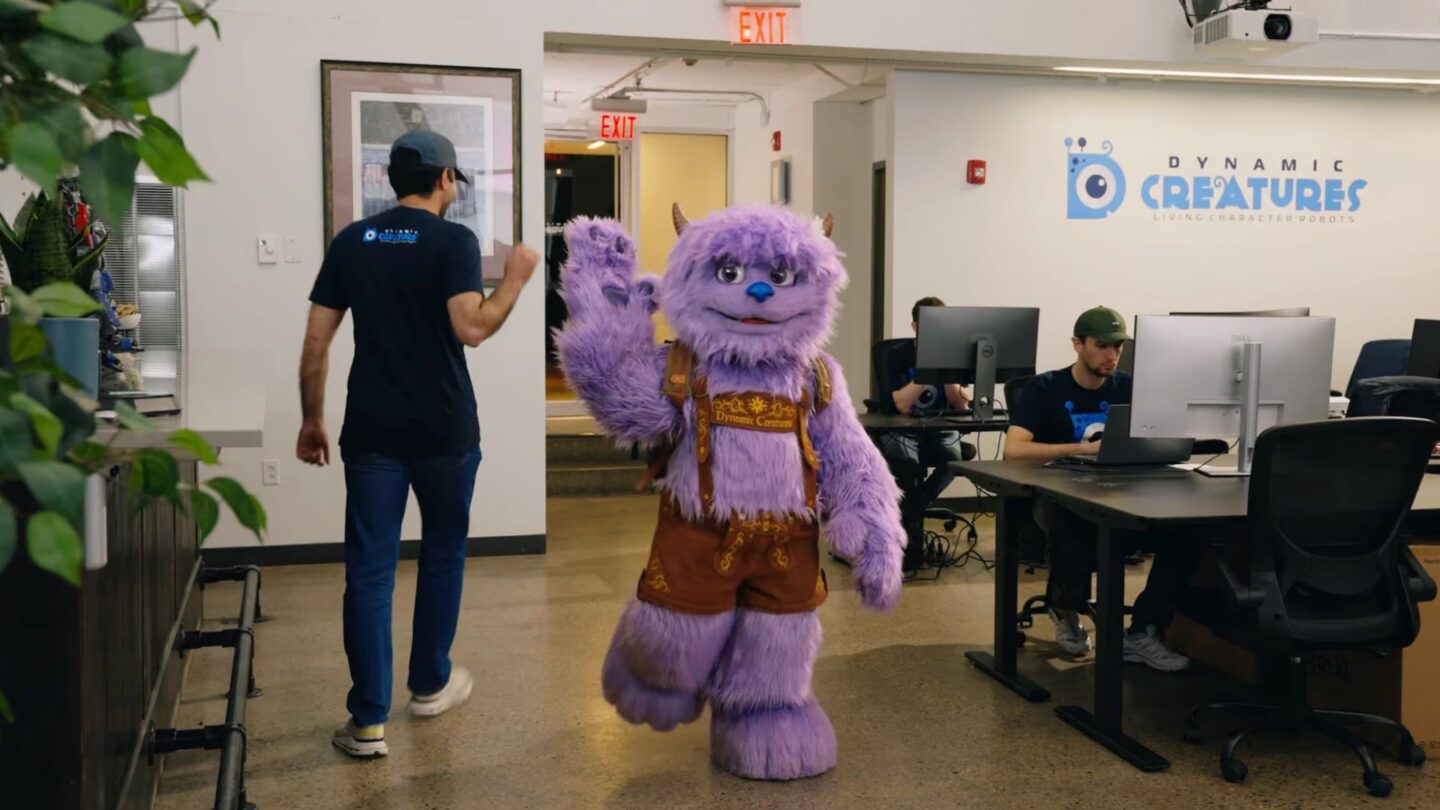
A furry purple robot named Hugo is in development to bring more interactive experiences to theme parks, hotels, and other entertainment venues. Cambridge-based robotics startup Dynamic Creatures created Hugo to walk among visitors, wave, dance, offer high-fives, and hug guests.
The robot represents a different approach to robotics, focusing on entertainment and social interaction rather than industrial work. With its small horns, blue nose, oversized hands and a flower tucked into its fur, Hugo has a colourful appearance intended to make it approachable. The design resembles a character from an animated film rather than a traditional humanoid machine.
Dynamic Creatures introduced Hugo in a video showing the robot moving around the company’s office and interacting with people. Although its appearance is meant to appeal to a broad audience, the technology beneath its furry exterior supports physical movement and expressive behaviour. The company hopes that combining robotics with character-driven interactions will create memorable experiences for visitors.
Hugo combines advanced robotics with expressive movements
Hugo has 43 actuators that convert energy into mechanical movement. These components enable the robot to walk on two legs and perform gestures that help communicate its intended personality. Its movements are developed using motion-capture data or animation files, combined with reinforcement learning, a machine-learning technique that allows a system to improve its behaviour through feedback.
Combining animation and machine learning is intended to give Hugo a more natural range of movements. Instead of relying entirely on a fixed sequence of actions, the robot’s underlying systems are being developed to support different behaviours and responses. This could help it appear more expressive when greeting visitors, dancing or participating in other entertainment activities.
Hugo operates on SnowJay, Dynamic Creatures’ software platform for managing perception, behaviour sequencing, and transitions between skills. The platform provides the foundation for coordinating the robot’s movements and determining how it performs specific actions. This coordination is important for a character that must move around people while maintaining an engaging, consistent personality.
Dynamic Creatures is also developing technology that links what Hugo sees and hears to its gestures, posture, and facial expressions. The aim is to make its physical behaviour better reflect the interactions around it. For example, a greeting could eventually involve more than a simple wave, with the robot adjusting its posture or gestures to suit the situation.
This approach could distinguish Hugo from conventional animatronic characters, which commonly remain in fixed positions and perform pre-programmed routines. A mobile robotic character could move around a venue, approach guests, and participate in more personal encounters. However, how independently Hugo can recognise and respond to different situations remains an important consideration.
Despite the demonstration, Hugo is still a prototype, not a fully autonomous entertainment robot. Reports surrounding its unveiling indicate that a human currently operates the machine remotely. Dynamic Creatures is working toward greater independence, but the demonstration does not show that Hugo can safely handle every interaction without human assistance.
Dynamic Creatures targets theme parks, hotels and entertainment venues
Marc Theermann, a former strategy chief at Boston Dynamics, and robotics researcher Farbod Farshidian founded Dynamic Creatures. The startup uses robotics to create experiences centred on human interaction. It is also Boston Dynamics’ official partner for entertainment and hospitality, applying robotics technology in settings where visitor engagement is central to the experience.
The company sees theme parks, hotels, resorts, casinos, museums and retail stores as potential markets for its character robots. In these environments, robots such as Hugo could welcome guests, entertain families, provide photo opportunities, and enhance a venue’s atmosphere. Their role would be different from that of industrial robots, which are generally designed to perform repetitive tasks in controlled environments.
For theme parks, a character that can move around public spaces could offer visitors a new way to interact outside traditional stage shows or scheduled performances. Hotels and resorts could potentially use similar robots to greet guests or provide entertainment in shared areas. Retail businesses and museums might also explore character robots to attract attention and encourage visitors to engage with their surroundings.
Dynamic Creatures is planning controlled pilot deployments to test how its robots perform in real-world settings. These programmes could combine remote operation, partial autonomy, and puppeteering, allowing human operators to guide the character while its software handles selected behaviours. Initial trial programmes are expected to begin in early 2027.
The company is also considering a leasing model. This could let venues test the technology without committing to the full cost of purchasing a robot. Pilot deployments would also allow the company to assess practical requirements, including staff training, maintenance, operating costs, and the level of human supervision needed during public interactions.
However, bringing a mobile robot into crowded entertainment spaces presents several challenges. Hugo would need reliable navigation, consistent movement and effective responses to unexpected situations. Physical contact adds concerns, especially if the robot is expected to hug children or interact closely with visitors of different ages and sizes.
Safety and autonomy will determine Hugo’s commercial future
For Hugo to become a regular attraction, Dynamic Creatures must demonstrate that the robot can operate reliably around people. Its ability to walk and perform expressive gestures is only part of the challenge. The system must also respond appropriately when visitors approach unexpectedly, enter its path, or attempt interactions outside its planned behaviour.
Remote operation could provide an important safeguard during early deployments, allowing a human operator to oversee the robot and intervene when necessary. However, this approach also introduces operational requirements, including reliable communications, trained personnel and procedures for handling technical problems. Venues will need to determine whether the entertainment value justifies these additional responsibilities.
Greater autonomy could eventually make character robots easier to deploy across different locations, but independent operation would require dependable perception, decision-making and movement control. The robot would need to interpret its surroundings accurately enough to avoid collisions and adjust its actions when circumstances change. These capabilities matter most in busy environments where children and adults may move unpredictably.
Practical questions also remain about how well Hugo’s design will withstand daily use. A furry exterior and expressive features may help establish its character, but commercial operation will require equipment that can be maintained, cleaned and repaired. Venues will also need to consider how the robot performs during long operating hours and whether its movements remain consistent across repeated interactions.
The planned pilot programmes should help establish how the technology performs outside controlled demonstrations. They could reveal which interactions work best, how much human oversight is required and whether visitors respond positively to mobile robotic characters. The findings may also help Dynamic Creatures refine its software and determine which venues best suit the technology.
For now, Hugo offers an early look at robotics designed to entertain rather than complete a task. Its combination of movement, expressive design and interactive behaviour could create new opportunities for visitor experiences, provided the technology can meet the practical demands of public spaces. Whether Hugo becomes a familiar sight at theme parks and resorts will depend on its safety, reliability, and ability to deliver engaging interactions consistently.