A human-versus-robot cage fight in San Francisco has sparked unexpected interest in people taking on machines, according to the company behind the event.
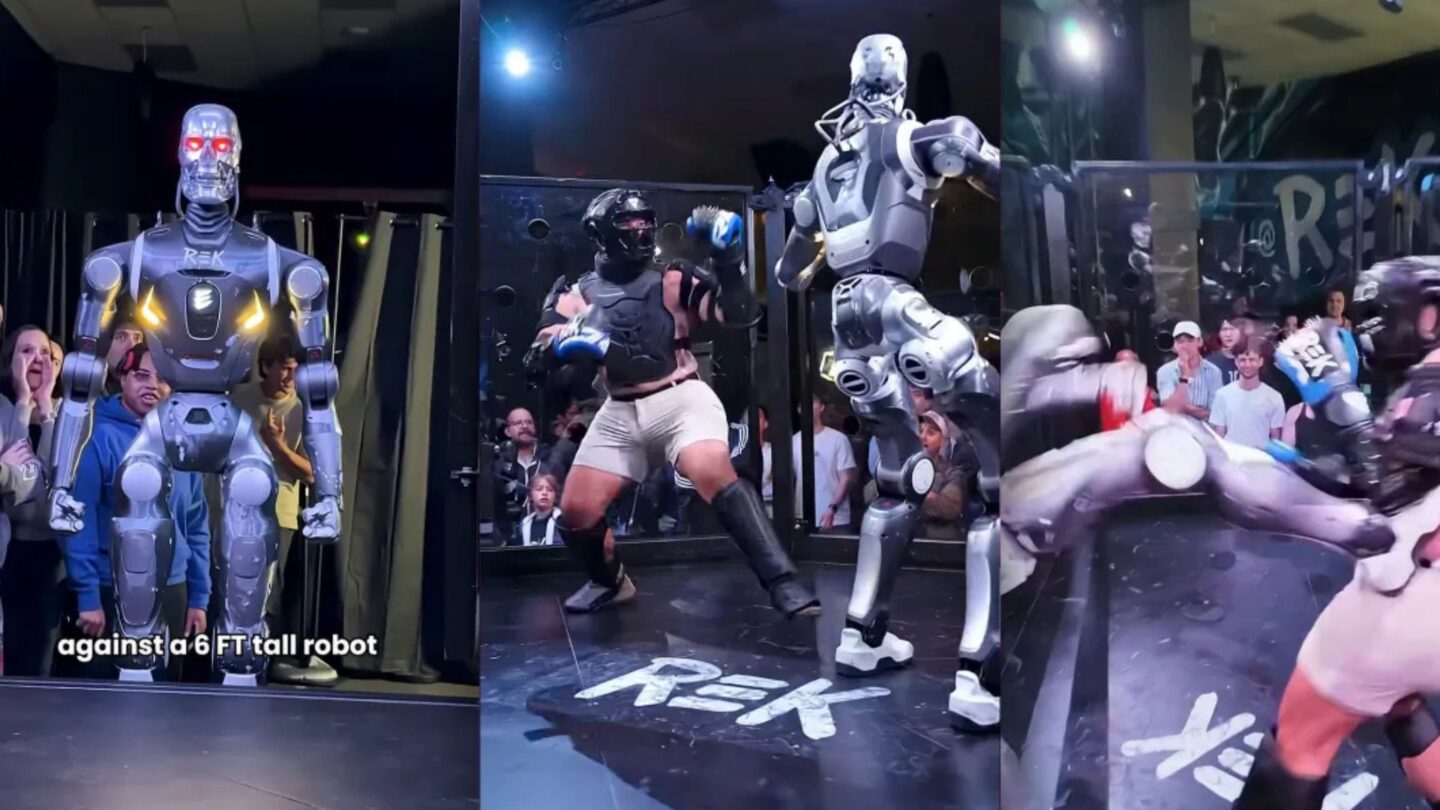
REK founder Cix Liv said the company had initially expected robot-versus-robot fights to be the main attraction. However, attention shifted after TikTok creator Frankie LaPenna entered the cage to face three different robots, including a six-foot humanoid machine in a fight promoted as Human VS Terminator.
The event was designed primarily as a publicity stunt rather than a conventional combat competition. Even so, the response has shown REK that human-versus-robot contests could become a significant part of its future events.
A human takes on machines in the cage
LaPenna’s appearance centred on entertainment and spectacle, with the social media personality facing robots capable of delivering punches and kicks. The unusual contest quickly became a talking point because of the contrast between a human participant and machines designed to perform physical movements.
World’s FIRST human vs. terminator robot fight. Is the end near? Or do we still stand a chance? https://t.co/MTnmDOLfq6
— GYAT COIN (@frankie_lapenna) September 20, 2026
The six-foot humanoid robot was presented as a Terminator-style opponent, adding to the event’s theatrical nature. LaPenna later described the experience as scary, especially given the machine’s size and how the fight was presented to the audience.
Although the machines appear autonomous, REK’s robots do not decide how to fight on their own. Human operators control the machines in real time, while the robots themselves manage lower-level functions required for movement and balance.
That means the fights are closer to a remote-controlled combat performance than a battle between fully autonomous artificial intelligence systems. The operator issues commands while the robot carries them out inside the cage.
The concept has similarities to the 2011 science-fiction film Real Steel, which features remotely controlled humanoid robots competing in boxing matches. Liv has previously cited the film as an inspiration for the company’s approach.
Robot fights were expected to be the main attraction
REK originally planned robot-versus-robot bouts as the central feature of its events. The idea was to showcase humanoid machines competing against one another while demonstrating their ability to move and perform physical tasks.
The San Francisco event, however, produced a different result. Once LaPenna entered the cage, the human-versus-machine confrontation became one of the spectacle’s most notable parts. The response seems to have given REK a new indication of what audiences may want to see.
The appeal is partly based on the novelty of putting a person directly opposite a humanoid machine. While robot demonstrations are becoming increasingly common, a physical contest between a human and a robot creates more immediate, easily understood entertainment.
The event also highlighted an important distinction between today’s humanoid robots and the fictional machines often depicted in films. REK’s robots still depend on human operators, so the technology remains considerably different from a machine capable of making combat decisions independently.
Even with that limitation, the format combines technology, performance, and live entertainment in a way that can attract attention beyond the robotics industry. The viral response to the San Francisco event suggests that audiences may be curious about what happens when humanoid robots are placed in situations involving direct physical competition.
REK has yet to announce another human-versus-robot event
REK has not confirmed another human-versus-robot fight, and no dates or venues have been announced for a follow-up event. The company therefore has not yet committed publicly to turning the format into a regular competition.
The San Francisco event has nevertheless given the company useful feedback on audience interest. REK entered the event expecting robot-versus-robot battles to be the main draw, but the reaction to LaPenna’s participation demonstrated that human-versus-machine encounters could attract significant attention.
That could influence how future events are structured if REK decides to continue developing the concept. Rather than treating a human participant as an additional attraction alongside robot fights, the company could place greater emphasis on human-versus-robot contests.
For now, the format remains primarily entertainment rather than a demonstration of fully autonomous robotics. People operate the machines, and the events focus on spectacle rather than establishing a formal sporting competition between humans and robots.
Nevertheless, the strong reaction to the San Francisco fight has given REK another possible direction for its events. If the company stages another event, the human-versus-robot matchup may receive a much more prominent role than it did in the original concept.