


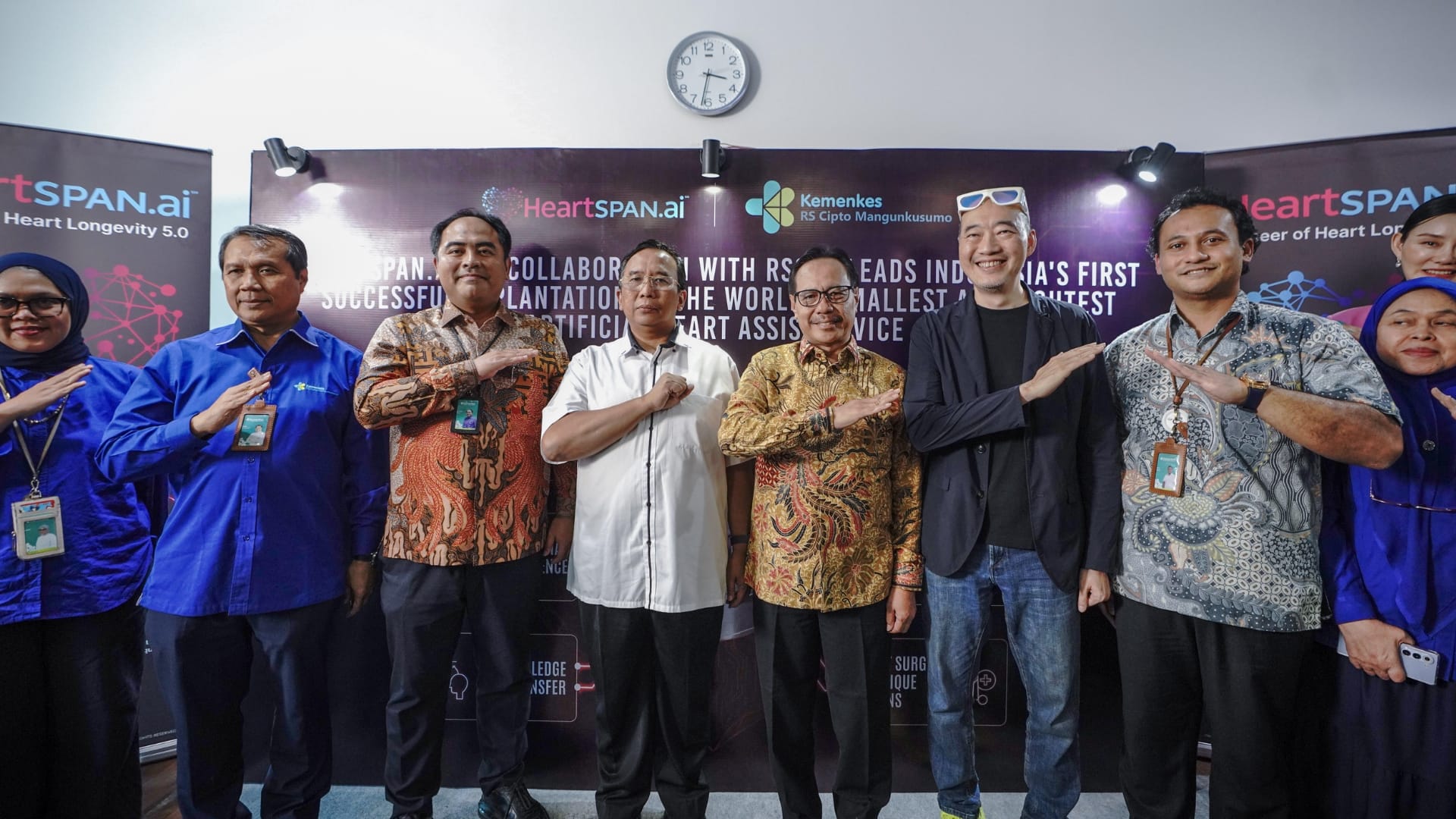
Dr Cipto Mangunkusumo National Central General Hospital, known as RSCM, has completed Indonesia’s first successful implantation of a left ventricular assist device, or LVAD. The complex procedure was carried out with training and clinical support coordinated by Singapore-led healthcare platform HeartSpan.ai. Conducted in Jakarta on 1 August, the operation also marked the first successful deployment of this specific device within Southeast Asia, according to HeartSpan.ai. The company describes the technology as the world’s smallest and lightest LVAD.
The recipient was a 45-year-old woman suffering from advanced heart failure, who presented with a left ventricular ejection fraction of 14%. Following the surgery, RSCM reported that she was successfully taken off mechanical ventilation and extubated on post-operative day one. Although her condition had stabilised and active rehabilitation had begun, medical staff noted that she continued to require close monitoring.
Dr M. Arza Putra, Lead Cardiovascular and Thoracic Surgeon at RSCM, noted that the initial clinical outcomes were encouraging. “Our patient’s recovery has been encouraging. She has successfully weaned from mechanical ventilation and extubated at post-op day 1. Her condition has stabilised, and rehabilitation has already begun. While the post-operative period remains critical and requires close monitoring, these early clinical outcomes are very encouraging. This successful implantation demonstrates what can be achieved through meticulous surgical planning and multidisciplinary teamwork. We look forward to offering this life-saving therapy to more eligible patients in Indonesia,” he said.
Training supports continued treatment at RSCM
To prepare for the procedure, HeartSpan.ai, the heart longevity division of Borderless Healthcare Group, connected RSCM with the device and arranged intensive training at Fuwai Hospital in Beijing. Specialist personnel from Fuwai Hospital also assisted the Indonesian medical team on site during the initial operation.
The comprehensive training programme covered the full range of clinical systems required for RSCM to continue offering the therapy independently once visiting specialists had departed. These included rigorous patient selection criteria, coordination mechanisms between medical teams, clinical protocols, and long-term follow-up procedures. To sustain this capability, RSCM established a dedicated care team involving cardiologists, surgeons, intensive care specialists, nurses, and coordinators tasked with managing LVAD patients. HeartSpan.ai and Fuwai Hospital provided additional support to help the hospital develop its overall treatment and post-operative care frameworks.
Dr Birry Karim, Head of the Cardiovascular Department at RSCM, emphasised that delivering effective treatment requires an integrated approach across multiple disciplines. “Successful LVAD therapy extends far beyond the operating theatre. It requires rigorous patient selection, seamless coordination between cardiologists, surgeons, intensivists, nurses and LVAD coordinators, as well as structured long-term follow-up. Through our collaboration with HeartSpan.ai and Fuwai Hospital, RSCM has established the multidisciplinary care model, clinical protocols and specialist capabilities needed to build a sustainable advanced heart failure programme for Indonesia,” he explained.
Programme expands access to advanced heart failure care
RSCM expects the new programme to expand access to specialised care for advanced heart failure across the country. By offering this advanced intervention domestically, the hospital aims to reduce the need for eligible Indonesian patients to travel abroad for complex surgical procedures.
The hospital’s President Director, Dr Supriyanto Dharmoredjo, attributed the achievement to international collaboration, targeted specialist training, and access to advanced medical technology. He added that the programme would strengthen the overall capabilities of Indonesian healthcare professionals while providing another viable treatment option for patients with severe heart failure. Continued access will rely on RSCM maintaining the clinical expertise, team coordination, and follow-up protocols required to manage post-surgical patients over time. Ultimately, the programme is structured to retain these critical capabilities within the hospital rather than relying on visiting external teams for subsequent operations.
HeartSpan.ai plans regional expansion
HeartSpan.ai was founded by Singaporean doctor Dr Wei Siang Yu, who is also the founder and chairman of Borderless Healthcare Group. The organisation plans to utilise Singapore as a regional base for deploying its medical technologies, clinical models, and intellectual property across surrounding markets.
Its operating model combines direct on-site implementation and specialist training with a cloud platform designed for sharing medical knowledge and artificial intelligence tools to support the transfer and reuse of clinical expertise. The Indonesian project represents the initial deployment of this operational model. In discussing its expansion targets, HeartSpan.ai cited National Heart Centre estimates showing that heart failure affects 4% to 5% of Singapore’s population, compared with 1% to 2% globally. The company has also tied its regional growth strategy to Singapore’s S$37 billion RIE2030 programme, which highlights biomedtech and biomanufacturing as core priorities.
At the domestic level, the Indonesian programme is being executed through Indonesia.md, Borderless Healthcare Group’s Indonesia-focused subsidiary and the exclusive distributor of the LVAD in the country. Looking ahead, the group plans to support additional specialist education, knowledge transfer, and research collaboration across the region. It has also designated advanced medical device manufacturing in Indonesia as a key long-term objective.