



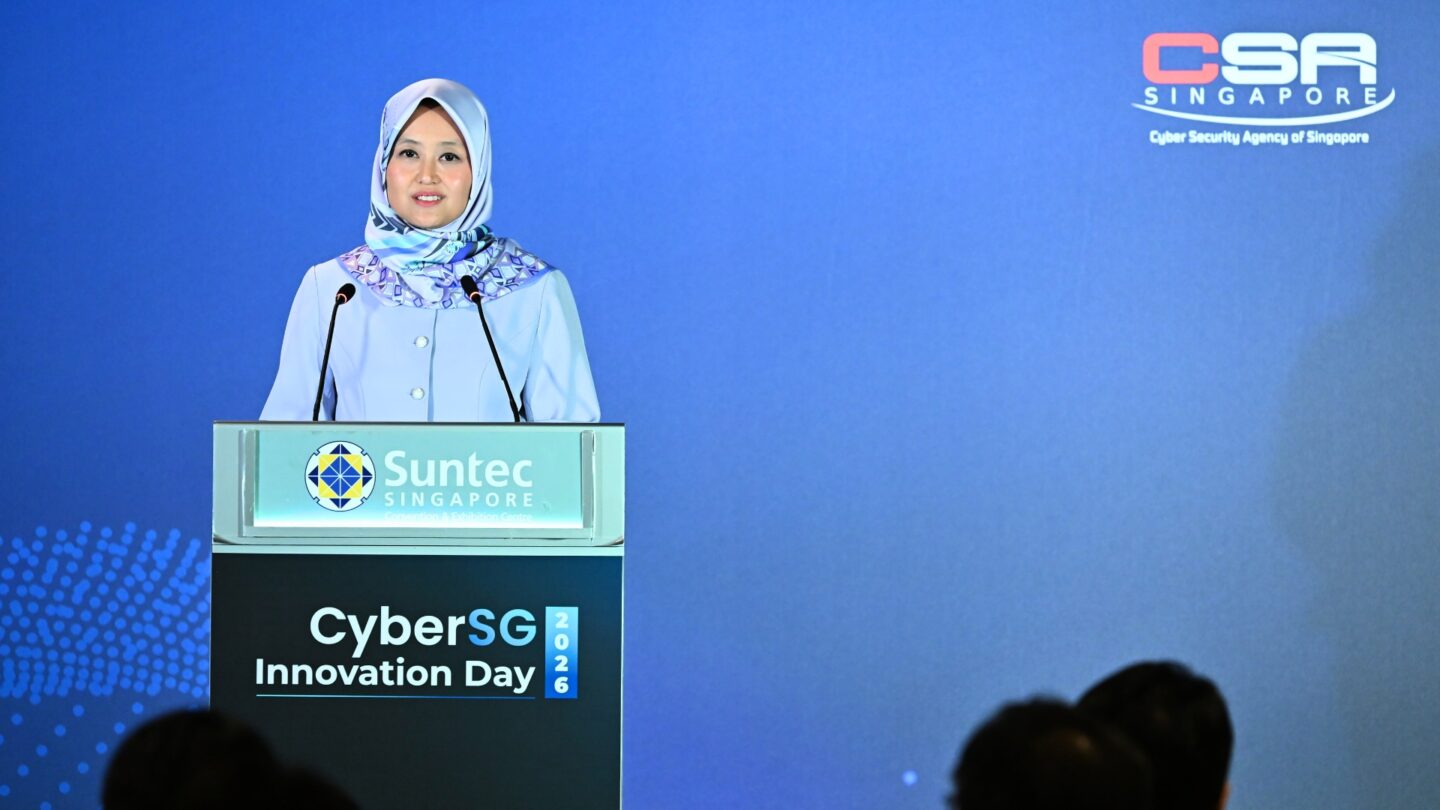
Singapore’s Cyber Security Agency (CSA) has awarded approximately S$5.6 million to 13 companies under CyberCall 2025 to develop cybersecurity solutions addressing AI-related threats, quantum risks and critical infrastructure security.
Announced at CyberSG Innovation Day on 10 November, the funding was accompanied by the launch of CyberCall 2026 and new measures to help companies turn research into products that organisations can deploy. The initiatives form part of the Singapore Cybersecurity Strategy 2026.
Funding targets AI security and quantum threats
The 13 recipients are developing solutions across AI security, operational technology and quantum-safe protection. CyberCall is supported by the CyberSG Talent, Innovation and Growth Collaboration Centre (TIG Centre), managed by NUSX at the National University of Singapore.
Among the projects, CloudsineAI is developing TAGAAI to map potential attack paths across systems using multiple AI agents. Flexxon’s proposed X-PHY AI Armour combines a Model Context Protocol (MCP) proxy with secure storage hardware to detect threats such as prompt injection and tool hijacking. Ensign InfoSecurity is developing an AI framework to investigate incidents in operational technology environments by correlating industrial anomalies with IT security events.
Quantum-related projects include ST Engineering D’Crypt’s proposed encryptor for industrial control systems, combining quantum key distribution with post-quantum cryptography. pQCee is developing a red-teaming tool to help organisations assess the exposure of existing encryption systems to future quantum threats. Other projects address identity management for AI agents, automated security support for smaller businesses and privacy-enhancing technologies.
CyberCall 2026 focuses on operational needs
The new programme has two tracks. Its Open Call covers six priority areas: cybersecurity for AI, AI for cybersecurity, quantum-safe technologies, operational technology and Internet of Things security, cloud security, and privacy-enhancing technologies.
The User-Driven track seeks solutions to problems identified by organisations including CSA and the Civil Aviation Authority of Singapore. Challenges include detecting and responding to fast-moving cyber intrusions, identifying spoofed or unauthorised Automatic Dependent Surveillance-Broadcast (ADS-B) messages without disrupting aviation operations, and helping smaller businesses resolve security problems independently.
Gwenda Fong, Commissioner of Cybersecurity and Chief Executive of CSA, said involving end-users early improves the chances that new capabilities will work in practice. She also highlighted the need to turn guidance from CSA’s Securing Agentic AI Addendum into tools for testing, monitoring and securing autonomous agents. CyberCall 2026 proposals close on 9 January 2027.
New initiatives address adoption barriers
The TIG Centre has established the CyberSG CISO Advisory Committee, bringing together cybersecurity leaders from critical infrastructure sectors, government, academia and industry. It is intended to help developers identify unmet needs, connect with prospective users and test solutions against operational requirements.
The centre has also relaunched its cybersecurity solutions catalogue as CyberSG Atlas. Covering offerings from more than 200 Singapore-based cybersecurity companies, the catalogue uses categories aligned with the National Institute of Standards and Technology Cybersecurity Framework. A new AI chatbot helps businesses find relevant solutions and guidance, including reporting information during cyber incidents.
Minister of State for Digital Development and Information Rahayu Mahzam pointed to Protos Labs as an example of research moving towards use. The company developed NEXUS with Nanyang Technological University and a public-sector partner to combine risk assessments with threat intelligence. That partner is now implementing the platform. Protos Labs is also among the CyberCall 2025 recipients, developing a separate AI-supported cybersecurity investigation system.
Research funding supports industry growth
Since 2023, the CyberSG R&D Programme Office, established by CSA and Nanyang Technological University, has funded 23 projects worth approximately S$44 million, according to Rahayu. These include work on telecommunications security, post-quantum cryptography and critical infrastructure protection. Seven spin-off companies have been supported.
The TIG Centre has separately supported more than 120 companies since 2023. Rahayu said the Government has committed S$50 million to the centre, while industry stakeholders have invested approximately S$150 million in companies it has supported.
She cited pQCee, whose quantum-safe solutions are already used by critical infrastructure providers, government agencies and financial institutions, as an example of a company progressing from support programmes to commercial adoption. The TIG Centre’s CyberGrowth programme is also helping Singapore firms connect with potential overseas customers and investors, reflecting efforts to turn local cybersecurity research into deployable products and export opportunities.


