

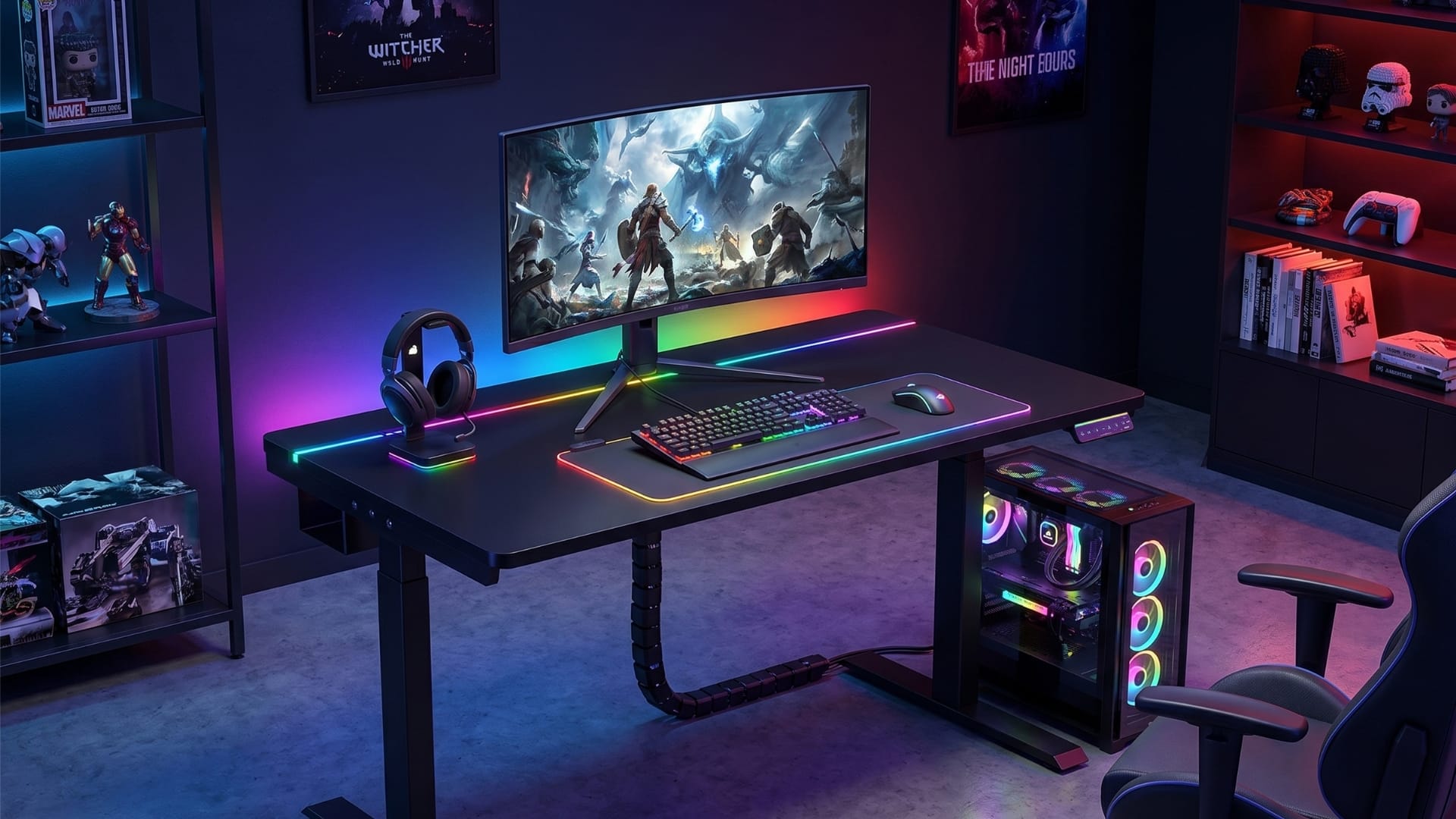
The Interdesk Aura RGB Standing Desk is built for multi-purpose workspaces where a single setup handles office work during the day before switching to gaming, editing, or streaming at night. As home setups expand to include multiple displays, speakers, peripherals, desktop PC, and laptops, qualities like ample space, frame stability, cable management, and easy adjustment become important to the daily experience.
Our verdict
The Interdesk Aura RGB Standing Desk delivers exceptional stability, rapid elevation, and extensive customisation for gaming and creator setups. Its fast motor, integrated cable management, and broad selection of sizes and finishes make it a compelling workstation, though its heavy frame hinders mobility (without wheels) and the basic two-position memory system limits shared use.
Pros
- Extensive customisation across four footprint sizes and 18 surface finishes
- Fast 80 mm/s motor speed with exceptional stability and minimal wobble
- Integrated RGB lighting and an under-desk cable tray keep setup wiring tidy without external light strips.
Cons
- Basic two-position memory system restricts multi-user or multi-task setups
Interdesk’s focus on ergonomic furniture grew from its founders’ personal experience with back pain after long hours spent at conventional desks. Since launching in Singapore in 2021, the brand has shaped its lineup around modern home workspaces, with an emphasis on durable materials, different finishes, and flexible configurations suited to different room layouts and working habits.
The Aura unifies those core principles into a single standing desk for work, gaming and content creation. It moves smoothly between sitting and standing positions while keeping the workspace organised and easy to manage.
Quality build with integrated cable management and RGB
Once assembled, the Interdesk Aura is exceptionally stable. Thick steel leg columns, wide foot plates, and a central crossbar eliminate the micro-vibrations that often plague lighter sit-stand frames. The desktop remains steady under heavy typing and rapid mouse movements, holding its balance even at full standing height. Powered by a strong motor system rated for up to 120 kg, the desk handles uneven weight distribution without jerking or straining, keeping mounted monitors and heavy desktop towers level throughout movement.
That weight, however, comes with a clear trade-off in mobility, although buyers can also opt to have lockable wheels installed to ease repositioning. Moving the fully loaded desk is a difficult task once monitors, mounts, and power supplies are in place. Interdesk reduces the initial setup effort by providing on-site assembly with trained technicians, which adds useful support for larger models. Because this service covers initial installation rather than ongoing relocation of the desk, users who frequently reconfigure their rooms will still find moving the heavy desk (without wheels) challenging.
Design details around the Aura are equally practical. Rounded corners reduce accidental bumps in tight spaces, while smooth chamfering along the front edge gives wrists and forearms a comfortable resting surface during long work sessions.
At the back of the desk, the integrated cable tray is equally useful for daily operation. Mounted directly beneath the surface of the desk, it houses power strips, bulky adapters, and excess wiring off the floor. This design keeps the entire cable loom moving in tandem with the desktop, preventing wires from pulling tight or snagging during height adjustments. That said, upfront planning is still necessary for floor-standing PCs, which require extra cable length to reach maximum standing height, but once properly arranged, the setup moves without dragging cables across the room.
The RGB lighting is built directly into the frame rather than attached later with aftermarket adhesive or magnetic strips. This clean integration hides exposed tape, clips, and mounting channels while keeping extra desktop wiring to a minimum. Built-in diffusers project a soft ambient wash against nearby walls without creating harsh reflections on computer monitors, blending naturally into creator setups while remaining subtle enough to turn off in an office setting.
For safety, a gyroscope-based anti-collision system stops and reverses movement when it detects an obstruction. Its sensitivity can be adjusted through the desk’s built-in settings. At higher sensitivity levels, the system can respond to light contact with an obstacle while filtering out false triggers caused by airflow, incidental touches, or normal resistance from the desk’s own movement. This gives users greater control over how readily the protection engages, although chairs and under-desk pedestals should still be kept clear of the movement path.
Rapid height adjustments with limited memory slots
Height adjustment is one of the Interdesk Aura’s main features, driven by a lifting mechanism that moves at a rapid 80 mm/s across a 60 cm to 125 cm range. This speed allows the desk to transition between sitting and standing without creating a lengthy pause, while balanced force keeps the surface level throughout. Movement remains smooth from top to bottom, accelerating and decelerating gently so equipment stays steady during routine height changes. Throughout operation, the motor runs quietly and unobtrusively, registering as a low hum that easily blends into background room noise.
The vertical range caters well to different body types, with the 60 cm lower limit supporting lower seating positions and the 125 cm upper limit accommodating taller standing heights. Taller users can stand comfortably without hunching, while shorter individuals can achieve an ergonomically sound seating position with their feet resting flat on the floor. Manual height adjustments can be made in 0.1 cm increments, an unusually precise level of control for a standing desk. This makes it easier to align the surface closely with chair armrests or set a preferred wrist position for typing, audio editing, and graphic design.
The control panel pairs a real-time digital display with tactile buttons that provide clear feedback and reduce accidental inputs. It offers two memory settings for quick recall of a sitting and standing height, which should be sufficient for most individual users who regularly alternate between these two positions.
The limitation becomes more apparent in shared workspaces or multi-purpose setups. Two users cannot each store separate sitting and standing heights, while an individual may prefer different positions for typing, gaming, drawing, or other activities. Additional memory slots would have improved flexibility for these use cases, although the precise manual controls make it straightforward to adjust the desk when needed.
To encourage active habits, the Aura also includes a built-in standing reminder that prompts users to change position after prolonged periods of sitting. While its value depends on whether users act on the alerts, the timer integrates neatly with the fast motor and responsive controls. Overall, the adjustment mechanism feels polished, with the two memory presets covering the main sitting and standing positions required by most users.
Full customisation from size to finishes
Customisation sets the Interdesk Aura apart from many standing desks in the market, beginning with its flexible physical footprint. Interdesk offers four width configurations spanning 120 cm, 140 cm, 160 cm, and 180 cm, with all models maintaining a standard 70 cm depth. This depth strikes a pragmatic balance, providing sufficient distance from large monitors while maintaining a compact room footprint. The smaller variants suit basic single-monitor setups, while the 160 cm and 180 cm variants provide ample room for multi-display arrays, audio monitors, and peripheral control decks.
In practice, this extra surface area keeps the primary workspace uncluttered. The review unit offered enough space around core equipment to maintain an open keyboard and mouse area, allowing secondary gear to sit comfortably off to the side rather than competing for central space. That clearance proves particularly valuable in hybrid work and gaming setups, where laptops, controllers, audio interfaces, and charging docks frequently reside on the desk together. Heavy-duty monitor arms clamp securely onto the rear overhang without crushing the frame or interfering with the under-desk cable tray.
Beyond physical dimensions, Interdesk complements the size range with an unusually broad selection of 18 surface finishes. Options extend from neutral black, white, and grey shades to wood-style veneers such as Celtic ash, walnut, maple, cherry, beech, and England oak.
The choice of finish dictates how the desk fits into a room. Darker finishes reinforce a gaming aesthetic by making the RGB lighting pop, whereas lighter tones and wood grains offer a more understated look for home offices or shared spaces. Because a standing desk occupies so much visual real estate, its finish and signature design remain noticeable even when the computer and lighting are turned off.
The verdict: Interdesk Aura RGB Standing Desk
The Interdesk Aura RGB Standing Desk delivers a stable, responsive workstation for gaming, content creation, and daily productivity. Its fast motor and precise 0.1 cm manual controls allow users to fine-tune the surface height while keeping equipment steady during transitions. An integrated cable tray beneath the desktop houses power adapters and excess wiring, helping the entire setup move smoothly without pulling cables across the room.
Seamlessly built into the frame, the RGB lighting provides a far cleaner aesthetic than aftermarket stick-on strips without compromising core functionality. Broad customisation further sets the desk apart, with four sizes and 18 finishes offering significantly more visual flexibility than standard black or white options.
Still, the heavy frame creates a clear trade-off—unless casters are added. The same mass that provides rock-solid stability during daily use makes repositioning the assembled workstation demanding. Beyond mobility, the basic two-position memory system can feel restrictive in shared workspaces, yet may suit most individual users who mainly alternate between sitting and standing.
Priced between S$649 and S$799 during the current promotion with assembly included, the Aura represents a compelling choice for a permanent multi-device workstation. It delivers solid value for users who prioritise fast movement, robust cable management, and extensive customisation in a desk.