

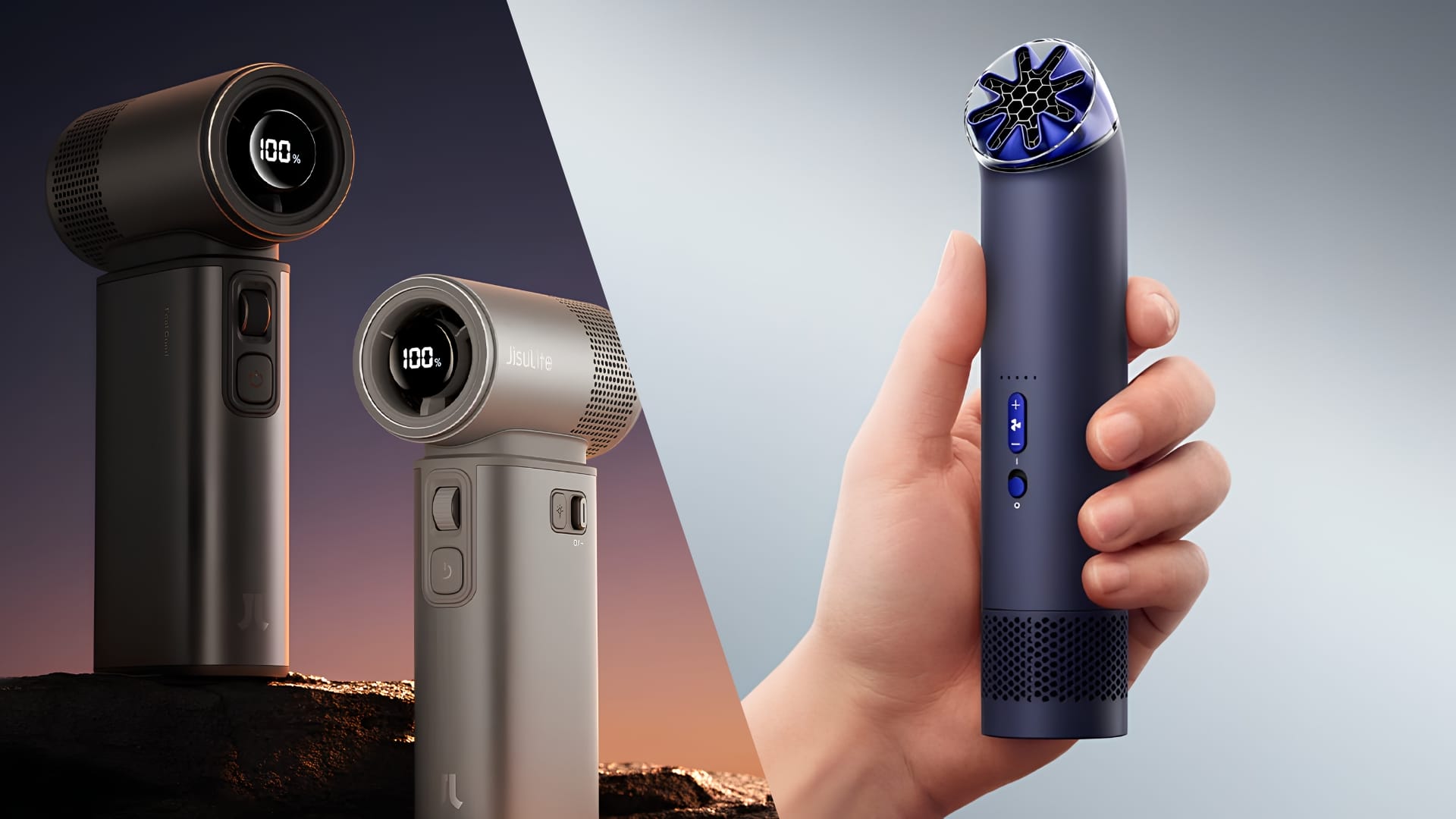
Portable fans are a practical part of daily life in Singapore and across Southeast Asia, particularly during outdoor commutes, queues, travel and events. At the premium end of the category, practical factors such as weight, noise, battery life and airflow control decide whether the device remains useful throughout the day.
The JisuLife Handheld Fan Ultra2 and Dyson HushJet Mini Cool are two of the premium portable fans in the market right now, and they target users with different priorities. Built for strong airflow, the Ultra2 focuses on delivering stronger cooling performance, a larger battery and a wider range of secondary functions. HushJet, on the other hand, takes a simpler approach, with a lighter and quieter fan that is easier to position for hands-free use.
Neither design is inherently better. Therefore, our team compares both fans across design, airflow strength, stability, noise, battery performance, and extra features, highlighting where each model excels and which trade-offs matter most in daily use.
Build quality against portability
Measuring 135 mm in height and weighing approximately 295 g, the Ultra2 uses an aluminium-alloy body with a shorter, wider profile than the HushJet. Its solid construction delivers a far more premium feel than a typical plastic handheld fan, though that extra weight becomes noticeable during extended one-handed use.
By contrast, the HushJet stands 180 mm tall but weighs approximately 212 g. Its polycarbonate body lacks the Ultra2’s metallic finish, yet the 83 g weight saving makes it noticeably easier to carry and less tiring to hold. Measuring roughly 38 mm across, its slender cylindrical frame easily slides into tight bag compartments alongside a phone or other daily essentials.
That said, the Ultra2’s shorter frame still holds an advantage in shallower bags where the HushJet’s extra height might stick out. Overall, both fans occupy a similar amount of space. The Ultra2 is shorter and wider, and the HushJet is taller and slimmer, meaning overall suitability still depends entirely on bag shape and pocket layout.
HushJet further improves practical handling with a rotating head and neck-strap attachment, letting users direct airflow hands-free without constant repositioning. It stands out as the more practical option for extended carrying, with the Ultra2 countering through a more solid build in a shorter form factor.
Airflow strength against cooling performance
On paper, official specifications show a clear difference in cooling performance between the two devices. JisuLife rates the Ultra2 for a maximum wind speed of 16.8 metres per second at a distance of 10 cm, managed through a roller dial with 100 speed levels. Dyson claims an even higher peak of 25 metres per second at the same distance in Boost mode for the HushJet, driven by a brushless DC motor running at up to 65,000 RPM. Beyond its Boost setting, the HushJet offers five standard speed controls.
In real-world testing, however, hands-on results tell a very different story than what those headline figures may suggest. During a paper-cup distance test, the HushJet operating at maximum output only moved the cup as far as the Ultra2 running at 45% capacity. Pushing the Ultra2 to higher speeds drove the cup considerably further along the tabletop, demonstrating substantially stronger airflow in practice.
A separate test using a digital anemometer further reinforced those findings, measuring the Ultra2 at 9.8 metres per second at maximum power compared to 7.5 metres per second for the HushJet in Boost mode. Together, these measurements highlight how official wind-speed claims often fail to reflect differences in total air volume, nozzle design, and testing methodology.
JisuLife also states that the Ultra2 can drop a surface temperature reading from 36°C to 30°C in five seconds under its lab conditions. Backed by physical testing, the Ultra2’s superior effective airflow makes it the far more capable choice for direct sunlight, crowded queues, and demanding outdoor environments where rapid cooling matters most.
Airflow stability against cooling coverage
Airflow strength is only part of the comparison, as a fan must also deliver steady, smooth airflow during extended use. A hands-on ping-pong-ball test demonstrated that both fans kept the ball floating with similar stability when their power outputs were evenly matched.
JisuLife states that the Ultra2 produces airflow measuring 13.4 cm wide at a distance of 20 cm, giving it broader coverage across the face and upper body. Dyson does not publish an equivalent airflow-width measurement, noting instead that its HushJet nozzle is engineered to concentrate air into a focused stream to reduce turbulence and higher-frequency noise.
These distinct design approaches translate directly into daily performance. The Ultra2 disperses its airflow across a wider area; the HushJet delivers a narrower stream that can be redirected using its rotating nozzle. Both fans remained stable at moderate output, yet the Ultra2 provided considerably stronger airflow when turned up to higher speeds.
Noise against indoor usability
Pulling out a portable fan in a quiet open-plan office, library or train carriage can quickly draw unwanted attention if the motor produces a loud hum. In shared indoor spaces, low noise output becomes just as important as airflow strength, as personal cooling must deliver comfort without distracting those nearby.
When evaluated at maximum output, the HushJet runs noticeably quieter than the Ultra2. Official specifications support this difference, with JisuLife listing the Ultra2 at 65 dB on its lightest setting and 84.65 dB at full power, while Dyson claims the HushJet ranges from 52 dBA at its lowest setting to 72.5 dBA at maximum output.
Peak figures, however, only tell part of the story. Dialling the Ultra2 down to lower speeds significantly drops its noise profile. Its 100-level scroll dial gives users precise control over the balance between airflow and noise, allowing the motor to be slowed down for quiet indoor environments yet keeping upper speeds available for severe outdoor heat where stronger airflow takes priority.
The Ultra2’s higher noise level at maximum speed represents a deliberate trade-off for its superior airflow, rather than a drawback across its entire operating range. For users who prioritise quiet operation and lightweight portability above raw power, however, the HushJet proves the clearer fit.
Battery life and charging capabilities
Battery capacity marks another clear difference between the two devices. JisuLife equips the Ultra2 with a substantial 9,000 mAh battery, quoting runtimes between 1.5 and 25 hours depending on fan speed. Reaching that top estimate requires running the fan on its lowest setting, while sustained operation near maximum speed drops endurance closer to the 1.5-hour mark. By comparison, Dyson equips the HushJet with a smaller 5,000 mAh battery and claims up to six hours of use on its lowest setting.
Even when accounting for differing maximum airflow levels, the Ultra2 holds a distinct advantage in battery life. Its larger capacity makes it better suited to long travel days, outdoor events, and extended stretches away from a power socket, reducing the need to recharge frequently when continuous cooling is required throughout the day.
JisuLife further complements that extra capacity with 18W USB-C fast charging and reverse charging support. This enables the Ultra2 to double as a power bank for emergency smartphone top-ups, a practical feature that adds real-world utility, even if charging external devices naturally reduces the remaining battery life for personal cooling.
Extra features beyond personal cooling
Beyond raw power, the Ultra2 includes several practical design touches. Useful details, such as a safety lock to prevent accidental activation inside a bag and a removable rear grille for straightforward cleaning, boost its everyday usability.
JisuLife expands that versatility with features designed for travel and emergencies. An integrated light with an SOS mode provides backup illumination during outdoor trips or power outages, and attachable magnetic nozzles concentrate airflow for inflation, dust removal and other focused tasks. Combined with its reverse charging capability, these additions make the Ultra2 a versatile multi-tool for travel beyond personal cooling.
By contrast, Dyson takes a far more minimalist approach, ditching extra gadgets for a built-in rotating head that makes hands-free positioning effortless. The table below summarises how each fan compares across its key specifications, additional features and intended use.
How the Ultra2 and Hushjet compare
| Specification | JisuLife Handheld Fan Ultra2 | Dyson HushJet Mini Cool |
|---|---|---|
| Dimensions | 135 × 40 × 74.5 mm | 180 mm tall × 38 mm diameter |
| Weight | Approximately 295 g | Approximately 212 g |
| Speed controls | 100 speed levels | 5 speed levels plus Boost mode |
| Claimed maximum wind speed | 16.8 m/s at 10 cm | 25 m/s at 10 cm in Boost mode |
| Claimed maximum noise | 84.65 dB at 100% | 72.5 dBA in Boost mode |
| Battery capacity | 9,000 mAh | 5,000 mAh |
| Claimed battery life | 1.5 to 25 hours, depending on speed | Up to 6 hours on the lowest setting |
| Additional features | Safety lock, removable grille, SOS light, magnetic nozzles and reverse charging | Rotating head, neck attachment and hands-free positioning |
| Best suited for | Outdoor heat, long queues, travel and extended use away from charging | Offices, public transport and quiet indoor environments |
| Price | S$115 (US$89.99) | S$149 (US$99.99) |
The verdict: JisuLife Handheld Fan Ultra2 vs Dyson HushJet Mini Cool
Choosing between the JisuLife Handheld Fan Ultra2 and the Dyson HushJet Mini Cool comes down to where personal cooling is needed most. Rather than competing directly on identical terms, the two devices suit different use cases. One prioritises maximum cooling power and battery life for demanding environments, and the other focuses on quiet, low-effort indoor comfort.
For outdoor travel, prolonged exposure to heat or long days away from a power source, the Ultra2 is the more capable option. Its primary advantage is strong airflow, backed by a high-capacity 9,000 mAh battery that can also top up a smartphone in a pinch. Although its heavier frame and higher noise levels at maximum speed make it less suited to quiet shared spaces, that extra airflow becomes essential in extreme heat, direct sunlight and crowded outdoor settings.
Conversely, the HushJet excels in offices, train carriages and quiet indoor settings where quiet cooling matters most. Its lightweight body is noticeably less tiring to carry, its motor operates more discreetly, and its built-in rotating head allows users to adjust the airflow angle without repositioning the entire device. Although it cannot match the Ultra2’s maximum airflow or larger battery, it delivers a far more refined experience for everyday indoor use.
Ultimately, the Ultra2 is the better choice for buyers who need strong airflow and extended battery life on the move. The HushJet remains the preferred option for those who value quiet operation and lightweight portability.