

For several generations, vivo has made camera performance a defining part of its flagship X series. Its partnership with ZEISS, continued focus on portrait photography and increasingly capable telephoto cameras have helped the range build a strong reputation for mobile imaging.
Our verdict
The vivo X500 Pro Max is a polished flagship with strong everyday performance, a sharp display and an impressive camera system led by its 85mm telephoto. Video stabilisation and low-light photography are also strong, although sustained GPU performance drops under heavier workloads and portrait processing can be slightly aggressive.
Pros
- Excellent 85mm telephoto
- Strong main and low-light cameras
- Effective video stabilisation
- – Large battery and sharp display
Cons
- Sustained GPU performance drops under load
- Portrait processing can smooth fine facial detail
That focus has gradually expanded to video. Stabilisation, autofocus, colour control and high-frame-rate recording now receive similar attention, giving the X series a broader set of tools for travel, events and content creation.
The X500 Pro Max continues in that direction, placing photography and video at the centre of the overall experience while pairing its camera hardware with the performance, display and battery capacity expected from a modern flagship.
A large body with a display to match
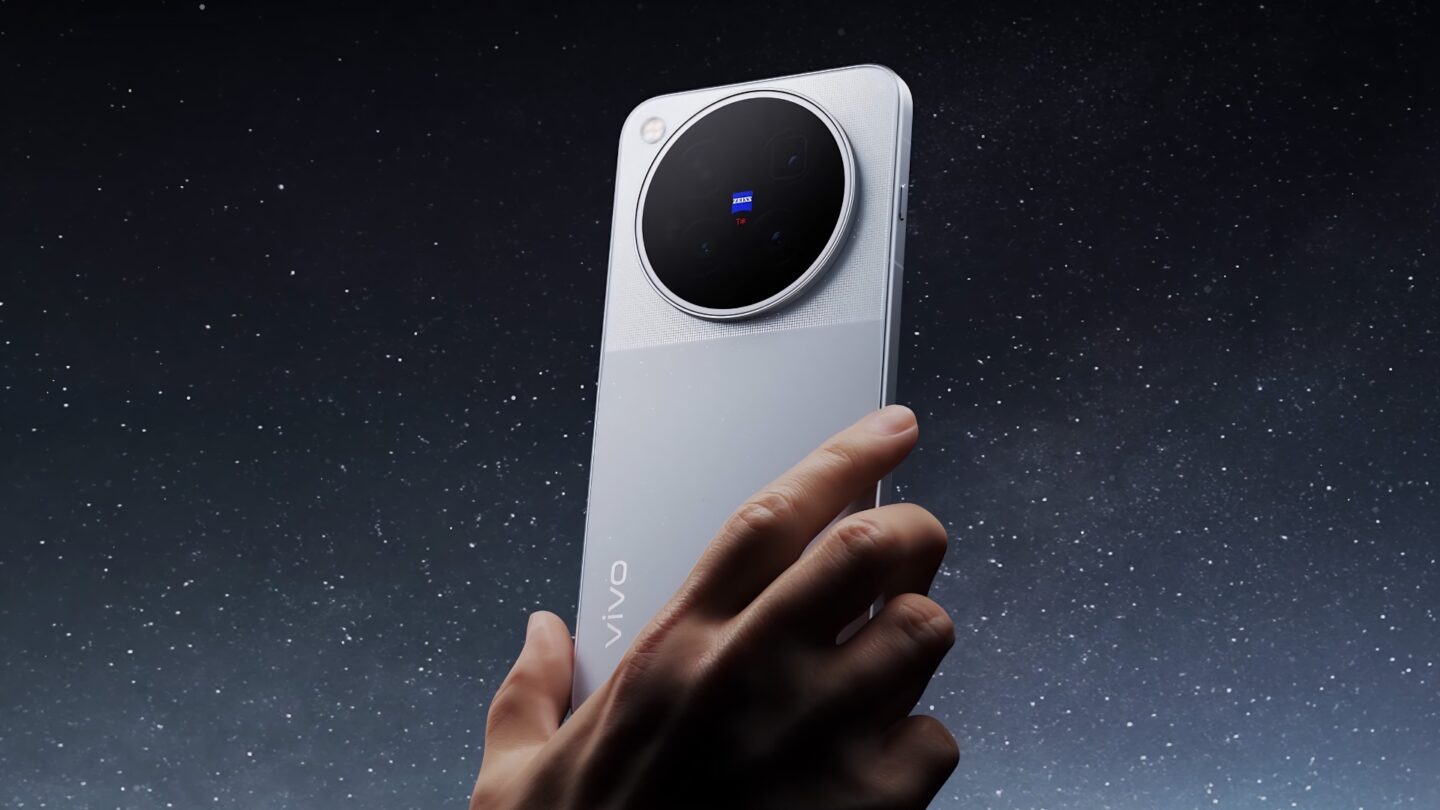
The vivo X500 Pro Max arrives with slight variations across its finishes. The white, grey, and orange editions feature anti-glare (AG) glass backs measuring 163.32 × 76.82 × 8.12 mm and weighing 229g, while the black version uses glass fibre, trimming thickness to 7.95 mm and weight to 225g. In practice, that four-gram reduction does little to alter the in-hand feel; the sheer heft remains immediately noticeable during extended one-handed use, particularly when framing stills or shooting vertical video.
A 6.85-inch ZEISS Master Colour Display dominates the front, running at 1440 × 3168 pixels (507 ppi). The expansive canvas proves particularly practical in the field for verifying composition and critical focus right after a shoot. It features an adaptive refresh rate from 1 Hz to 144 Hz in supported applications, with vivo quoting a peak brightness of 4,400 nits (at 20% APL under direct ambient light), plus Dolby Vision and Ultra XDR playback.
Protection and hardware security are thoroughly addressed. The screen is shielded by Armor Glass, the rear camera cluster receives an Ultra Hard anti-reflective coating, and the chassis carries dual IP68 and IP69 ratings against dust and water ingress. Biometric access relies on a responsive 3D ultrasonic fingerprint scanner. Yet, while the device excels as a large-format viewfinder, its physical footprint and pocket presence remain impossible to overlook.
Strong performance drops noticeably under sustained load
Under the hood, the X500 Pro Max runs on the MediaTek Dimensity 9600 Pro chipset, paired with 12GB of RAM and storage options of 256GB, 512GB, and 1TB. Standard synthetic benchmarks show substantial compute headroom. Geekbench 7 returned a single-core score of 3,070, a multi-core result of 10,109, and a GPU compute score of 17,623. In everyday use, the X500 Pro Max feels consistently fast and responsive. Apps launch quickly, camera processing finishes with little delay, and switching between demanding apps stays smooth even during heavy multitasking.
Initial graphics tests show similarly strong performance, with the X500 Pro Max delivering high scores in shorter benchmark runs. In 3DMark, the device posted 3,403 points in Steel Nomad Light at an average of 25.21 FPS, alongside a score of 1,580 (11.06 FPS) in the ray-traced Solar Bay Extreme benchmark.
However, sustained graphical workloads reveal a distinct throttling curve. During the 20-loop Steel Nomad Light Stress Test, the handset recorded an initial high of 3,170 points before tumbling to a low of 1,744, yielding a stability rating of just 55%. Over the course of the test, internal temperatures climbed from 32°C to 41°C, battery levels dropped from 98% to 89%, and frame rates fluctuated widely between 10 FPS and 35 FPS.
The sharpest decline occurs within the opening few runs before output settles into a consistent 1,800 to 2,000-point plateau. While peak surface temperatures capped at a relatively manageable 41°C, this controlled thermal ceiling clearly comes from aggressive early throttling. The Dimensity 9600 Pro is therefore far better suited to short bursts of intensive GPU usage, such as brief gaming sessions or quick video exports, rather than prolonged rendering loads.
The main and telephoto cameras deliver strong results
The 200MP ZEISS APO telephoto camera defines much of the imaging experience on the X500 Pro Max. Built around a large 1/1.4-inch HP0 sensor paired with an 85mm-equivalent f/2.67 lens, it incorporates CIPA 7.0-rated optical stabilisation and continuous autofocus tracking at up to 60 fps.
In practice, this 85mm focal length excels at isolating portraits and architectural subjects. An architectural test capture taken at 1/50s and ISO 580 illustrates this balance well, as roof tiles, intricate stonework, and wooden lattices remain crisp without exhibiting the aggressive edge sharpening common to computational post-processing. While a bright overcast sky behind the structure pushes toward white, dynamic range management ensures the building itself preserves rich surface textures.
Portraits benefit even more from this optical configuration. At native 85mm framing, subjects stand out cleanly from busy surroundings, retaining natural definition across fine strands of hair and clothing fabrics. Skin tones render warm and pleasing, though vivo still applies a gentle smoothing effect to subtler facial textures. Pushing to a 135mm crop demonstrates the sensor’s resolving power beyond its native optics. Details across facial features and apparel remain intact, while the compressed telephoto perspective flatters the subject without introducing the digital artefacts or softening typical of sensor cropping.


Photo taken with vivo X500 Pro Max (left) vs photo taken with Samsung S26 Ultra (right)
The primary camera uses a 50MP vivo and Sony LYTIA L910 sensor measuring 1/1.28 inches, paired with a 24mm-equivalent f/1.57 lens and 3-degree gimbal-grade stabilisation. In daylight, it renders clean scenes with well-calibrated highlight retention and restrained colour saturation. In a test shot of the Alibaba building, structural clouds remain legible and horizontal façade elements maintain crisp resolution without artificial brightening across the shadows.
Direct comparisons with the Samsung Galaxy S26 Ultra highlight distinct approaches to image processing across identical real-world scenes. While slight variations in timing and framing must be factored in, consistent patterns emerge. Samsung prioritises brighter overall exposures by lifting shadow areas more aggressively. In contrast, vivo preserves deeper midtones and richer local contrast, giving structural lines on buildings a more sculpted appearance.


Photo taken with vivo X500 Pro Max (left) vs photo taken with Samsung S26 Ultra (right)
This difference is especially noticeable in waterside captures. The Galaxy S26 Ultra produces a brighter, warmer presentation with amplified detail across distant architecture. The X500 Pro Max opts for a moodier, cooler interpretation, marked by deeper blues across the water and sky. While this subdued tuning captures the natural ambience accurately, aesthetic preference will ultimately dictate which rendition a user favours. In close-up macro scenarios, such as a textured combination lock, vivo takes the lead in resolving fine surface grit and engraved numerals, whereas Samsung prioritises shallow depth of field, leaving more of the lock outside its narrow plane of sharp focus.
Low-light performance is particularly capable when tackling static architecture. A night capture of a temple at 1/20s and ISO 1357 resolves fine roof ornaments, stonework, and direct decorative lighting cleanly, keeping noise low without smearing delicate textures.
In extended exposures, such as a four-second capture at ISO 69 taken along Zhang Yuan, brickwork and urban signage render with remarkable clarity. However, because moving vehicles generate visible light trails and ghosting artefacts, these longer-exposure modes remain best suited to stationary compositions.
Video recording receives substantial technical backing, supporting 17 EV TrueDynamic Log, 4K Cinematic Portrait, 4K Cinematic Colour, and high-speed capture at up to 4K at 240 fps, alongside utility modes such as Stage Mode 3.0 and Auto Framing.
Handheld walking trials show that the physical stabilisation effectively tames vertical displacement without introducing corner warping or jitter. Footstep impacts register naturally, yet the resulting footage remains stable and immediately usable without post-processing stabilisation. Furthermore, focus tracking holds locked as subject distances shift.
In high-frame-rate testing, a slow-motion waterfall sequence isolates individual droplets and distinct water ribbons, while surrounding foliage and wet rocks remain crisp, exposure remains uniform, and focus hunting is completely absent.
Across stills and video, the X500 Pro Max delivers its strongest results through the main and telephoto cameras. The 85mm lens is particularly convincing for portraits and architectural details, retaining enough resolution for useful 135mm crops, while the main camera produces detailed images with controlled highlights and stronger local contrast in the scenes tested. Night mode handles static subjects well, though longer exposures introduce ghosting once movement enters the frame. Video performance is similarly assured, with effective stabilisation, steady exposure and reliable focus tracking across the walking and slow-motion tests. Portrait smoothing remains noticeable, but the camera system is otherwise consistent across a wide range of shooting conditions.
OriginOS 7 remains responsive and the battery is substantial
On the software front, the device runs OriginOS 7, which integrates productivity and workflow tools such as Origin Workbench, Snap Note, AI Recorder, Snap & Go, and the vivo Office Kit, alongside Quick Share and Shake & Share for local file transfers. The interface feels smooth and responsive, with system menus opening quickly, fluid animations and no noticeable stutter when switching between heavier apps. vivo also includes its AI Creative Camera tools, although availability depends on the region, system language and supported apps.
A substantial 7,800mAh BlueVolt battery provides power, with a rated capacity of 7,605mAh and a typical energy rating of 28.94Wh. The large battery holds up well through mixed daily use, including extended camera sessions, and provides enough endurance to get through a busy day without needing an early top-up. The battery also supports 90W wired fast charging and up to 40W wireless charging, with the latter requiring vivo’s second-generation 50W Vertical Wireless Flash Charger or an equivalent iQOO accessory, as the first-generation vivo wireless stand is incompatible with the X500 series.
The verdict: vivo X500 Pro Max
The vivo X500 Pro Max is at its best when shooting with the 85mm telephoto. It works especially well for portraits and architectural details, while 135mm crops still hold enough detail to be useful. The main camera is dependable too, with good highlight control, plenty of detail and well-balanced contrast. Low-light shots are convincing with static subjects, and handheld video benefits from effective stabilisation and reliable focus tracking.
Performance feels fast in normal use, although the 55% stability result in the Steel Nomad Light Stress Test shows that GPU performance drops noticeably over longer workloads. The 229g weight and 6.85-inch display also make this a sizeable phone, particularly during prolonged one-handed use.
The X500 Pro Max makes the most sense for users who place a high priority on photography and video. Its camera system is the main draw, particularly for portraits, events and longer focal lengths, while sustained GPU performance is the more noticeable trade-off.