


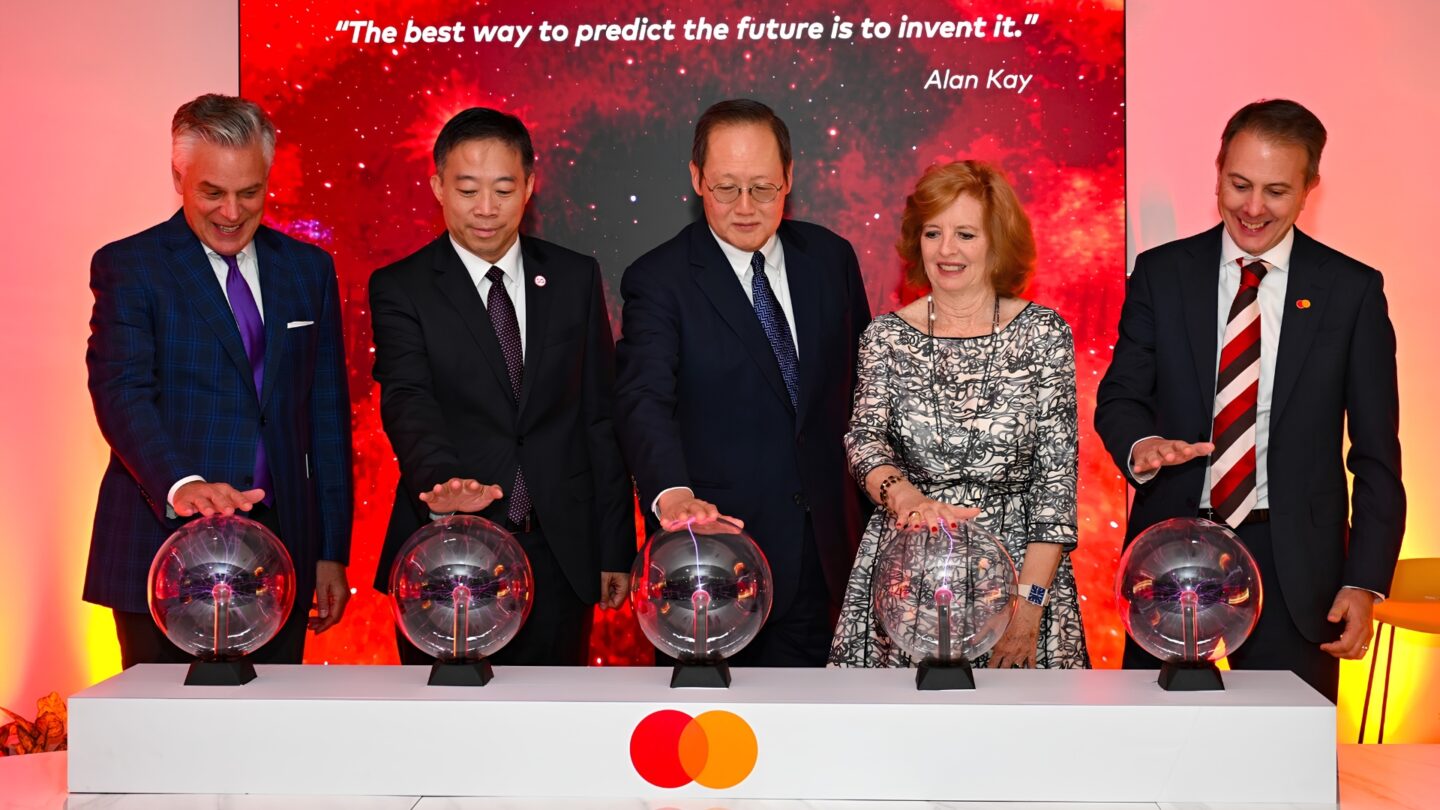
Mastercard has opened a new facility in Singapore that stands as its largest Innovation Centre of Excellence (ICoE) in Asia Pacific, bringing together artificial intelligence (AI), cybersecurity, customer experience and rapid prototyping capabilities to develop and test technologies for digital commerce. The regional centre will allow financial institutions, merchants, governments and technology partners to work directly with Mastercard specialists on new applications.
Spanning more than 7,200 sq ft, the facility already has over 55 specialists working across its operations. By the end of 2029, the company plans to add more than 250 specialist roles in Singapore, expanding its expertise in responsible AI, cybersecurity, data and payments as it develops technologies for regional use.
Four specialised spaces bring development and security together
Inside the ICoE, four complementary spaces cover AI development, security, technology exploration and prototyping. Bringing these disciplines into one facility supports collaboration between Mastercard and its partners.
For AI development, the AI Centre of Excellence will focus on responsible AI solutions for commerce, including agentic commerce, fraud and scam prevention. Teams there will explore how AI can be applied to commercial transactions while addressing the security considerations associated with increasingly automated purchasing activities.
Operating alongside it, the Fusion Centre combines expertise in cybersecurity, fraud and physical security. Its work centres on identifying emerging threats, coordinating responses and strengthening resilience across Mastercard’s wider ecosystem.
The remaining two spaces support technology exploration and development. Through the Mastercard Experience Centre, financial institutions, merchants and public-sector organisations will have an environment to explore emerging technologies and their potential business applications, while the Makerspace will provide facilities for building, testing and refining prototypes to help teams develop ideas into potential solutions.
Agentic commerce brings security and oversight into focus
Agentic commerce, where AI agents make purchases on behalf of consumers, is among the areas Mastercard plans to develop through the ICoE. Pointing to market forecasts, the company cited projections that more than one in 10 online shoppers will routinely use AI agents to make purchases by 2030, alongside estimates that agentic AI could influence or orchestrate between US$3 trillion and US$5 trillion in global consumer commerce.
The centre pairs this focus on AI development with an emphasis on cybersecurity and fraud prevention. As automated systems take on purchasing activities, businesses will need to address security, governance and human oversight when implementing these technologies. Mastercard also cited cybercrime as accounting for over 30% of recorded crime in the region.
Richard Wormald, President, Asia Pacific, Mastercard, said: “The ICoE builds on Mastercard’s longstanding collaboration with EDB and Singapore’s strength as a proven testbed for innovation. It unites capabilities that traditionally sat apart, supporting the region in tackling shared challenges and moving promising ideas into practice faster.”
Singapore centre to support more than 40 Asia Pacific markets
Using Singapore as a base to develop solutions that address different regional requirements, the ICoE will connect Mastercard’s expertise and insights across more than 40 Asia Pacific markets. The company also sees opportunities for applications developed through the centre to be adapted for wider global deployment.
Speaking at the opening, Dr Tan See Leng, Singapore’s Minister for Energy, Trade and Industry (Energy and Industry), expressed the hope that the centre would support the development and testing of payment technologies in Singapore prior to their adaptation and deployment across ASEAN, India and other markets.
Png Cheong Boon, Chairman of the Singapore Economic Development Board (EDB), described the investment as an extension of the agency’s longstanding collaboration with Mastercard. He pointed to AI, cybersecurity and threat intelligence as areas where the company’s expanded capabilities could help address emerging challenges across Asia Pacific while creating specialist employment opportunities in Singapore.
The new facility also builds on Mastercard’s existing presence in Singapore, which houses its Asia Pacific headquarters and a regional market support centre. Locally, the company currently employs more than 850 people, with its Singapore workforce expected to exceed 1,000 by the end of 2029.