



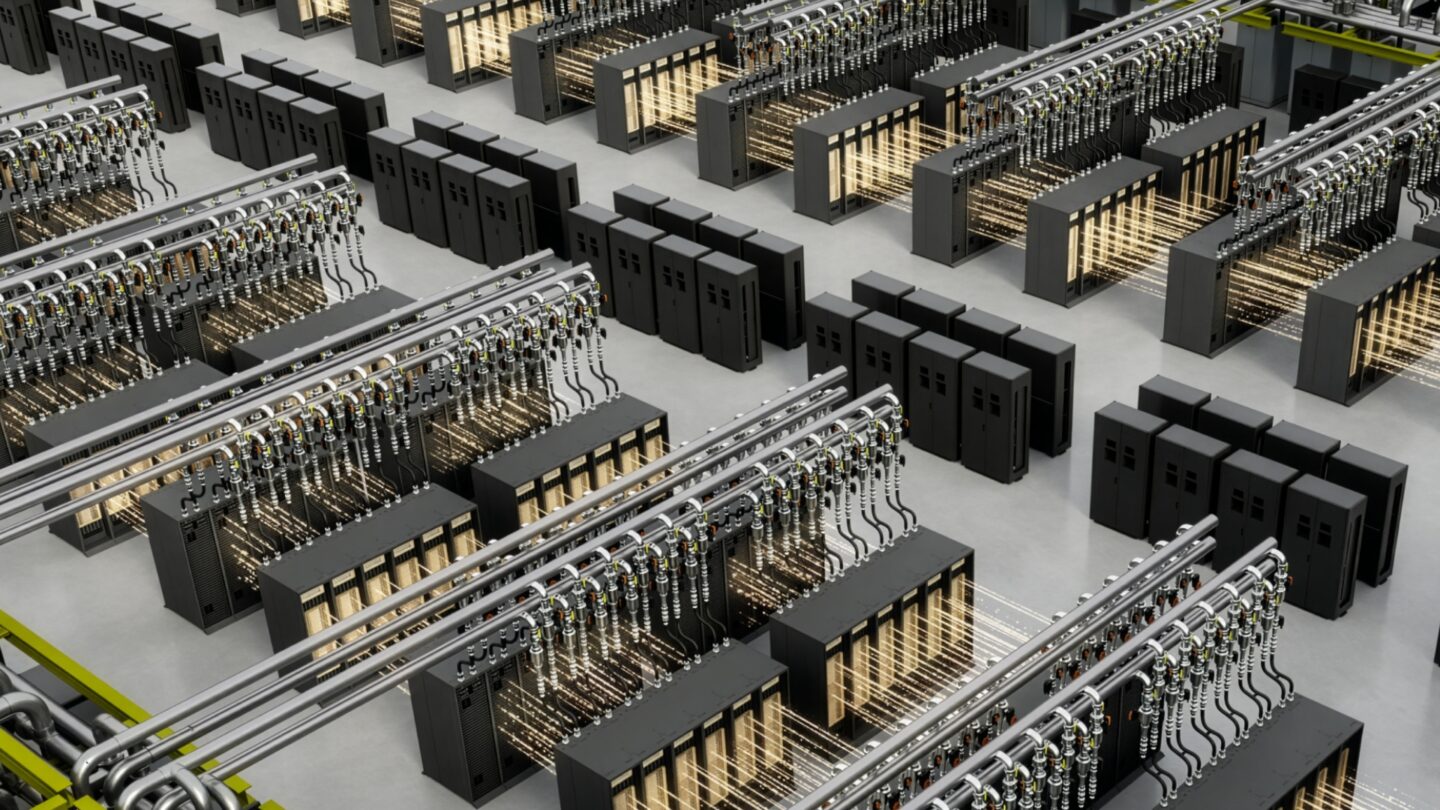
NVIDIA has contributed its Vera Rubin rack and compute tray designs to the Open Compute Project (OCP), extending its open MGX architecture to help manufacturers develop large-scale AI infrastructure. The move forms part of a broader set of announcements at the OCP Global Summit spanning rack design, power distribution, networking and AI factory management software.
Alongside infrastructure partners establishing common technical standards, the summit’s developments involve technology companies including AMD, Cisco, Google, Meta and Microsoft. As part of the initiative, NVIDIA is also expanding its DSX AI Factory platform with open source software designed to simplify how large computing clusters are deployed and operated.
MGX 1.2 extends open rack design to Vera Rubin infrastructure
Under the updated MGX 1.2 specification, NVIDIA has introduced rack-scale capabilities tailored to Vera Rubin AI factories, supporting deployments of up to 250 kW. The specification incorporates blind-mate liquid cooling connections, interoperable interconnect infrastructure, and a liquid-cooled 5,000A busbar engineered for higher-power systems.
To reduce configuration divergence across accelerated computing platforms, MGX 1.2 adds support for standard 19-inch equipment, configurable input/output bays, and fanless liquid-cooled compute trays. By providing common power and cooling interfaces, the architecture allows manufacturers to build compatible hardware around shared infrastructure designs.
Through the OCP Open DC Initiative, NVIDIA and other industry participants have also contributed to the third-generation MGX AI data centre reference design. Incorporating open liquid-cooling technologies such as MQD and MQDB, this collaborative work aims to standardise hardware manufacturing and servicing. In practice, the shared architecture is intended to cut assembly, testing and maintenance times while allowing components to be reused across varying deployments. According to NVIDIA, the modular structure simplifies infrastructure rollout and servicing as operators scale up their accelerated systems.
Beyond raw compute density, the Vera CPU rack design specification extends MGX into infrastructure tailored for agentic AI workloads. While Vera Rubin NVL72 underpins large-scale AI training and inference, the Vera CPU rack is built to handle orchestration, tool calling and sandboxed execution, providing the backend support AI agents need to interact with live applications, data and services in real time. Because both systems adhere to the third-generation MGX architecture, computing, networking, power and cooling are unified within a single modular framework. This allows infrastructure partners to engineer systems for diverse AI workloads while maintaining consistent rack-level design principles.
Open specifications address facility design and grid resilience
At the facility level, NVIDIA, AMD, Google and Meta have released the Open Data Center Specification v0.7, establishing a shared framework for AI factory design. Encompassing power architecture, cooling infrastructure and physical layout, the document offers equipment manufacturers, colocation providers and data centre operators a common technical baseline for building large-scale compute facilities.
Addressing utility interactions, Google, Meta, Microsoft and NVIDIA have separately published the OCP Grid Resilience Specification, which defines how large facilities should manage disturbances in the electricity grid. The specification sets out how AI infrastructure should remain connected during utility grid disturbances, respond automatically, and restore operations to near-full load within less than two seconds, setting unified standards for demand management. Both open specifications align with NVIDIA’s DSX reference design, which offers a validated implementation spanning facility layouts, power systems, and software that monitors and reacts to grid signals in real time.
In tandem with these facility guidelines, Visionbay.ai has unveiled plans for K-1, an AI factory platform built on an 800 VDC architecture intended for future Vera Rubin deployments. Developed by pairing NVIDIA’s 800 VDC reference architecture with power and thermal technologies from Vertiv, the project targets the physical bottlenecks of high-density computing. According to NVIDIA, conventional lower-voltage power distribution becomes increasingly difficult to scale as rack power densities rise, demanding substantially more copper, cabling and power-conversion equipment.
K-1 addresses these constraints by using cluster-level power centres that centralise AC-to-DC conversion and deliver 800 VDC closer to computing hardware, simplifying downstream distribution and facilitating modular expansion. The framework also allows operators to phase in 800 VDC distribution gradually, targeting high-impact zones without requiring an immediate, facility-wide conversion. Paired with support for liquid cooling, the design aims to accommodate next-generation high-density systems while preserving flexibility for existing deployments.
Meta, Cisco and Google advance networking designs for larger AI clusters
Meta is expanding its networking collaboration with NVIDIA by adopting Spectrum-6 Ethernet switches for its Vera Rubin AI factories. According to NVIDIA, Spectrum-6 delivers 102.4 Tb/s of switching capacity, doubling both the capacity and per-lane bandwidth of the earlier Spectrum-4 generation. The switch supports 200G-per-lane connectivity and incorporates performance isolation designed to prevent network traffic from one workload affecting another.
Meta is integrating the technology into N-IceCube, a custom Spectrum-6 switch engineered for its IcePack liquid-cooled networking rack. N-IceCube runs the Facebook Open Switching System (FBOSS), Meta’s open source network operating system contributed to the OCP. FBOSS operates via the Switch Abstraction Interface, an OCP standard providing a vendor-independent framework for managing switching hardware.
Omar Baldonado, senior director of data center and AI networking at Meta, explained how the integration supports the company’s infrastructure plans. “Extending FBOSS to Spectrum ASICs means we can run that same software stack across our fabrics, and Meta’s new Spectrum-based switch, N-IceCube, brings that into Icepack – our liquid-cooled 102.4T network rack for scale-out that connects upcoming generations of accelerators in our fleet.”
The partnership also encompasses Spectrum-X Multiplane technology, combining Spectrum-6 switches with ConnectX-9 SuperNICs to distribute GPU traffic across up to eight independent network planes. NVIDIA says this architecture can support AI factories with more than 100,000 GPUs while cutting infrastructure costs and requiring fewer switching tiers. Distributing traffic across multiple paths also builds in hardware resilience, allowing data to flow across surviving planes if components fail, even under reduced overall bandwidth. Meta and NVIDIA have validated these enhancements across on-premises and cloud environments, drawing on operational findings to establish architectures that other infrastructure providers can deploy.
Separately, NVIDIA and Cisco have announced plans for Ultra-Dense Small Form Factor Pluggable (USFP), a new optical transceiver form factor engineered to raise bandwidth density in AI networking hardware. Designed to support 400Gb/s-per-lane networking, USFP maintains roughly the same physical footprint as the current 200Gb/s-per-lane OSFP format. The proposed architecture incorporates 16 full-duplex lanes, with plans to expand to 32. NVIDIA and Cisco expect the design to yield four times the bandwidth density of traditional 200Gb/s-per-lane pluggable optics, alongside roughly 1.3 times greater power efficiency.
By delivering higher bandwidth density, USFP could allow operators to link more computing resources without adding extra switching tiers, which typically increase latency, power draw and system complexity. NVIDIA and Cisco are collaborating with TE Connectivity and Amphenol on cages, connectors and modules, intending to advance USFP through an open, community-led, multi-source effort that preserves the flexibility and serviceability of pluggable optics while ensuring broad interoperability.
Google is also collaborating with NVIDIA to introduce Falcon Transport support to future ConnectX-10 SuperNICs and BlueField DPUs. Designed to ensure reliable data delivery over Ethernet even during periods of network congestion and packet loss, Falcon provides multipath load balancing, programmable congestion control, hardware loss recovery and per-connection security.
The joint implementation pairs NVIDIA hardware acceleration with its DOCA software framework. This enables NVIDIA and Google network interface controllers to communicate using a shared transport protocol, while client applications continue to rely on standard Remote Direct Memory Access (RDMA) programming interfaces. By balancing traffic over available pathways and dynamically responding to fluctuating network conditions, Falcon aims to enhance bandwidth utilisation and deliver more predictable performance across large-scale AI and storage workloads.
DSX OS gains open source tools for AI factory operations
On the software side, NVIDIA has expanded DSX OS, the operating layer of its DSX AI Factory platform, with four open source tools. The DSX AI Factory platform is designed to coordinate computing, networking, power, cooling and facility systems within a unified operational framework, while the new tools address network configuration, cluster validation, rack management and the preparation of physical servers for production workloads.
To streamline network administration, NVIDIA Config Manager automates switch provisioning across fabrics, reducing manual intervention as operators deploy, validate and maintain uniform network settings. Cluster health is addressed by the NVIDIA Cluster Readiness Engine, which stress-tests GPU infrastructure using simulated real-world workloads prior to training runs, helping identify hardware faults that could derail costly jobs.
At the physical infrastructure tier, the NVIDIA Rack Management Service introduces a hardware abstraction layer that treats individual racks as self-contained operational units, aiming to simplify firmware maintenance across large facilities. Completing the quartet, the Cluster API Provider for NVIDIA Infrastructure Controller automates bare-metal server provisioning and tenant onboarding. NVIDIA claims the tool cuts the time needed to transform unconfigured hardware into production-ready clusters from days down to hours.
Drawing on operational experience from NVIDIA’s DGX Cloud deployments, the four open source components are designed for integration into multi-tenant platforms operated by cloud providers and software partners. The code has been made publicly available for developer review and contribution on the NVIDIA DSX AI Factory GitHub page.