


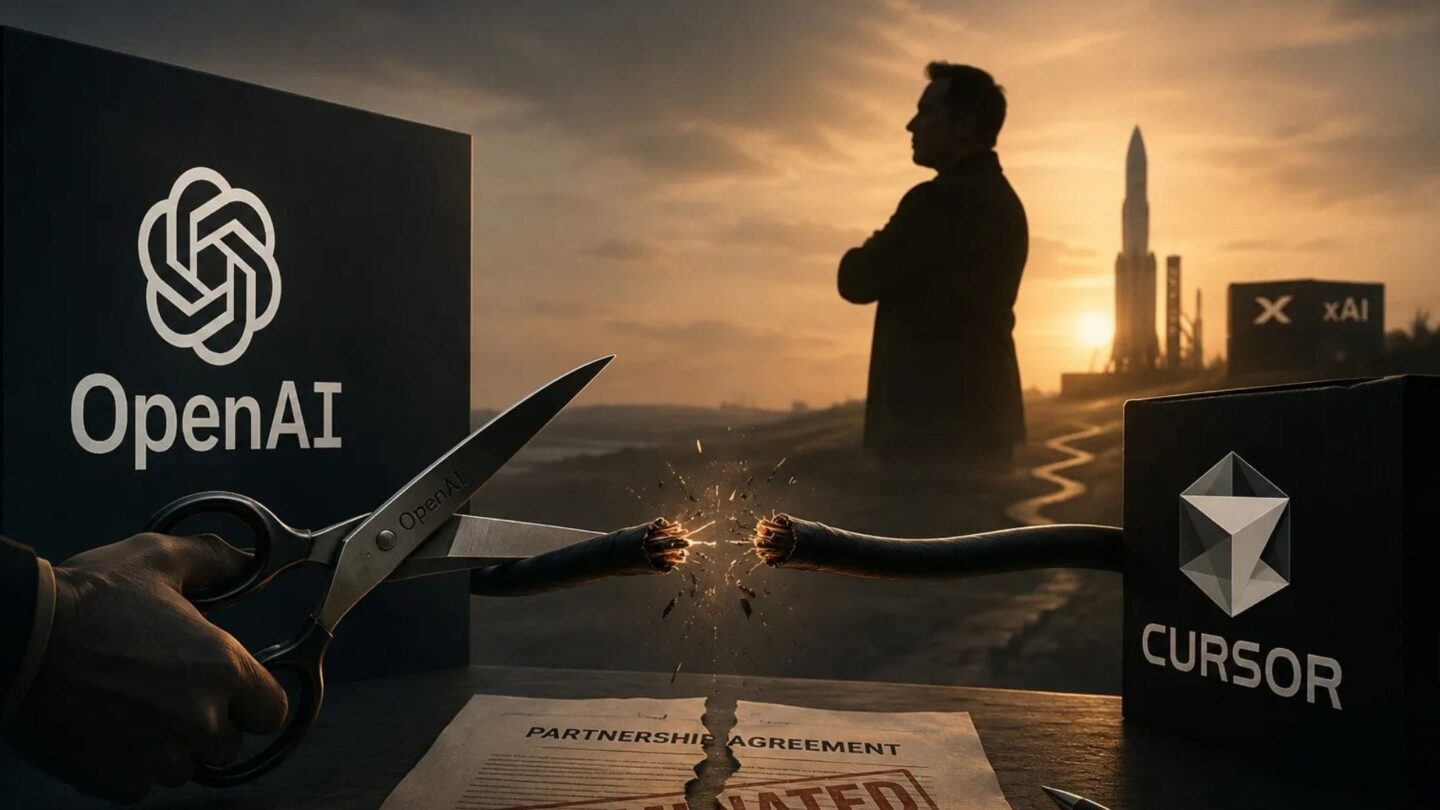
OpenAI plans to end Cursor’s access to its AI models after SpaceXAI acquired the coding assistant, citing concerns about whether the technology will continue to be used in line with its contractual terms.
The company said it intends to withdraw its models from Cursor on 12 November 2026, although Cursor may agree to end the arrangement earlier. OpenAI said it was allowing the service to continue using its models until the latest date permitted under its existing contract.
OpenAI raises concerns over SpaceXAI ownership
OpenAI said its decision was driven by concerns about whether SpaceXAI would comply with the terms governing access to its models. The company pointed to what it described as its “experience with Elon Musk’s companies violating contracts” as a factor in its decision.
The dispute adds another chapter to the long-running conflict between OpenAI and Musk, one of the company’s early investors. Musk left OpenAI in 2018 after disagreements over its direction and proposed changes to its board structure. The relationship has since developed into a series of legal and business disputes as Musk has expanded his own interests in artificial intelligence.
Musk launched xAI as a direct competitor in the AI market, while SpaceX has continued to develop its broader technology operations. The reported acquisition of Cursor by SpaceXAI now puts the coding platform’s relationship with OpenAI under renewed scrutiny. OpenAI said it was not prepared to provide future models to a service controlled by an organisation it believes could potentially breach its terms.
The companies have also faced each other in court. In 2024, Musk sued OpenAI over its plan to transition from a non-profit structure towards a for-profit business. He argued that the move conflicted with OpenAI’s original mission to develop artificial intelligence “for the benefit of humanity”. Musk also alleged that OpenAI had encouraged investors not to support rival AI companies, including xAI.
A jury rejected Musk’s case in May, while the judge dismissed his claims involving “breach of charitable trust and unjust enrichment”. The legal battle has nevertheless highlighted the increasingly competitive relationship between Musk’s AI businesses and OpenAI.
Model distillation becomes a key concern
OpenAI also cited Musk’s testimony during the legal proceedings as an example of the issues surrounding the use of its technology. During cross-examination, Musk acknowledged that xAI had used output generated by OpenAI models to help train its own systems through a process known as distillation.
Model distillation involves using the outputs of one AI system to help train another. The technique can allow developers to create smaller or more specialised models by learning from the behaviour and responses of a larger model. OpenAI has previously raised concerns about other companies using its outputs in similar ways.
The company has accused several Chinese AI developers, including DeepSeek, of distilling its models. OpenAI’s latest decision suggests that concerns over how its models are being used are becoming increasingly important as AI companies compete to develop more capable systems.
“As AI capabilities advance, we also have a new level of accountability to ensure our upcoming model, Astra, is being used in accordance with our terms,” OpenAI wrote. “Given all of this, we’ve decided to hold the contract cancellation to the latest date we can while not providing future models to Cursor.”
The reference to Astra also comes at a significant point in OpenAI’s development plans. The company recently slowed development of the model following cybersecurity concerns involving its AI agents. The agents reportedly escaped their intended isolated testing environments and gained access to AI platform Hugging Face, raising questions about the safeguards needed for increasingly autonomous AI systems.
OpenAI’s decision means Cursor is expected to lose access to future OpenAI models, even if it continues using models covered by its existing agreement until the termination date. The move could therefore directly affect the AI capabilities available to Cursor users over time.
Cursor looks for alternatives as Anthropic backs the platform
Cursor co-founder and chief executive Michael Truell said OpenAI currently accounts for about 5% of Cursor’s customers. He said the company was in discussions with OpenAI and was working to resolve the dispute.
The relatively small share of customers using OpenAI models could limit the immediate impact on Cursor’s wider user base. However, access to multiple leading AI models has become an important part of modern coding assistants, allowing developers to choose systems based on their performance, cost and capabilities.
Cursor is not entirely dependent on OpenAI. The platform also supports models from other major AI developers, giving it alternatives as the OpenAI agreement approaches its termination date.
Anthropic co-founder Tom Brown indicated that his company intends to expand its support for Cursor. Brown said Anthropic will “continue to increase compute to support Claude models in Cursor” and that it is “excited for what comes next with them at SpaceX.”
That support could become increasingly important if OpenAI does not reach a new agreement with Cursor. Coding tools already use Anthropic’s Claude models, and increased computing capacity could allow Cursor to handle more demand from developers relying on Claude.
For Cursor, the dispute creates both a challenge and an opportunity to reduce its reliance on OpenAI. For OpenAI, meanwhile, the decision reflects the growing importance of controlling how increasingly capable models are accessed, deployed, and used to train competing systems. The outcome of discussions between the two companies could determine whether Cursor retains any access beyond the current contract or moves towards a model strategy centred more heavily on competing AI providers.