


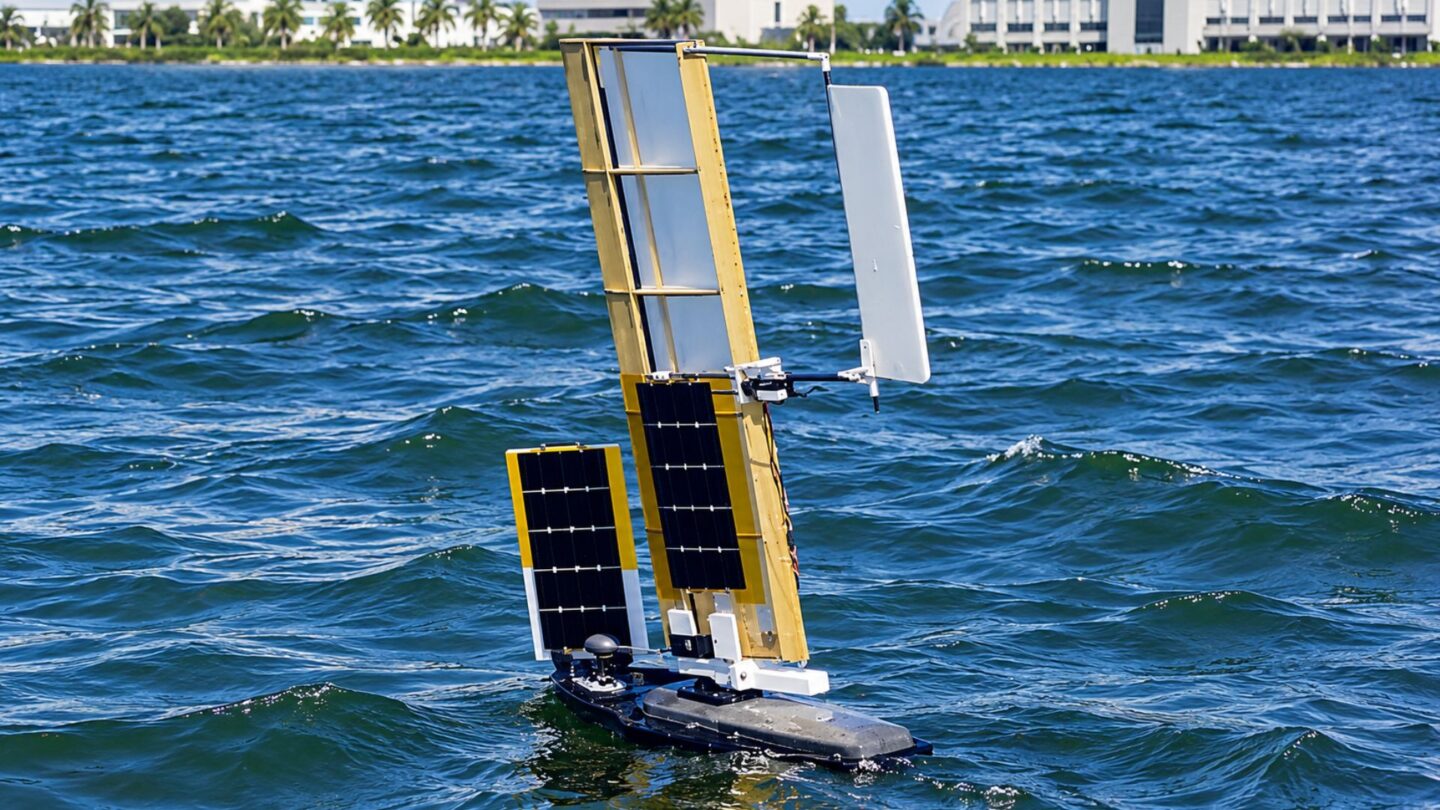
Researchers at the Singapore University of Technology and Design (SUTD) developed ALBATROSS, a lightweight drone that descends from the air, lands on water, and continues its mission as a wind-powered sailing vessel. The prototype combines aerial deployment with autonomous marine operation, offering a potential approach to collecting data in remote ocean environments.
Weighing just 1.107kg, ALBATROSS uses rigid wingsails to control its descent rather than relying on a conventional powered flight system. As it falls, the craft rotates in a controlled motion that slows it before it reaches the water. The design aims to minimise landing impact without requiring conventional landing gear.
Once it reaches the surface, the drone is designed to right itself automatically and transition into sailing mode. Wind then provides the power needed to move across the water, allowing the vehicle to operate without a dedicated propulsion system for surface travel. The researchers say the approach could enable deployment over distances exceeding 100km, although real-world performance will depend on operating conditions.
A drone that rotates before landing on water
ALBATROSS takes a different approach to moving between air and water. Rather than attempting a conventional aircraft-style landing, it uses its rigid wingsails to autorotate on descent. This motion slows the craft as it approaches the ocean, reducing the forces generated when it contacts the surface.
The technique aims to eliminate the need for additional landing equipment, which can increase a small autonomous vehicle’s weight and complexity. By incorporating descent control into the craft’s structure, the researchers aim to simplify the transition from aerial deployment to marine operation.
The SUTD research team described the intended process: “ALBATROSS is designed to be released from an aircraft or UAV, passively enter autorotation for a controlled, low-impact water landing, self-right without actuation,”
After landing, the prototype is designed to return to an upright position before beginning its sailing mission. This self-righting capability matters because the vehicle must remain operational even if it first contacts the water in an unfavourable orientation. A successful transition is necessary for the craft to move from descent to sustained surface travel.
The system uses three control actuators and three main sensors, alongside a rudder for directional control. The rudder helps guide the vehicle across the water, and its movement also contributes to propulsion. The researchers compare its action to a fish’s tail, which generates movement while helping an aquatic animal change direction.
This combination of passive descent, automatic recovery and wind-powered travel is central to the prototype’s design. Instead of carrying separate systems for powered flight and conventional marine propulsion, ALBATROSS uses its structure to manage the aerial phase and wind to support its subsequent journey.
A design focused on range and simpler deployment
One of the project’s main aims is to increase the distance an aerially deployed marine vehicle can cover without requiring a complex propulsion system. The researchers report a potential operating range of more than 100km for ALBATROSS, compared with approximately 7km reported for SailMAV, another small aerial-marine vehicle.
The figures suggest a potential range advantage, but direct comparisons depend on how each system measures range and the conditions under which it operates. Wind strength, sea conditions, deployment altitude and the vehicle’s ability to maintain its intended course can all influence its practical operating distance.
Its low weight could also make ALBATROSS easier to transport and deploy. An aircraft or uncrewed aerial vehicle could carry the prototype to a selected location, then release it over the water. This could be useful when equipment needs to reach an offshore area that is difficult to access using conventional boats.
Potential applications include environmental monitoring and deploying ocean sensors. A lightweight vehicle could carry sensing equipment to locations where researchers need to collect information about changing marine conditions. Once deployed, its ability to sail with the wind could help it cover more distance without consuming fuel for continuous surface propulsion.
The concept also differs from established autonomous sailing platforms such as Saildrone and Sailbuoy, which are designed to carry out marine missions over extended periods. ALBATROSS combines aerial delivery with sailing, potentially reducing the need to transport a small sensing platform by sea to its destination.
The SUTD team highlighted this distinction, stating: “Unlike many hybrid aerial-marine systems, ALBATROSS eliminates the need for aerial propulsion, complex mechanical reconfiguration, or active stabilisation during the air-water transition and can sail back to shore at the end of a mission.”
Removing the need for powered flight during deployment could reduce energy requirements and simplify some aspects of the system. However, aerial release still requires a suitable aircraft or UAV. At the same time, successful marine operation depends on the vehicle’s ability to land safely, recover its upright position and navigate after reaching the water.
Testing will determine its practical capabilities
Although ALBATROSS combines aerial descent and wind-powered sailing, its reported range and operating concept do not show how reliably it will perform in all marine environments. A prototype must demonstrate consistent results across different wind conditions, wave heights and deployment scenarios before its suitability for wider use can be established.
The transition between air and water is particularly important. The wingsails must produce a controlled rotation during descent, while the craft must withstand water impact and recover without damage. Its sensors, actuators and steering mechanism must also work together to maintain control once the sailing phase begins.
Wind-powered operation reduces the need for onboard propulsion energy, but it also introduces limitations. The vehicle’s movement depends on available wind and the effectiveness of its sailing configuration. Strong currents, changing weather and rough seas could affect its ability to follow a planned route or return to shore at the end of a mission.
Further testing would help establish how much equipment ALBATROSS can carry, how accurately it can navigate and how consistently it can complete its aerial-to-marine transition. These factors would determine whether the prototype could support practical ocean-monitoring tasks rather than remaining an experimental platform.
The project’s central idea is to combine two methods of movement in a single lightweight vehicle: a controlled, rotating descent through the air and wind-driven travel across the water. If the approach proves reliable beyond controlled testing, ALBATROSS could offer researchers another option for deploying marine sensors in remote locations without requiring powered flight or conventional landing equipment.