



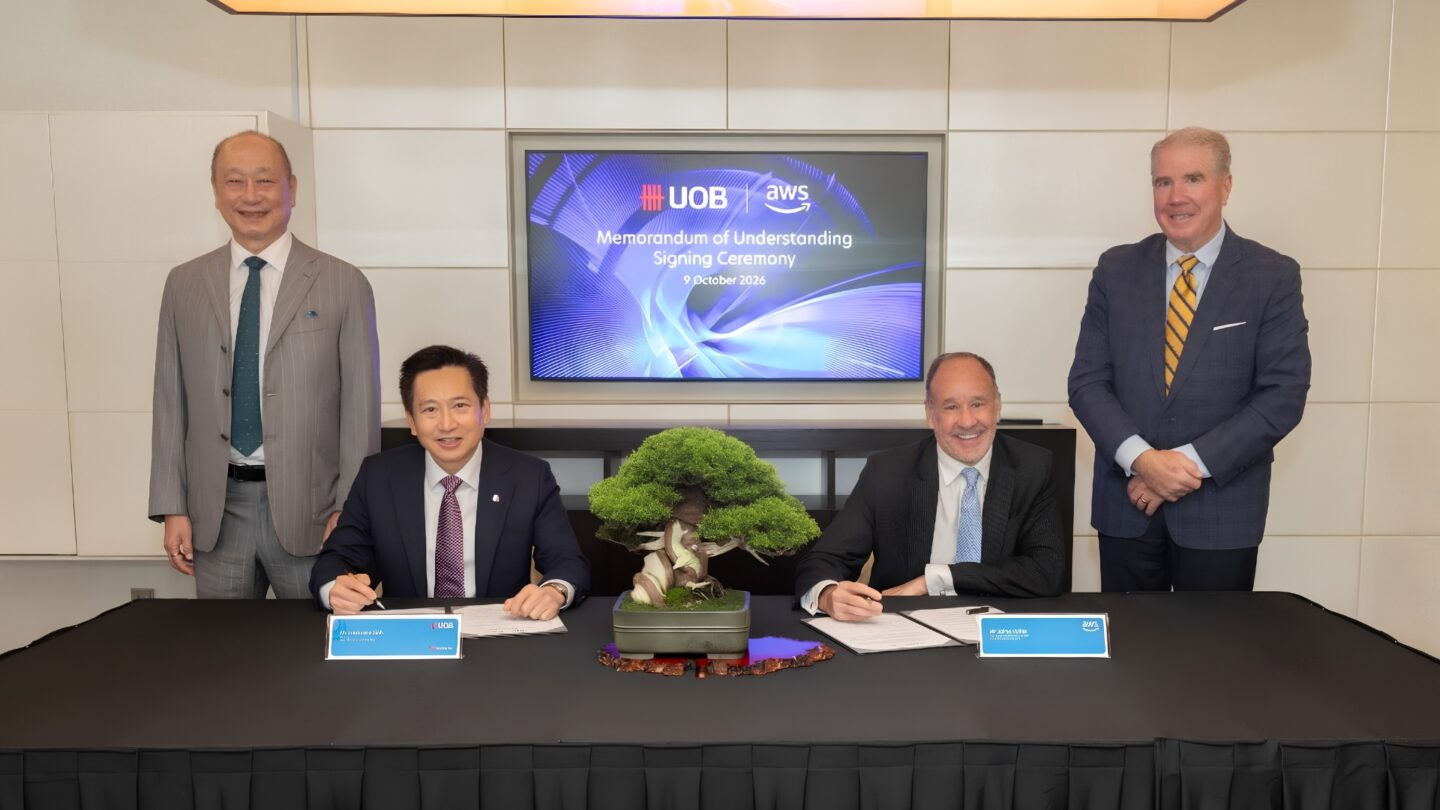
UOB and Amazon Web Services (AWS) have signed a Memorandum of Understanding (MoU) to explore a hybrid cloud infrastructure model for banking across ASEAN. Centred on a dedicated cloud environment in Singapore, the proposed arrangement is designed to meet security, governance and data residency requirements while supporting the bank’s adoption of cloud and artificial intelligence (AI) technologies.
The collaboration covers UOB’s operations in five ASEAN markets, namely Singapore, Malaysia, Thailand, Indonesia and Vietnam. Initial areas of focus include hybrid cloud architecture, data and analytics, and AI-powered customer engagement, alongside workforce training to support the development and use of these technologies.
Hybrid cloud infrastructure designed around regulatory requirements
Under the proposed model, UOB’s systems and data would operate across on-premises infrastructure and cloud environments, anchored by a dedicated cloud environment located in Singapore. Designed to meet the bank’s security, governance and data residency requirements across the five ASEAN markets, this setup would retain UOB’s data and systems within the environment, which could be configured to support compliance with the regulatory requirements of each market. The architecture would also incorporate an isolated cloud extension that could be strategically deployed in specific countries or jurisdictions to meet regulatory requirements.
Alongside dedicated infrastructure, UOB would have access to AWS cloud tools to modernise its technology infrastructure and develop capabilities in areas such as AI and data analytics. The arrangement would combine UOB’s regional banking expertise and governance framework with AWS’s cloud infrastructure, data and AI services.
According to UOB and AWS, this is the first collaboration between AWS and a bank to bring together hybrid cloud capabilities in ASEAN with security, governance and data residency controls aligned with the requirements of a highly regulated industry. The proposed architecture is intended to strengthen UOB’s operational resilience while supporting the development of new technology capabilities.
AI development to build on UOB’s existing enterprise platform
Another area of collaboration involves using AI to improve customer interactions and internal banking operations. Within this scope, UOB and AWS will explore conversational banking capabilities and more personalised customer services supported by AWS’s AI technologies.
The work would build on UOB’s existing Enterprise GenAI Platform (EGP), with the bank examining how Amazon Bedrock could support the development and deployment of generative AI applications. Amazon Bedrock is AWS’s fully managed service for building and scaling generative AI applications. Potential uses range from employee productivity tools to enterprise-grade applications deployed across the bank, and UOB will explore how Amazon Bedrock could support faster development and deployment of these solutions across its operations.
Workforce training and potential expansion of the collaboration
UOB will also explore AWS’s structured learning and enablement programmes to strengthen cloud and AI skills among its employees. The proposed training would cover cloud technologies, generative AI, data and analytics, security and compliance. These programmes are intended to help employees develop, deploy and scale cloud and AI-powered solutions responsibly, supporting UOB’s ongoing workforce transformation efforts by developing internal capabilities alongside its plans for cloud infrastructure and AI applications.
Jaime Vallés, Vice President & Managing Director for APAC at AWS, identified employee training as part of the collaboration, with a focus on improving AI fluency and cloud skills while maintaining customer data security. From UOB, Lawrence Goh, Head of Group Technology and Operations, pointed to secure and resilient infrastructure, strong governance and partnerships as requirements for the bank’s AI ambitions. He also indicated that UOB sees potential to broaden its collaboration with AWS over time and explore additional opportunities involving the wider Amazon group.