

At NVIDIA AI Day Singapore 2026, ASUS detailed a range of NVIDIA-powered AI systems spanning rack-scale infrastructure, desktop systems, edge computing and storage. Across these categories, the portfolio supports workloads including model training, inference, agentic AI and industrial automation.
For its larger data centre platforms, ASUS is using NVIDIA Vera Rubin and HGX Rubin architectures. Smaller systems complement these platforms for local model development and inference.
Rubin systems address high-density AI workloads
Built for rack-scale deployments, the ASUS AI POD XA VR721-E3 is based on the NVIDIA Vera Rubin NVL72 platform. ASUS claims that the system delivers up to 10 times the performance per watt of the previous generation, targeting high-volume AI processing and lower-cost token generation. For training, inference and post-training workloads, the XA NR1I-E12LR and XA NR1I-E12L use NVIDIA HGX Rubin NVL8. To meet the performance and efficiency requirements of high-density data centres, the XA NR1I-E12L Series supports liquid or hybrid cooling configurations.
Agentic AI workloads are addressed by the XA P2N-E2, a 2U NVIDIA MGX platform equipped with two NVIDIA Vera CPUs and support for up to two dual-slot NVIDIA GPUs. ASUS designed the system for AI reasoning, data processing and orchestration at scale.
Desktop systems support local AI development
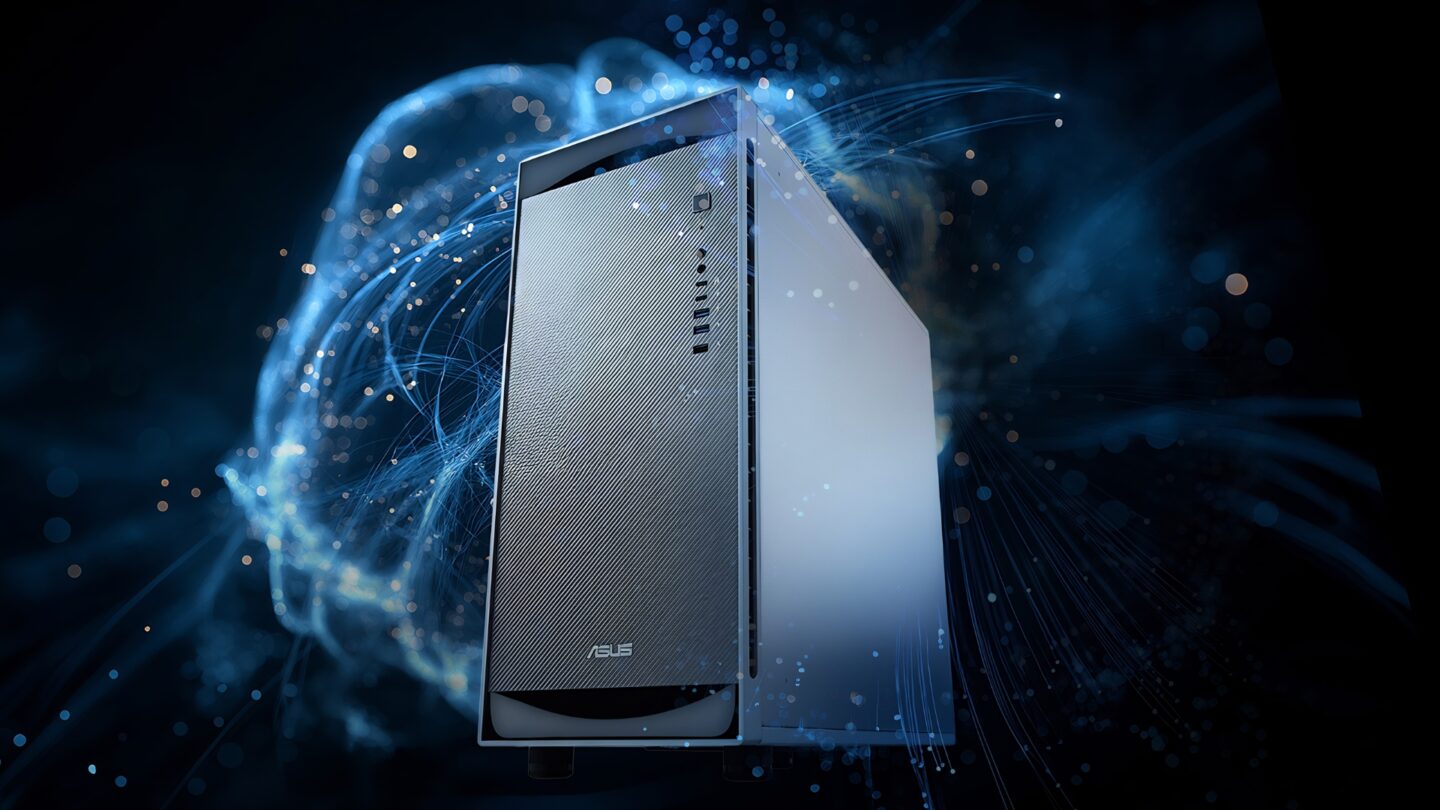
The ExpertCenter Pro ET900N G3 brings large-model development and inference into a deskside system. Built on NVIDIA DGX Station architecture, it uses the GB300 Grace Blackwell Ultra Desktop Superchip and provides up to 20 PFLOPS of AI performance with 748GB of coherent CPU-GPU memory. The smaller ASUS Ascent GX10 is based on NVIDIA DGX Spark and uses the GB10 Grace Blackwell Superchip, delivering up to 1 petaFLOP of AI performance with 128GB of unified memory in a 150 x 150 x 51 mm chassis for local model development, fine-tuning and inference. Support for NVIDIA ConnectX-7 also allows two GX10 systems to work together on larger AI models.
ProArt GR1X targets creators, developers and professionals working on Windows. Powered by NVIDIA RTX Spark, the workstation combines a 20-core NVIDIA Grace CPU with a Blackwell RTX GPU, up to 128GB of unified memory and up to 1 petaFLOP of FP4 AI performance. ASUS lists always-on local AI agents, creative workloads, AI development and advanced 3D work among its intended uses.
Edge systems extend AI processing into industrial environments
The ESC8000-E12P supports NVIDIA RTX PRO 6000 and RTX PRO 4500 Blackwell Server Edition GPUs for enterprise inference, vision AI and visual computing. In robotics and industrial automation environments, the smaller PE3000N uses NVIDIA’s Jetson Thor T5000 module to provide real-time inference, sensor fusion and autonomous control.
Storage completes the hardware portfolio. The UF920-E3-RS24 server is based on NVIDIA’s STX modular foundation for AI-native storage, operating alongside the OJ340A-RS60 object storage system and VS320D-RS26N storage system. According to ASUS, these systems are designed to meet the capacity, availability and data-management requirements of AI workloads, supporting deployments from design validation through production-scale use.
ASUS presented the portfolio at NVIDIA AI Day Singapore 2026, held from 22 to 23 September at the Raffles City Convention Centre. The event covers generative AI, agentic AI, physical AI and accelerated computing.