


ASUS has introduced the ProArt P16 (H7607BA) in Singapore, marking its first ProArt laptop powered by the NVIDIA RTX Spark superchip. Designed for creators and developers running AI workloads locally, the 16-inch laptop combines an NVIDIA Blackwell RTX GPU, up to 128GB of unified memory and a 4K OLED touchscreen.
Starting at S$6,599, the ProArt P16 is designed to run generative AI models and autonomous agents directly on the device. ASUS is pairing the new processor with creative applications and AI workflow tools, allowing users to generate content, manage media and develop customised processes using local computing resources.
NVIDIA RTX Spark supports larger local AI workloads
At the core of the system sits the NVIDIA RTX Spark N1X, which combines an NVIDIA Grace CPU, Blackwell RTX GPU and fifth-generation Tensor Cores supporting FP4 precision. Connected through NVIDIA NVLink-C2C, the architecture delivers up to one petaflop of AI computing performance, according to ASUS. All three Singapore configurations feature a 20-core CPU and a 6,144-core GPU, with memory options ranging from 48GB to 128GB of LPDDR5X unified memory to provide different capacities for running local AI models and creative applications.
Support for NVIDIA’s CUDA ecosystem is also integrated into the platform. Together with the available memory capacity, ASUS says the architecture allows users to run larger generative AI models, produce higher-resolution content and handle more complex workflows directly on the laptop.
Local processing allows creators to experiment with prompts, regenerate content and run AI agents without paying per-token or per-generation charges for cloud processing. Keeping prompts, project files, creative assets and selected models on the device can also help protect sensitive work, while compatible workflows can remain available offline. Developers also gain greater control over model selection and configuration, allowing them to customise how models behave, connect trusted applications and build repeatable workflows suited to their requirements.
Creative applications integrate local models and AI agents
Among the preloaded ProArt applications, MuseTree incorporates FLUX and WAN models for token-free local generative creation. For media management, StoryCube uses AI-powered scene recognition to help users organise, identify and manage creative assets within Windows.
Workflows involving Hermes, an open-source autonomous AI agent developed by Nous Research, are also supported on the laptop. Hermes can execute tasks across desktop applications, terminal environments and local files, with capabilities including persistent memory, isolated sandboxes and self-improving skills. Through a dedicated Hermes Skill, the agent connects with ASUS MuseTree to support AI image and video generation using FLUX and Wan models, allowing users to incorporate generative tasks into workflows managed by the agent.
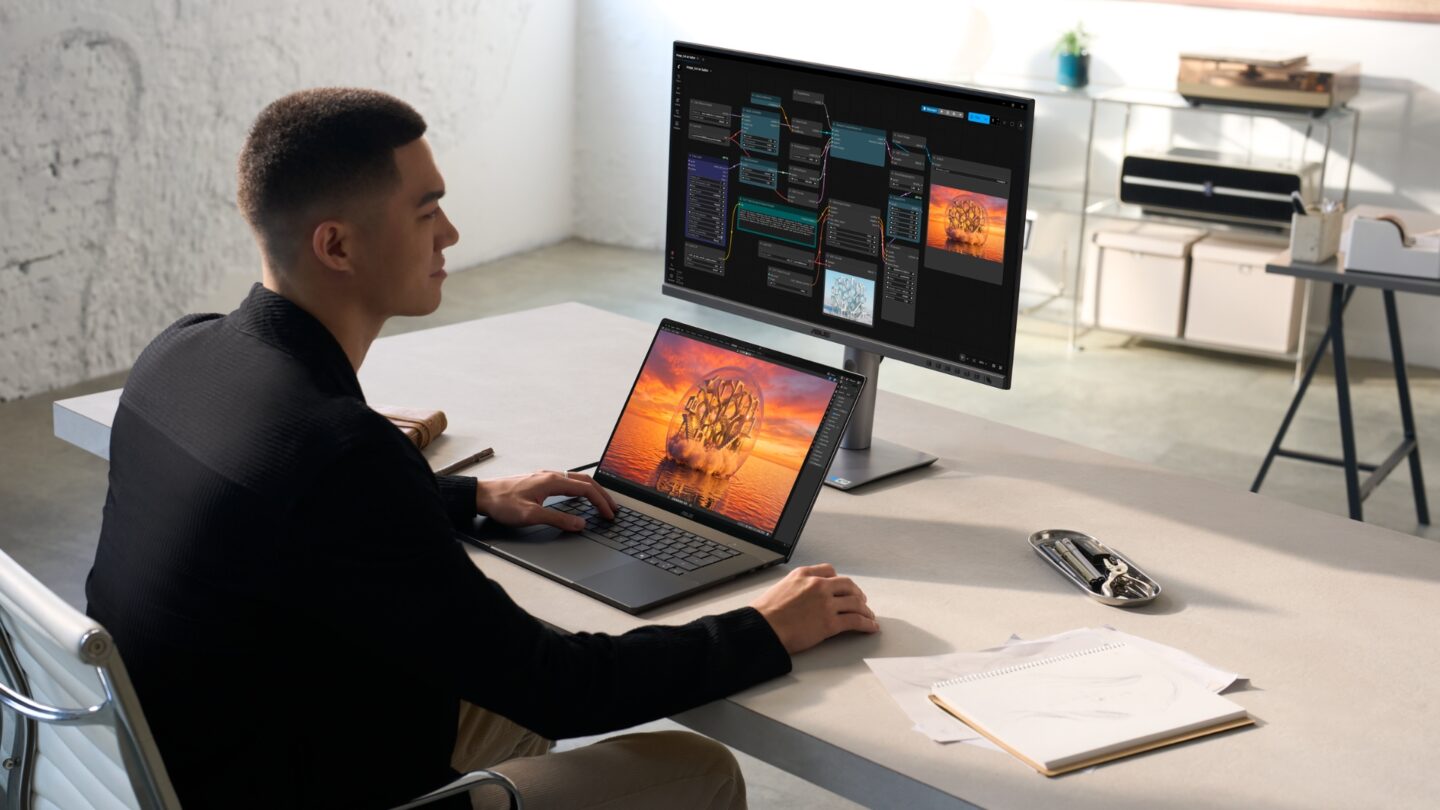
ASUS has also partnered with ComfyUI, an open-source platform for visual AI workflows. Its validated workflows and resource packs support image and video generation on ProArt laptops, while its agent-ready design allows assistants such as Hermes to build and execute workflows for users. ComfyUI’s community also contributes additional models and tools to the platform.
For everyday productivity, ASUS is introducing Zenni Claw, its native AI assistant designed to work more closely with ASUS applications and devices to handle daily tasks, content management and device controls. The ProArt P16 combines these local AI capabilities with cloud-based creative services. ASUS is offering Adobe Creative Cloud bundles and Google AI Pro offers, with the Google AI bundle available on eligible models.
4K OLED display and slimmer chassis for creators
On the visual side, the ProArt P16 features a 16-inch ASUS Lumina Pro OLED touchscreen with a 3840 × 2400 resolution and 16:10 aspect ratio. The panel supports a 120Hz refresh rate, 0.2ms response time, 100% DCI-P3 colour gamut and 1.07 billion colours, alongside PANTONE Validated status and VESA DisplayHDR True Black 1000 certification. Stylus support is included for users working directly on the touchscreen, while the available configurations offer different brightness specifications. The 48GB and 128GB models support up to 1,600 nits of peak HDR brightness and feature an anti-reflection coating, whereas the 64GB configuration has a lower peak HDR brightness rating of 1,100 nits, although all three retain the same 4K resolution and 120Hz refresh rate.
Beyond the display, ASUS has reduced the size and weight of its 16-inch ProArt design. The CNC-manufactured Nano Black chassis measures 12.9mm at its thinnest point and weighs 1.77kg, making it 14% thinner and 9% lighter than the previous generation, according to the company. A 99.9Wh battery supports portable use, with a 140W USB-C power adapter supplied, while a precision haptic touchpad is designed to provide responsive tactile feedback.
Physical connectivity options include three USB4 Type-C ports supporting data transfer speeds of up to 40Gbps, HDMI 2.1, a USB 3.2 Gen 2 Type-A port, a 3.5mm audio jack and an SD Express 7.0 card reader, with wireless connections handled through Wi-Fi 7 and Bluetooth 5.4. Other specifications include a Full HD infrared camera supporting Windows Hello, built-in speakers and an array microphone. All three Singapore configurations run Windows 11 Home and include a 1TB PCIe 4.0 NVMe SSD.
Singapore pricing and configurations
ASUS will offer three ProArt P16 configurations in Singapore, differentiated by their installed memory and certain display specifications. The base H7607BA-SE265W model features 48GB of LPDDR5X unified memory and 1,600 nits of peak HDR brightness for S$6,599. Moving up the lineup, the H7607BA-SE409W configuration provides 64GB of LPDDR5X unified memory with 1,100 nits of peak HDR brightness at S$7,499, while the top-tier H7607BA-SE049W combines 128GB of LPDDR5X unified memory and 1,600 nits of peak HDR brightness for S$11,099.
The 64GB configuration carries a lower peak HDR brightness rating than either the 48GB or 128GB version, despite its position between them on price. The ASUS ProArt P16 will be available from 30 October through the ASUS Online Store and authorised retailers across Singapore.