



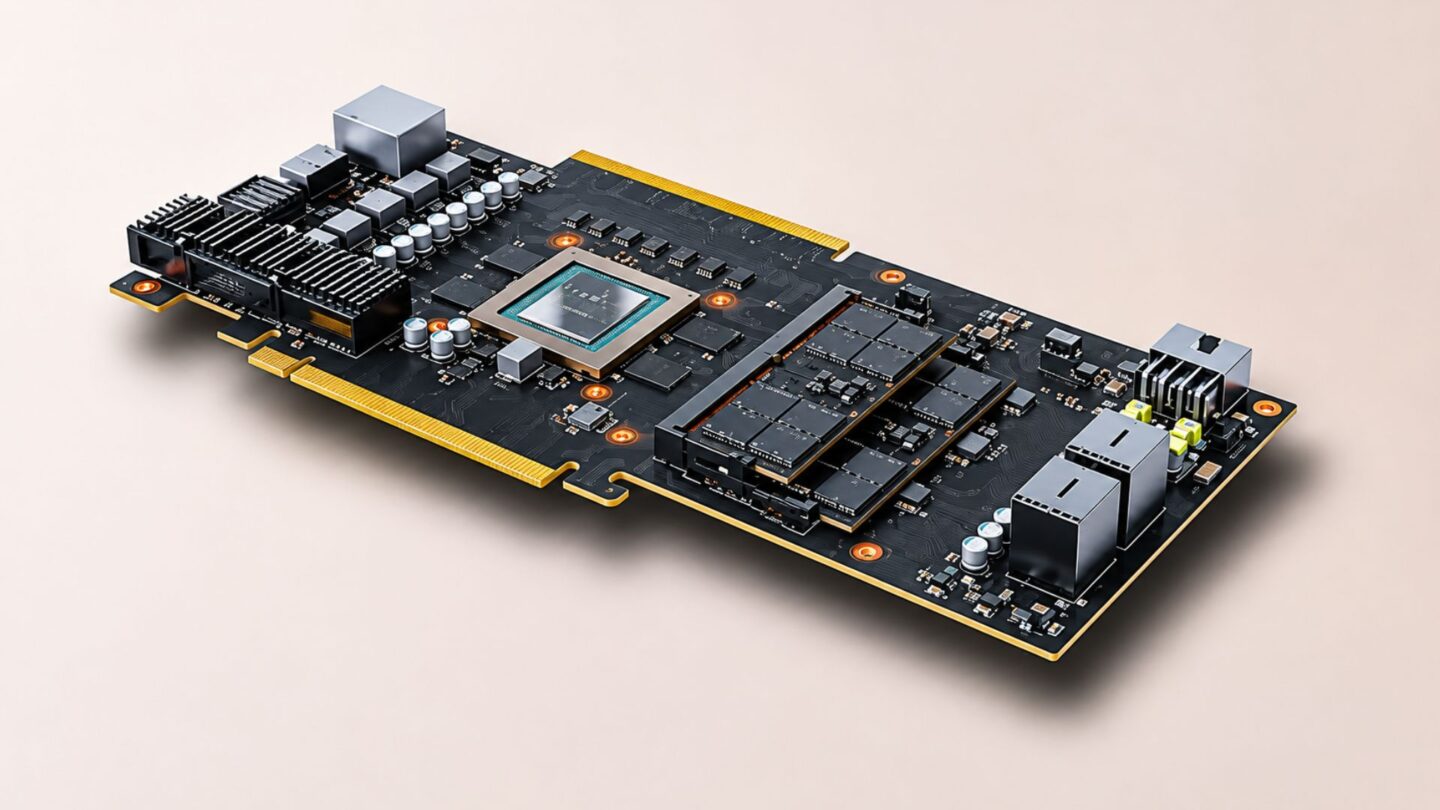
Bolt Graphics has powered on the first silicon for its upcoming Zeus GPU, marking an important step in developing its planned graphics processor. The California-based startup confirmed that its initial test chip operated as expected after being switched on in October. However, the commercial version of Zeus is still several years away from mass production.
The milestone comes as Bolt prepares to establish closer ties with its manufacturing partners and secure funding for its ambitions in the graphics processing market. The company is targeting volume production in 2028, positioning Zeus as a potential alternative to established GPU manufacturers such as Nvidia and AMD.
The first test chip was manufactured using TSMC’s 12nm process and measures just 6mm². According to Bolt, it consumes 1.4 watts of power, a considerable reduction compared with the 35 watts required by the field-programmable gate array (FPGA) previously used to test its design.
The development also coincides with reports that Bolt is seeking approximately US$100 million in additional investment. Reuters reported on 16 October that the company was pursuing the funding at a valuation of around US$700 million, citing three people familiar with the matter.
Bolt has also opened an office in Taipei, Taiwan, allowing it to work more closely with its manufacturing partners as development progresses towards commercial production.
First Zeus silicon demonstrates dedicated physics processing capabilities
The initial test chip focuses on a specialised function that sets Bolt’s technology apart from conventional graphics processors. It contains dedicated hardware designed to accelerate electromagnetic simulation, a type of computing used to develop technologies such as radar sensors, camera lenses, and other advanced electronic systems.
Electromagnetic simulation requires significant computing resources because it involves modelling how electromagnetic waves interact with different materials and objects. By developing specialised hardware for these calculations, Bolt aims to reduce processing times and improve efficiency compared with conventional computing approaches.
The successful activation of the test chip demonstrates that the company’s hardware design can execute its intended workloads outside a software-based or programmable prototype environment. It also represents an important step toward validating the architecture before developing the larger Zeus GPU.
Bolt Graphics founder and chief executive Darwesh Singh told HPCwire that the achievement demonstrates the potential of its approach. He said the chip shows Bolt can run “a highly complex physics algorithm, accelerated in hardware, which no one’s done before.”
However, the company has not released detailed performance figures for the test chip. Bolt said its results exceeded internal expectations but has yet to provide independent benchmarks or comparisons against competing processors.
The 12nm test chip should not be confused with the final Zeus GPU. The commercial processor will be a separate design manufactured using TSMC’s N5P process, which uses a significantly more advanced manufacturing technology.
Bolt said it selected the N5P manufacturing process partly to avoid competing directly with other chipmakers for limited supplies of the latest semiconductor production capacity. Although N5P is not the newest available technology, the company believes it can provide a suitable foundation for its planned GPU architecture.
The transition from the smaller test chip to the full Zeus processor will still require substantial engineering work, validation and manufacturing preparation. The company has therefore set 2028 as its target for volume production rather than suggesting that the successful test represents an imminent commercial launch.
Zeus combines RISC-V processors with specialised rendering hardware
Bolt’s Zeus GPU is built around RISC-V processor cores, which use an open-standard instruction set that lets developers build customised processor architectures. These cores will work alongside Bolt’s proprietary path-tracing hardware, which is intended to accelerate complex lighting and rendering calculations.
One of the more unusual aspects of the planned graphics cards is their memory configuration. Rather than relying exclusively on conventional graphics memory, Zeus PCIe cards will combine soldered LPDDR5X memory with DDR5 SO-DIMM slots, similar to those commonly found in laptops.
This approach is intended to give users the flexibility to expand memory according to their computing needs. Bolt says the cards will support up to 384GB of memory, potentially making them suitable for workloads involving large datasets, complex simulations and demanding rendering projects.
When Bolt first introduced Zeus in March 2025, it made ambitious performance claims. The company said its GPU could deliver up to 10 times the rendering performance of existing graphics processors and achieve up to 300 times the speed in electromagnetic simulation.
Bolt also claimed that Zeus could provide up to 10 times the path-tracing throughput of Nvidia’s GeForce RTX 5090. Path tracing is an advanced rendering technique that simulates the movement and interaction of light rays to produce realistic lighting, reflections and shadows. Its performance depends heavily on how many light rays a graphics system can process within a given period.
These figures remain company-provided estimates and have not been independently verified. Actual performance will depend on the final hardware, software optimisation, supported applications and real-world workloads.
The company is initially targeting professional users, including engineering firms, scientific researchers and creative studios. Its longer-term plans include entering the gaming and artificial intelligence markets, which would place Zeus in more direct competition with Nvidia and AMD.
However, entering the gaming market presents additional challenges beyond developing competitive hardware. Graphics processors must support a broad software ecosystem, including drivers, development tools and compatibility with thousands of existing games. Building that level of support could prove difficult for a new manufacturer without the established software infrastructure of its larger competitors.
Bolt targets professional markets as it prepares for commercial launch
Bolt has previously reported considerable interest in the Zeus project. In April, the company said more than 14,000 businesses, developers and individual users had registered for its early access programme.
It also announced that its product pipeline was worth more than US$500 million, suggesting potential demand across several professional computing markets. However, Bolt did not identify any customers or disclose how much of that pipeline represented confirmed orders rather than prospective business opportunities.
The company also claimed that Zeus could reduce computing costs by up to 17 times compared with existing hardware. If achieved, such savings could make specialised graphics processing more accessible to organisations that rely on expensive computing infrastructure.
For industries such as scientific research, engineering and advanced product design, faster simulations could help reduce development time and the resources required to test complex systems. This could be particularly valuable in applications where conventional processors and graphics cards struggle with computationally demanding workloads.
Nevertheless, Bolt still faces significant hurdles before it can establish itself as a serious competitor in the GPU industry. It must demonstrate that its architecture delivers the promised performance, secure sufficient manufacturing capacity and build the software support needed to attract professional users.
The successful activation of the first Zeus test chip shows the company has moved beyond its earlier prototyping stage. However, it does not yet establish how the final graphics processor will perform against products from established manufacturers.
With volume production targeted for 2028, Bolt has time to refine its technology and prepare its manufacturing operations. The next major test will be whether the company can turn its ambitious performance claims into a commercially viable product that delivers measurable advantages for its intended customers.