

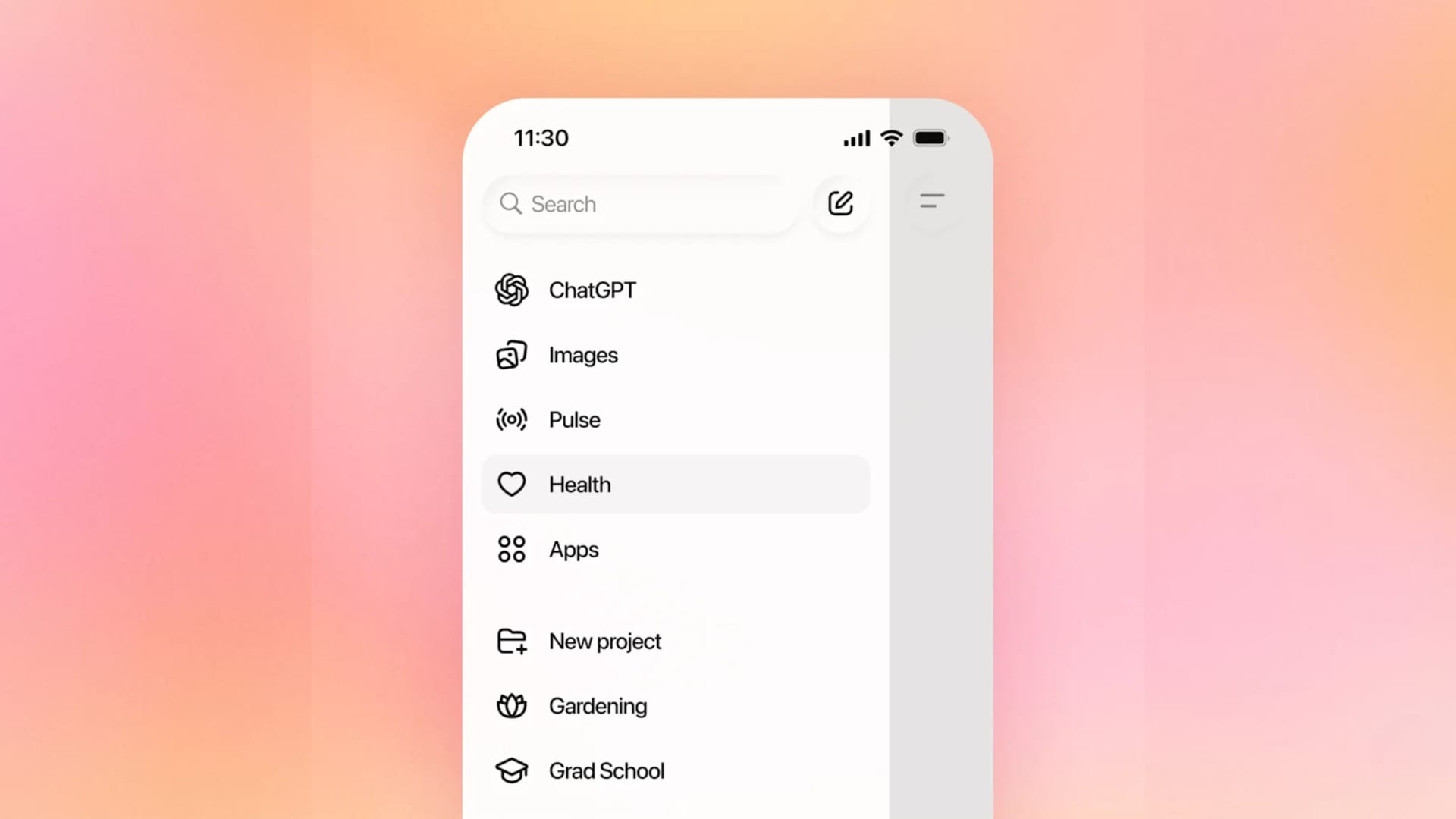
OpenAI has introduced ChatGPT Health, a dedicated experience within ChatGPT designed to help users better understand and manage their health and wellness. The new offering brings together personal health information and ChatGPT’s conversational capabilities in a separate, secure environment, with the aim of helping people feel more informed, prepared, and confident when navigating healthcare decisions.
Health and wellness already represent one of the most common use cases for ChatGPT. According to de-identified internal analysis, more than 230 million people worldwide ask health-related questions on the platform each week. ChatGPT Health builds on this behaviour by allowing conversations to be grounded in a user’s own health data, while adding additional layers of privacy and security tailored specifically for sensitive medical information.
The experience has been developed to support, rather than replace, professional medical care. It is not intended for diagnosis or treatment, but instead focuses on helping users interpret information, recognise patterns over time, and prepare for discussions with clinicians. OpenAI says the goal is to make everyday health information easier to understand and to reduce the complexity people often face when dealing with fragmented healthcare systems.
Bringing health information into one secure space
Health information is often spread across multiple portals, apps, wearables, documents, and clinical notes, making it difficult for individuals to see a complete picture of their wellbeing. ChatGPT Health addresses this by creating a single, dedicated space within ChatGPT where users can connect medical records and wellness apps to inform conversations.
Through these integrations, users can ask questions about recent lab results, prepare for upcoming medical appointments, review trends in fitness or nutrition data, or explore lifestyle changes such as diet and exercise routines. The system can also help users understand trade-offs between different insurance options, based on their healthcare patterns and needs.
ChatGPT Health operates separately from standard ChatGPT conversations. Health chats, connected apps, and uploaded files are stored in an isolated environment with separate memories. While health conversations remain visible in a user’s chat history for easy access, the information itself stays contained within the Health space. Data from Health is not shared back into non-Health chats, and conversations outside of Health cannot access Health-specific files or memories.
In certain cases, non-Health context such as a recent relocation or lifestyle change may be used to make a health-related response more relevant. However, OpenAI states that Health data never flows back into general chats, maintaining a one-way boundary designed to protect sensitive information. Users can review or delete Health memories at any time through Health or the personalisation settings.
Privacy, security, and data controls by design
Given the sensitive nature of health data, OpenAI has placed privacy and security at the centre of the Health experience. All ChatGPT conversations are encrypted by default, both at rest and in transit. ChatGPT Health builds on this foundation with additional, purpose-built encryption and isolation designed specifically for health-related conversations.
Importantly, conversations within Health are not used to train OpenAI’s foundation models. This policy is intended to give users greater confidence when sharing personal medical details. Users can also strengthen account security by enabling multi-factor authentication, adding another layer of protection against unauthorised access.
When users choose to connect medical records, responses are grounded in their own health information. In the United States, OpenAI partners with b.well, a large network for connected health data, to enable secure access to participating healthcare providers. Users remain in control and can remove access to their medical records at any time through the app settings.
In addition to medical records, users can connect Apple Health and other wellness apps such as Function and MyFitnessPal, with explicit permission required for each connection. Even if an app is already linked to ChatGPT outside of Health, it must be authorised again for use within the Health space. All apps included in Health are required to meet OpenAI’s privacy and security standards, collect only the minimum data needed, and undergo additional security reviews. Users can disconnect any app at any time, immediately revoking its access.
Built with clinicians and focused on real-world use
ChatGPT Health has been developed in close collaboration with physicians worldwide. Over the past two years, more than 260 doctors across 60 countries and dozens of medical specialties have contributed to its development. This group has provided feedback on model outputs over 600,000 times, helping shape how the system communicates, prioritises safety, and determines when to encourage follow-ups with healthcare professionals.
This clinician input is embedded directly into the model that powers Health and is evaluated using HealthBench, an assessment framework created with practising physicians. Rather than relying on exam-style questions, HealthBench uses physician-written rubrics that reflect how clinicians judge quality in real practice, focusing on safety, clarity, appropriate escalation of care, and respect for individual context.
As a result, the system is designed to perform well on practical tasks such as explaining lab results in plain language, summarising care instructions, preparing questions for medical appointments, and interpreting data from wearables and wellness apps. OpenAI positions this evaluation-driven approach as key to ensuring that the experience remains trustworthy and clinically responsible.
Access to ChatGPT Health is initially being rolled out to a small group of early users, with a waitlist available for those interested. Users on Free, Go, Plus, and Pro plans outside the European Economic Area, Switzerland, and the United Kingdom are eligible during this early phase. OpenAI plans to expand availability more broadly on web and iOS in the coming weeks, with some medical record integrations and apps currently limited to the United States.