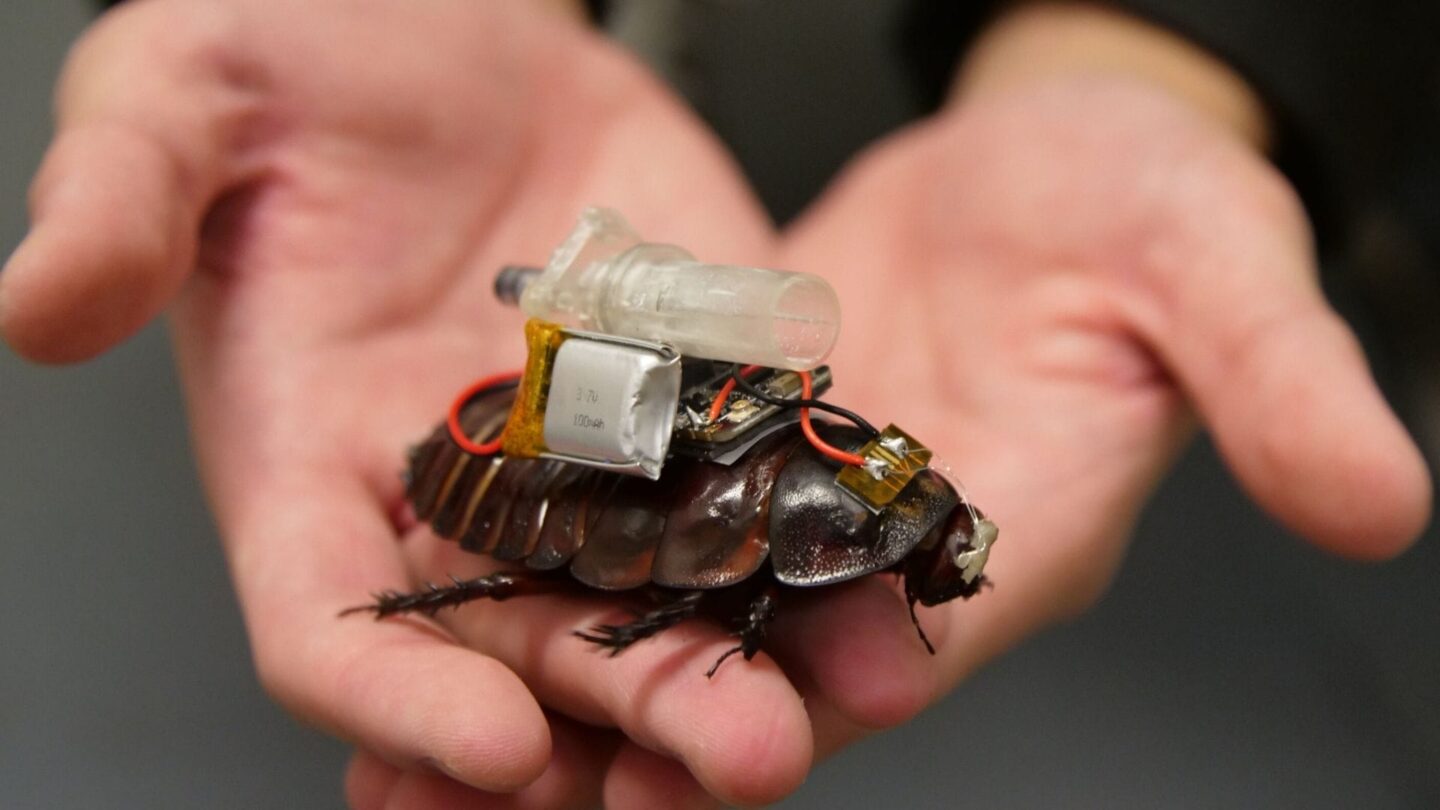
Researchers in Australia are developing cyborg cockroaches that could one day help emergency teams reach people trapped in collapsed buildings, caves, and other hard-to-access locations. The small robotic systems combine living insects with lightweight electronics, allowing the animals to move through spaces that may be too narrow or dangerous for conventional rescue equipment.
The project is being developed through collaboration between researchers at the University of Queensland and the University of New South Wales (UNSW). The team has equipped live cockroaches with miniature technology designed to support navigation and potentially deliver emergency assistance to people who cannot be reached directly.
Tiny machines designed for difficult environments
The researchers developed a system that uses the cockroaches’ natural ability to move through confined and uneven environments. The insects are fitted with electrode harnesses and compact electronic equipment while sedated. According to the researchers, the cockroaches survived the process without apparent harm, allowing their existing movement capabilities to be combined with robotic control.
The technology is intended for situations where rubble, debris or other obstacles make it difficult for conventional search-and-rescue equipment to reach survivors. Rather than replacing emergency workers, the cyborg insects could potentially operate as small mobile platforms capable of entering spaces where larger machines cannot travel.
“Augmenting their natural biomechanics could allow these cyborg insects to deliver timely emergency assistance when direct access to people trapped in narrow, debris-filled spaces isn’t possible,” said Thang Vo-Doan, a biorobotics engineer at the University of Queensland.
In controlled testing, the researchers guided the cyborg insects to a designated location and carried out a close-range delivery with a reported success rate of 95 per cent. However, the results became less reliable when the entire process was assessed, including movement towards the target, accurate positioning and the final injection.
When all three stages were considered together, the overall success rate fell to 72 per cent across the trials. The difference highlights one of the project’s main challenges: getting the insect to the correct location is only part of the task. It must also stop in the right position and remain sufficiently stable to perform a precise action.
Navigation remains a major challenge
Hai Nhan Le, a PhD candidate at the University of Queensland, said accurate insect control remains one of the most difficult aspects of the technology. A rescue system would need to guide the insect through an unpredictable environment before ensuring that it was positioned correctly near a person requiring assistance.
“The cyborg insect has to navigate to the target, position itself accurately and remain stable enough to perform the injection,” said Le.
That combination of movement and precision could become particularly challenging in real disaster environments. Collapsed buildings can contain shifting materials, dust, broken structures and narrow passages, all of which could interfere with navigation. Laboratory demonstrations therefore represent an early stage, not proof that the technology is ready for emergency deployment.
The researchers also recognise that the proposed rescue system could present an unusual obstacle. Cockroaches are widely regarded as unpleasant or frightening, and a large insect approaching a trapped survivor could cause additional distress.
“A lot of people might not like the sight of a giant cockroach scurrying towards them, but if you’re trapped in rubble or stuck in a cave and need help, it could make a real difference between life and death,” Le added.
The practical value of the technology could ultimately depend on how it performs when conditions are far less predictable than those found in controlled experiments. Reliability, safety and the ability to operate around injured or distressed people would all need to be demonstrated before the system could be considered for real rescue operations.
Emergency teams see potential for future use
Emergency services have also expressed interest in using cyborg insects as another tool for search-and-rescue operations. Tim Hassiotis, superintendent at Fire and Rescue NSW, said the technology could potentially help responders access locations that conventional equipment cannot reach.
“If cyborg insects can safely enter spaces we can’t, locate casualties and ultimately help deliver emergency care, they could become another valuable tool in the future of urban search and rescue,” said Hassiotis.
The researchers envision a future system involving groups of specialised cyborg insects rather than relying on a single animal. Different insects could potentially be assigned different tasks, creating a distributed rescue system capable of supporting emergency workers in complex environments.
Vo-Doan said the project could eventually lead to specialised insect-based rescue teams operating alongside conventional emergency services. “Hopefully, within the next five to 10 years, we could see cyborg insect rescue teams deployed to help people in real emergencies,” he said.
That timeline remains dependent on significant further development. The technology would need to undergo additional testing to establish whether the insects can reliably navigate real disaster sites and perform their intended functions. Researchers would also need to address questions around safety, regulation and how such systems could be integrated into established emergency procedures.
Public acceptance could become another important consideration. While the prospect of a cockroach delivering assistance may seem unsettling, the researchers argue that its ability to enter tight spaces could provide a useful advantage when conventional rescue methods are limited. For people trapped beneath rubble or inside confined environments, the potential benefit could outweigh the unusual nature of the technology.
The project remains at the research and testing stage, but it demonstrates how biological systems could be combined with electronics to create new approaches to emergency response. If the remaining technical and practical challenges can be addressed, cyborg insects could eventually become part of a wider range of tools available to rescue teams.