

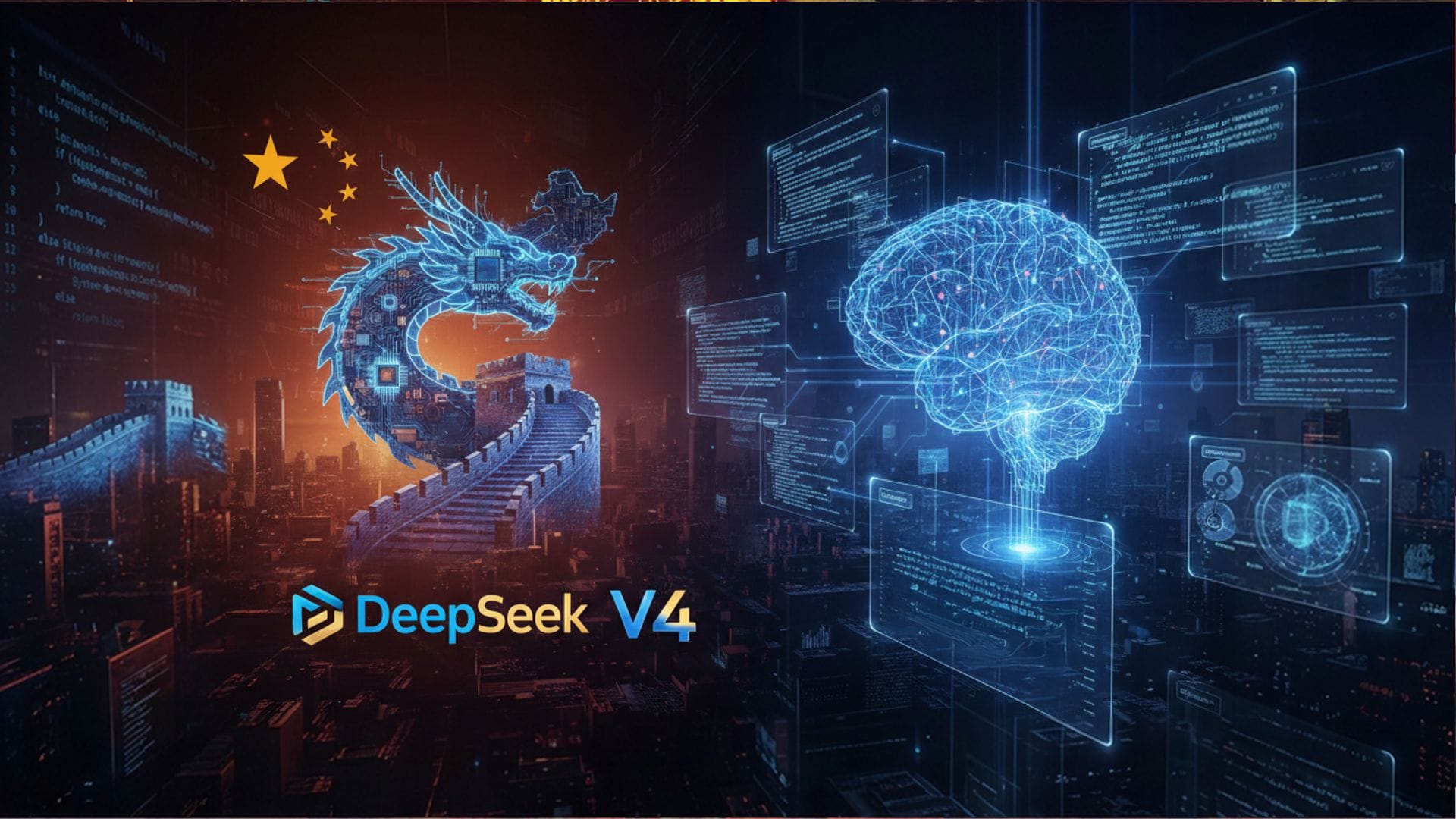
DeepSeek has unveiled two new artificial intelligence models, V4 Pro and V4 Flash, positioning them as significant upgrades that improve reasoning and support longer conversations. The announcement comes just over a year after the company gained global attention when its chatbot application became the most downloaded free app on the Apple App Store in the United States.
The company highlighted what it described as a major technical leap in context length, which determines how much information an AI system can retain during interactions. In its official statement, DeepSeek said, “Welcome to the era of cost-effective 1 million context length,” signalling its ambition to compete directly with leading global AI developers.
🚀 DeepSeek-V4 Preview is officially live & open-sourced! Welcome to the era of cost-effective 1M context length.
— DeepSeek (@deepseek_ai) April 24, 2026
🔹 DeepSeek-V4-Pro: 1.6T total / 49B active params. Performance rivaling the world's top closed-source models.
🔹 DeepSeek-V4-Flash: 284B total / 13B active params.… pic.twitter.com/n1AgwMIymu
Context length refers to the maximum number of tokens, or units of text, that an AI system can remember at any one time. A longer context window allows the system to maintain more consistent conversations, particularly in extended interactions involving complex instructions or detailed content. Rival systems, such as those developed by OpenAI, have also expanded their capabilities, with their GPT-5.5 model offering context windows ranging from 400,000 to one million tokens.
Focus on reasoning and open-source accessibility
DeepSeek emphasised that its new models continue to follow an open-source approach, allowing developers to download the underlying code and modify it according to their needs. This strategy contrasts with many competing AI systems that operate under closed-source frameworks, where internal mechanisms remain inaccessible to external developers.
The V4 Pro model is described as the flagship offering, with DeepSeek claiming it includes enhanced agentic capabilities. Agentic systems are designed to carry out multi-step tasks independently, often coordinating several processes without continuous user input. The company stated that V4 Pro delivers reasoning performance that rivals leading closed-source systems currently available in the market.
DeepSeek also suggested that its model ranks highly in overall knowledge performance. According to the company, V4 Pro trails only the advanced Gemini-3.1-Pro model developed by Google DeepMind in terms of rich world knowledge. Such claims indicate the company’s intent to position its models among the most capable AI systems currently in use.
The second model, V4 Flash, is intended to serve users who prioritise speed over maximum processing power. While it does not match the full capabilities of V4 Pro, DeepSeek said V4 Flash delivers faster responses while maintaining reasoning abilities that closely approach those of its more powerful counterpart. The company also stated that the Flash version performs on par with V4 Pro in simpler agent-based tasks, suggesting it may be suitable for everyday automation workloads.
Performance positioning and competitive landscape
The release of the V4 models reflects intensifying competition within the global AI sector, where companies are racing to deliver systems capable of handling more complex reasoning tasks while maintaining efficiency. Developers and enterprise users increasingly rely on AI tools to support research, software development, content generation, and decision-making.
DeepSeek’s emphasis on reasoning performance highlights an industry-wide trend in which raw text generation capability is no longer sufficient. Instead, companies are focusing on building systems that can analyse problems, follow instructions over multiple steps and produce logically consistent outputs. The introduction of long context windows plays a key role in enabling these functions, particularly for professional applications that require sustained accuracy across lengthy documents.
The open-source nature of DeepSeek’s models may also influence adoption among developers seeking flexibility and transparency. By allowing external users to modify its software, the company may encourage wider experimentation and integration into specialised systems. However, this openness may also introduce additional scrutiny, particularly in markets where regulatory oversight of AI technologies continues to evolve.
Industry analysts have noted that the combination of high reasoning capability and extended memory capacity could position DeepSeek as a credible challenger to established providers. Nevertheless, independent testing and real-world deployments will likely determine whether the models perform as effectively as claimed in promotional materials.
Security concerns and regulatory scrutiny
Despite its technical progress, DeepSeek continues to face regulatory challenges in several regions. Shortly after the company’s app rose to the top of the download charts in the United States, authorities imposed restrictions on its use in government environments. The software was banned from use by US federal agencies and from installation on government-owned devices.
Officials cited national security concerns as the primary reason for the restrictions. Authorities expressed concern that the technology could pose risks to data security or expose information. Some policymakers also raised concerns about the potential impact of foreign-developed AI tools on domestic technology industries, particularly those linked to publicly traded AI companies.
Regulatory caution has not been limited to the United States. In South Korea, downloads of the DeepSeek application were temporarily paused due to concerns about privacy. Local authorities reviewed whether the platform met national standards for handling user data and safeguarding sensitive information.
Such regulatory actions illustrate the growing importance of trust and transparency in the global AI market. As AI systems become more deeply integrated into government and commercial operations, oversight bodies are increasingly evaluating the risks associated with large-scale data processing and automated decision-making.
DeepSeek’s continued development of new models suggests that it intends to maintain its presence in the rapidly evolving AI landscape. However, the company’s ability to expand internationally may depend not only on technological performance but also on its capacity to address privacy, security and regulatory expectations in different regions.