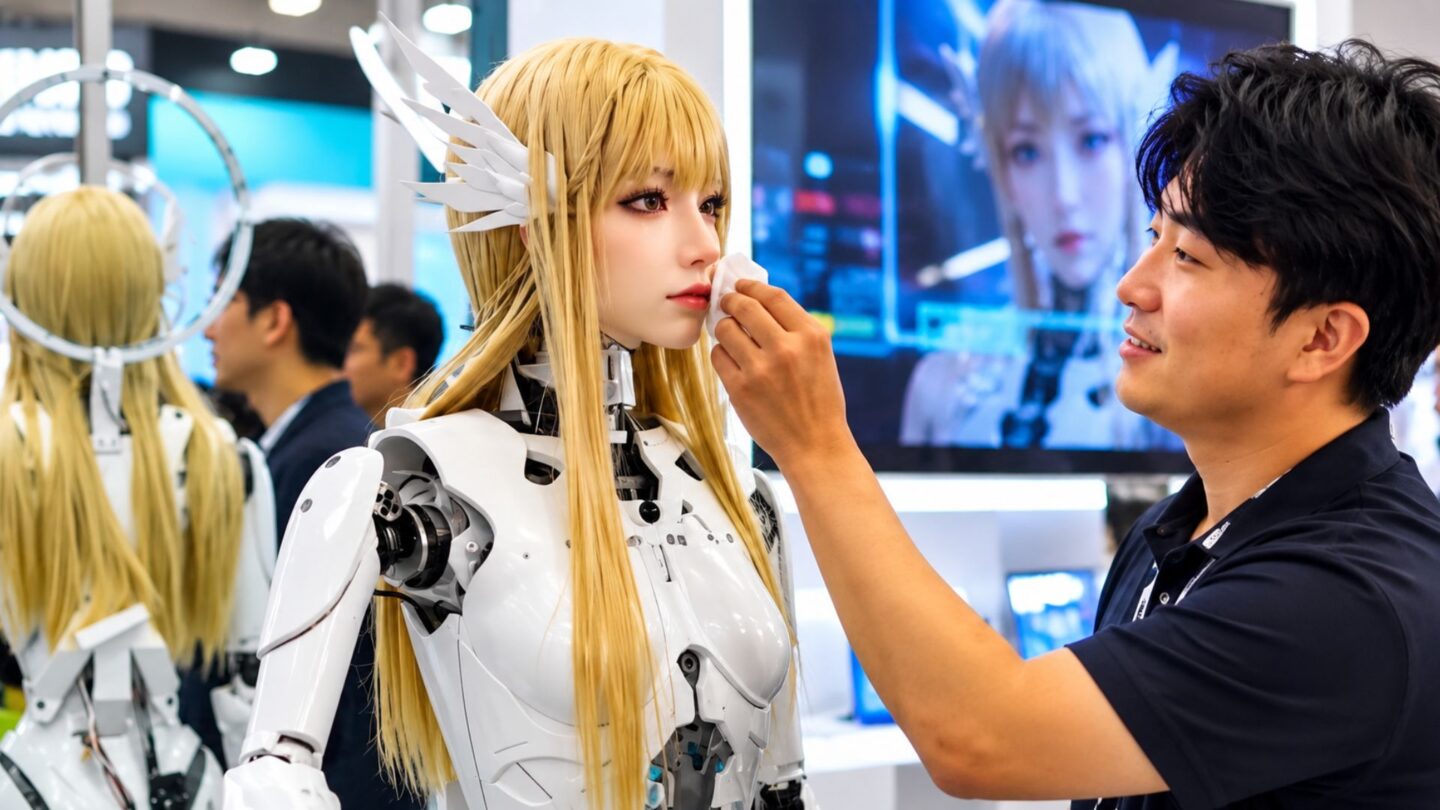
Humanoid robots are becoming increasingly capable of reproducing human-like behaviour, from holding conversations and making facial expressions to performing physical tasks. The latest example is the Yansyn-X2, a humanoid robot that has attracted attention for an unusual ability: producing tears on command.
Footage from the 2026 Inclusion Conference in Shanghai shows a demonstrator asking the robot, “Can you shed tears for me?” Moments later, a single tear appears to roll down the robot’s face. The demonstration highlights advances in robotics and artificial intelligence, while also raising questions about how closely machines should imitate human emotional behaviour.
Yansyn-X2 uses AI and microfluidics to produce tears
Yanxi Technology, a Chinese robotics company based in Ningbo, developed the Yansyn-X2. According to the company, the robot uses a three-layer system to create its emotional responses. Its AI first analyses the context and tone of a conversation to determine whether an emotional reaction is appropriate.
When the system identifies language associated with sadness or empathy, it can activate bionic components beneath the robot’s medical-grade silicone face. These components change the robot’s facial expression to create a sad appearance. A separate microfluidic system then releases liquid from the corner of its eye, producing the appearance of a tear.
The current Yansyn-X2 is primarily a stationary demonstration model rather than a fully mobile humanoid. It can turn its head, follow people and move its arms, but its facial system is the main focus of the demonstration. Yanxi Technology has indicated that future versions could replace conventional servo motors with bionic muscles, potentially allowing for smoother and more varied facial movements.
The technology is part of a wider research effort known as affective computing, which focuses on enabling machines to recognise, interpret and respond to human emotions. The objective is not necessarily to make robots genuinely experience emotions, but to make interactions between people and machines feel more natural.
Research has also examined how a robot’s facial expressions can affect people’s reactions. A 2023 study published in Frontiers found that robots whose facial expressions matched the emotional tone of a conversation were rated as more likeable, trustworthy and human-like than robots with no expressions or expressions that did not match the conversation.
Humanoid robots are becoming more capable
The Yansyn-X2 is one example of how quickly humanoid robotics is expanding. Companies are developing machines for household chores, industrial work, transport and other practical applications, while researchers are also exploring ways to make robots communicate and behave more naturally around people.
Several humanoid and human-inspired machines were demonstrated at CES 2026. LG’s CLOiD, for example, was shown performing household tasks such as folding and sorting laundry. WIRobotics demonstrated Allex, which can hold objects weighing up to 6.6lb while using recognisable hand gestures. SwitchBot’s Onero H1 was also designed around household tasks, including loading a washing machine.
Other developments have focused on physical performance. At the second annual World Humanoid Robot Games in Beijing, the Tiangong Ultra reportedly completed a 100-metre sprint in 9.39 seconds, faster than Usain Bolt’s official human world record of 9.58 seconds. The comparison shows progress in robotic movement, although the machines and conditions differ from those used in human athletics.
Humanoid robots are also being considered as a response to labour shortages. Japan Airlines began testing an android baggage handler at Haneda Airport in May, with the technology intended to support airport operations as Japan faces a shrinking workforce.
Meanwhile, 1X has been developing NEO, a home robot priced at US$20,000, designed to learn household tasks. The system is expected to rely on human teleoperators during its early stages, allowing people to assist with tasks remotely through the robot’s cameras.
The push towards more human-like machines
The growing range of humanoid robots shows that the industry is pursuing several goals at once. Developers are working to improve robots’ strength, speed, dexterity and ability to perform useful tasks, while also making their interactions with people more convincing.
Emotional expression is becoming another part of that development. Facial movements, gestures and vocal responses can help robots communicate information and make interactions easier for people to understand. In environments where humans and robots work together, these features could eventually help make machines easier to interact with.
However, increasingly realistic behaviour can also produce an uncomfortable reaction. A robot that moves or speaks like a person may appear familiar, but small differences can make the machine seem noticeably artificial. This phenomenon is commonly associated with the uncanny valley, where increasingly human-like machines can become unsettling rather than reassuring.
The Yansyn-X2’s ability to cry illustrates that tension particularly clearly. A tear produced by a small fluid system is not evidence that a machine is experiencing sadness, but it is designed to communicate the appearance of sadness to people watching it.
As humanoid robots move into more everyday environments, developers will continue to balance practical usefulness with increasingly sophisticated human-like behaviour. Robots that can fold clothes, handle luggage and perform physical work may become more familiar. At the same time, features such as artificial tears show how far the technology is being pushed to reproduce human appearance and expression.