

Lenovo could be preparing another laptop with a display that expands horizontally, potentially giving users a wider workspace without requiring them to carry a larger machine. A new report suggests the concept could form part of the company’s ThinkBook range, bringing rollable display technology to business and productivity-focused laptops.
The reported design is linked to a Lenovo patent covering a laptop computer that can be used in several configurations. The patent was filed in August 2024 and was granted in the United States on 10 March 2026, with Lenovo Beijing listed as the assignee.
The patent appears to show a laptop that can physically change its form, allowing the display area to become larger when required. Unlike conventional laptops, which have a fixed screen size, the concept could provide additional workspace when needed while keeping the device relatively compact when carried.
There are still few confirmed details about the reported ThinkBook. Lenovo has not officially announced the device, and information about its display technology, resolution, internal hardware, dimensions and potential price remains unavailable. The patent also does not necessarily mean that the design will reach the market, as manufacturers frequently patent experimental technologies that never become commercial products.
A wider screen could offer more room for work
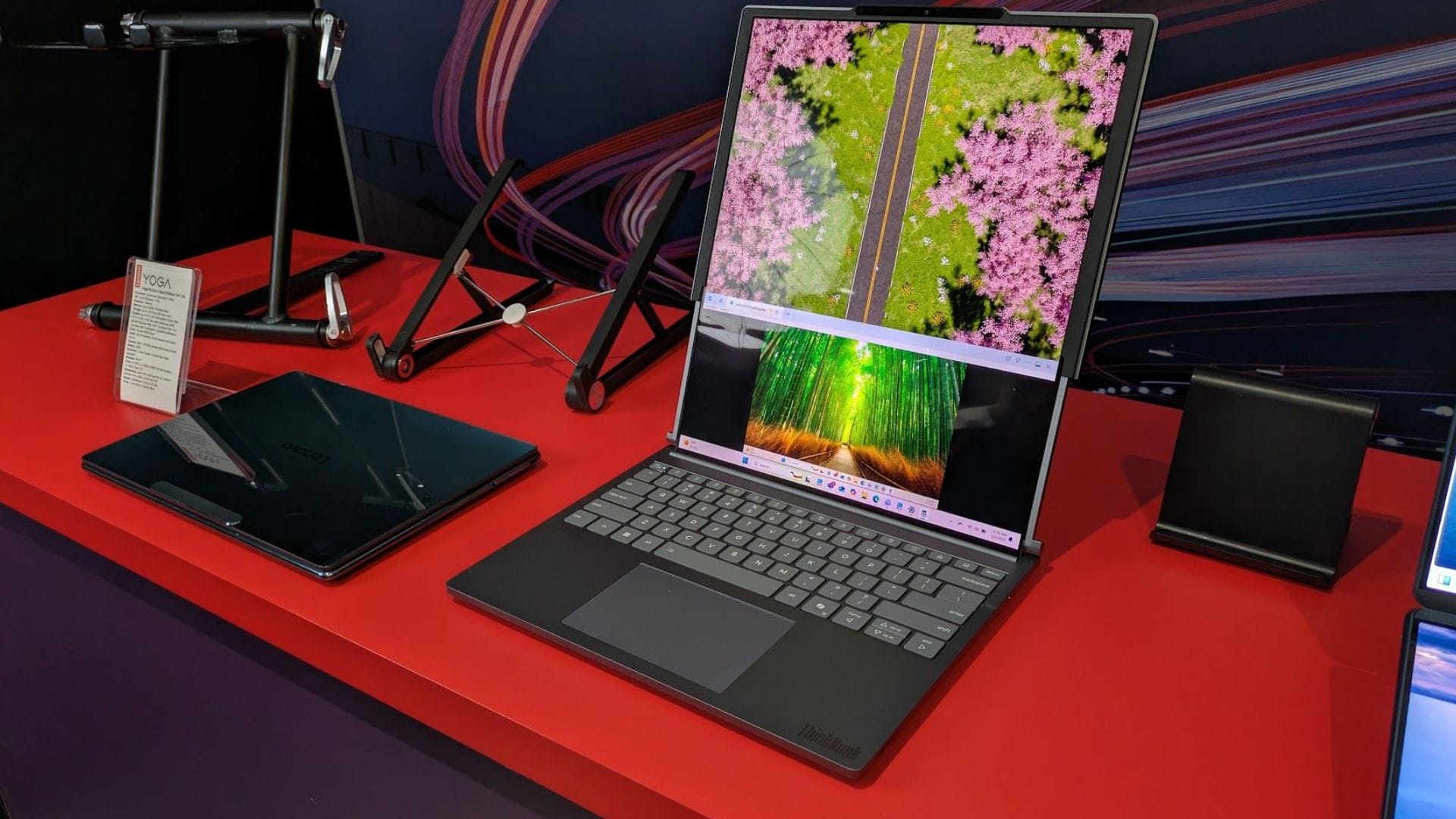
The reported concept would approach the problem of limited laptop screen space differently from Lenovo’s existing rollable designs. Instead of extending vertically to provide additional height, the ThinkBook could expand sideways to create a wider display.
A horizontally expanding screen could be particularly useful for people who regularly work with multiple applications simultaneously. A wider desktop could allow two or three windows to sit side by side, reducing the need to switch between applications constantly. It could also provide additional space for spreadsheets, coding environments and other work that benefits from a broad layout.
Creative professionals could also benefit from the extra width. Video editors, for example, could use the expanded display to see more of a timeline without reducing the size of other interface elements. Users working with large documents or data-heavy applications could similarly gain more visible information without connecting an external monitor.
Lenovo’s documentation indicates that its rollable display technology can be controlled using a keyboard shortcut or an upward hand gesture. A horizontally expanding ThinkBook could use a similar approach, allowing the user to increase the available screen area when needed and return it to a smaller format when the laptop needs to be packed away.
That could make the technology more practical for mobile workers. Rather than carrying a conventional laptop alongside a portable monitor, users could potentially have a wider workspace built directly into the computer. The trade-off would likely involve additional mechanical complexity, durability considerations, and higher manufacturing costs, although Lenovo has not provided details on those aspects of the reported design.
Lenovo has already demonstrated expanding laptop screens
The idea of a horizontally expanding ThinkBook would not be entirely new for Lenovo. At CES 2026, the company demonstrated the Legion Pro Rollable, a concept laptop designed to expand its display width. The prototype uses a 16-inch OLED panel that can expand to 21.5 inches and ultimately reach 24 inches.
Lenovo presented the Legion Pro Rollable as a proof of concept, with the additional screen space intended primarily to create a wider gaming experience. The concept demonstrated how a laptop could provide an ultrawide display when needed while retaining a more conventional form factor when closed or stored.
The technology also shows why a business-oriented ThinkBook could be a logical next step. Gaming is only one potential use for a wider screen, while productivity applications can benefit from additional horizontal space in many situations. A ThinkBook version could therefore focus on work-related tasks rather than gaming, potentially making the concept more useful to a broader group of users.
However, turning a prototype into a commercially available laptop presents significant engineering challenges. A rollable screen requires moving components to operate reliably while remaining thin enough for a portable computer. The display and its supporting mechanism would also need to withstand repeated use, transport and everyday handling.
Lenovo has already explored vertical expansion of displays in productivity laptops and has demonstrated horizontal expansion through its gaming concepts. A horizontally expanding ThinkBook would combine those ideas into a device aimed at professional users.
For now, the reported ThinkBook remains a patent-based concept rather than a confirmed product. Lenovo has not announced a release date or provided specifications, pricing or availability. If the company decides to develop the design further, however, it could offer an alternative to traditional laptops by providing an ultrawide workspace that can be folded into a conventional-sized machine when it is no longer needed.