

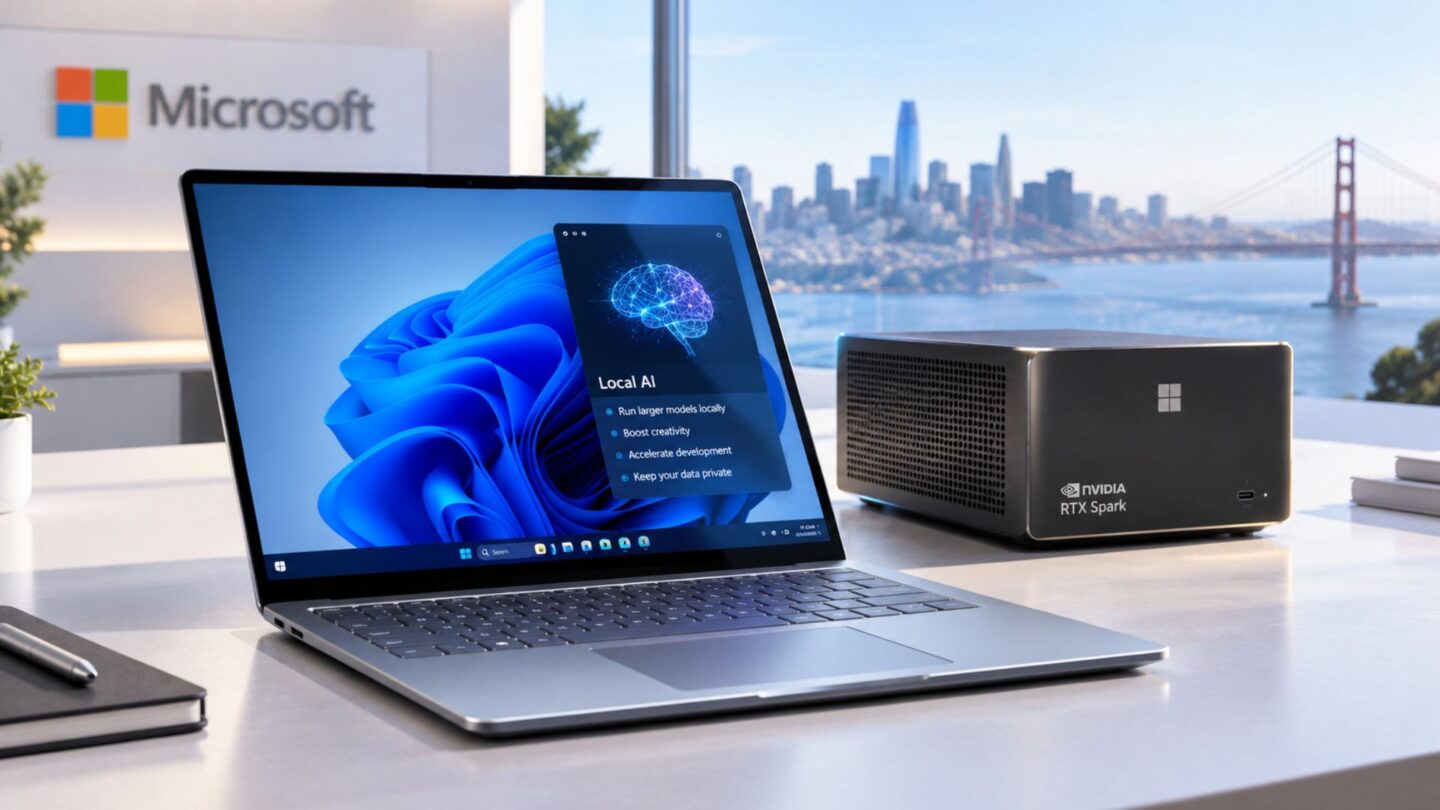
Microsoft is preparing to host a Windows and Surface event in San Francisco on 7 October, focusing on the growing role of local artificial intelligence in personal computers. The company says the event will examine “how local AI will shape the next chapter of the PC”, pointing to a future in which more AI processing takes place directly on devices rather than relying entirely on cloud services.
The event comes several months after NVIDIA introduced its first system-on-a-chip platform designed for Windows PCs, known as the NVIDIA RTX Spark. Microsoft has not yet provided full details on how the platform will fit into its upcoming hardware plans. Still, the October event could offer more information about the Surface Laptop Ultra, which is expected to use the technology.
Microsoft and NVIDIA executives to discuss the PC ecosystem
Microsoft CEO Satya Nadella, NVIDIA CEO Jensen Huang and Pavan Davuluri, Microsoft’s executive vice president of Windows and Devices, are all scheduled to attend the event. Their presence suggests the company plans to discuss more than a single product, likely focusing on the broader relationship between Windows, Surface hardware, and NVIDIA’s latest computing platform.
Microsoft says the three executives will present the “latest innovations across Windows, NVIDIA RTX Spark, Surface and the broader PC ecosystem.” The wording leaves room for several announcements, including more details on hardware already revealed but not yet fully available or priced.
The appearance of both Nadella and Huang also highlights the companies’ shared interest in developing PCs that can handle increasingly demanding AI workloads. Rather than sending every AI task to remote data centres, the approach centres on putting enough processing capability inside consumer computers to run certain AI models and features locally.
That shift could have practical implications for how people use Windows PCs. Local processing can reduce the need to send information to cloud services for some tasks, while potentially improving response times and allowing certain AI functions to operate without a constant internet connection. The exact capabilities will depend on the hardware and software Microsoft and its partners ultimately deliver.
Surface Laptop Ultra could be a key announcement
One product that could receive more attention at the event is the Surface Laptop Ultra. Microsoft announced the laptop in June 2026 but did not provide a detailed timetable for when customers could purchase it. The company also left important questions surrounding pricing and broader availability unanswered.
The laptop is expected to run on NVIDIA’s RTX Spark platform, making it particularly relevant to an event centred on local AI. The hardware is positioned around running AI workloads directly on a PC, potentially giving the Surface Laptop Ultra the processing capacity needed for applications that rely heavily on AI models.
Microsoft has already demonstrated other experimental hardware as part of its Project Solara work. Those devices further indicate the company’s interest in changing how computers interact with AI and automated software. However, conventional PCs with sufficiently powerful processors could offer another route to the same goal.
AI agents are becoming an increasingly important part of Microsoft’s broader computing strategy. These systems are intended to carry out tasks that traditionally require direct user input, potentially handling parts of everyday computer work on the user’s behalf. As AI capabilities expand, running more of that processing locally could become increasingly important.
For the Surface Laptop Ultra, this hardware-software combination could make local AI one of its defining features. Microsoft has not yet confirmed exactly which AI workloads the laptop will support or how its performance will compare with other RTX Spark-based systems, so further details from the October event will be important.
RTX Spark laptops still face unanswered questions
Microsoft is not the only company preparing PCs based on NVIDIA’s RTX Spark technology. Other laptop manufacturers have also announced or introduced devices using the platform, suggesting NVIDIA’s approach could become part of a broader push toward more powerful, AI-capable Windows machines.
However, one of the biggest unanswered questions remains the cost of these systems. Details about pricing have been limited so far, making it difficult to determine where RTX Spark laptops will sit within the wider PC market. The October event could allow Microsoft to clarify the price and availability of its own hardware.
Pricing will matter because local AI processing requires significant computing resources. Manufacturers need to balance performance with factors such as battery life, thermal management and overall device cost. The final specifications of the Surface Laptop Ultra will therefore help show how Microsoft intends to position the machine for consumers and professionals.
The event could also provide more insight into how Windows itself will take advantage of local AI hardware. Microsoft has been adding AI capabilities throughout its software ecosystem, and dedicated processing hardware could let some features run more efficiently on compatible PCs.
For now, Microsoft has confirmed the event’s focus and the participation of its senior executives, while several product details remain undisclosed. The 7 October presentation is expected to provide a clearer picture of Microsoft’s plans for Surface, Windows and local AI, including whether the Surface Laptop Ultra is ready to move from announcement to wider availability.