



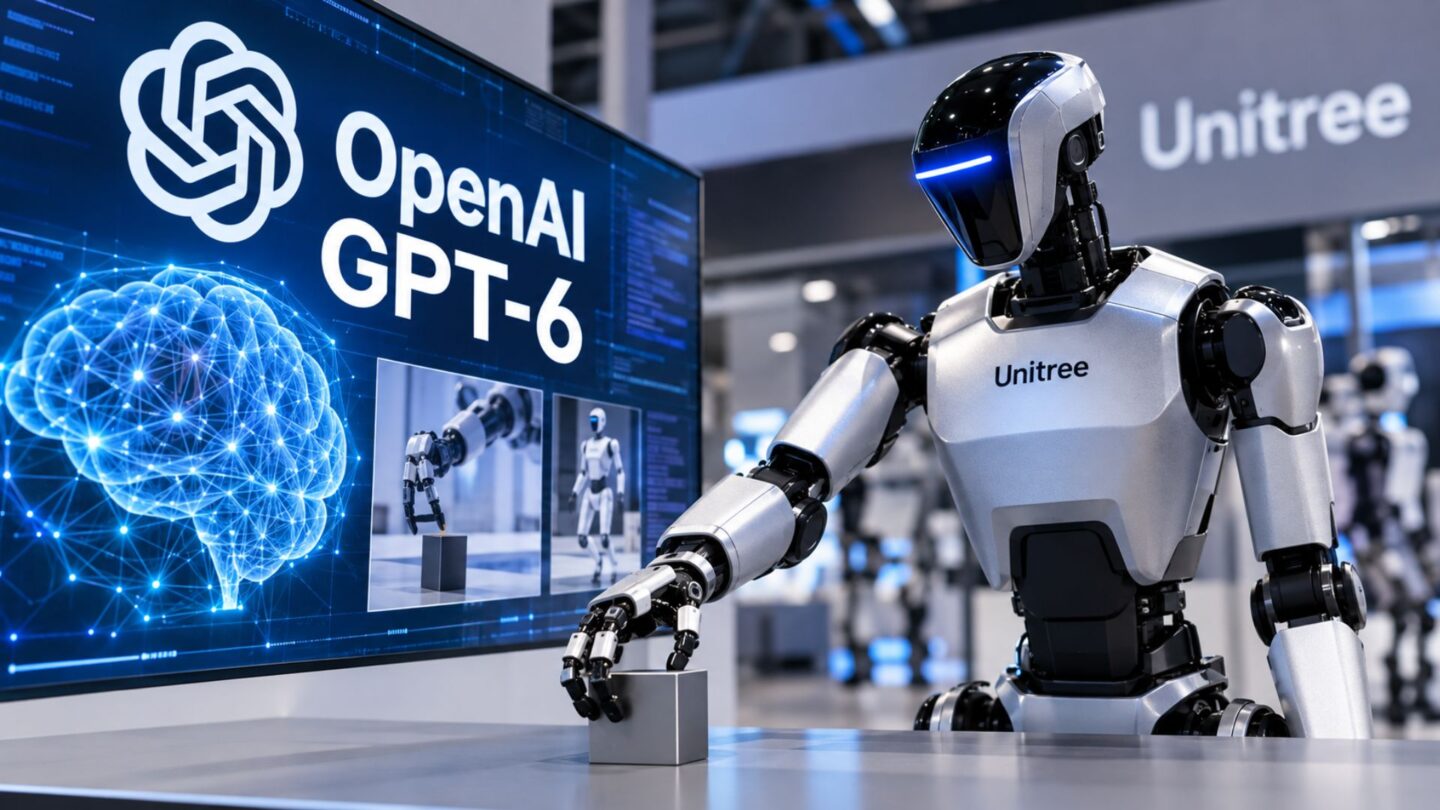
OpenAI’s latest artificial intelligence developments could help the robotics industry overcome major technical challenges as early as next year, according to Wang Xingxing, founder and chief executive of Chinese robotics manufacturer Unitree Robotics.
Speaking at an industry event in Shanghai on Monday, Wang said the release of OpenAI’s GPT-6 model had raised expectations that robots could make significant progress towards operating independently in real-world environments. He suggested that the industry might achieve a breakthrough within the next one or two years, potentially transforming how robots understand instructions and carry out physical tasks.
GPT-6 raises expectations for embodied intelligence
Wang said the rapid development of advanced AI models had changed his outlook on how quickly robotics could mature. He pointed to the possibility of a more advanced model arriving next year and helping resolve some of the most difficult problems in embodied intelligence, a field focused on enabling AI systems to interact with and operate in the physical world.
“It’s possible that, say, a GPT-7 model released next year could directly crack the problems of embodied intelligence,” he said at the event.
His comments marked a shift from a more cautious assessment he offered in August, before GPT-6 was released. At that time, Wang estimated that, under an optimistic scenario, the robotics industry would need at least two to three years to reach what he described as its “ChatGPT moment”. He also warned that the process could take as long as a decade.
The term refers to a stage at which robots become sufficiently capable and reliable to perform a broad range of everyday tasks without extensive human intervention. Wang defined this threshold as robots completing around 80 per cent of tasks in 80 per cent of unfamiliar environments when given instructions through voice or text.
Reaching that level of performance would represent a substantial improvement over systems that can perform impressive demonstrations but struggle with unfamiliar surroundings or unexpected situations. It would also bring the industry closer to deploying robots for practical work across factories, warehouses and other commercial settings.
OpenAI unveiled its flagship GPT-6 Astra model in September, demonstrating advanced robotic manipulation capabilities. These capabilities matter because robots must not only recognise objects and understand instructions but also translate that information into accurate physical movements.
Unitree has tested the new model on its own robots, with Wang reporting encouraging results. His remarks suggest that advances in AI software could help overcome limitations that have kept increasingly sophisticated robot hardware from achieving greater autonomy.
“The whole embodied intelligence industry has been shaken up after the release of GPT-6,” Wang said on the opening day of the 26th China International Industry Fair in Shanghai.
He also reflected on his earlier approach to the technology, saying: “The biggest mistake I’ve made over the past decade or so is that I didn’t believe in AI enough.”
China’s humanoid robot industry faces software challenges
Wang’s assessment carries weight in China’s robotics sector, where Unitree has become a prominent humanoid robot manufacturer. Investors and industry analysts closely follow his public statements for clues about how quickly the domestic market might develop and when companies could start generating returns from commercial deployments.
China’s humanoid robot manufacturers have made considerable progress in developing machines capable of running, jumping and performing complex movements. Their physical achievements have attracted widespread attention, including speed records set during the World Humanoid Robot Games in Beijing in August.
However, impressive demonstrations do not necessarily translate into practical applications. Many humanoid robots still struggle to operate independently for extended periods, respond to changing conditions, and complete tasks consistently without human assistance.
These limitations have raised questions about the sector’s commercial prospects. While manufacturers have developed increasingly advanced hardware, the software needed to make robots genuinely useful in everyday work environments remains a major challenge.
Wang previously cautioned against excessive investor enthusiasm, highlighting a gap between the pace of hardware development and progress in robotic intelligence. His earlier comments reflected concerns that companies could produce increasingly capable machines without developing the software needed to support reliable, autonomous operation.
Embodied intelligence aims to narrow that gap by combining AI reasoning with perception, decision-making and physical action. A robot must interpret its surroundings, understand what a person wants it to do, plan the necessary movements and adjust its behaviour when circumstances change.
For example, a robot working in a factory may need to identify different components, select the correct object, handle it without causing damage, and respond when an item is positioned differently than expected. These tasks require more than pre-programmed movements and can become difficult when the environment changes.
More advanced AI models could help robots generalise their knowledge across different situations instead of relying on narrowly defined instructions. However, progress in model capabilities does not automatically guarantee safe, consistent performance in physical environments, where mistakes can damage equipment or create risks for workers.
The industry must therefore show that AI improvements translate into dependable performance beyond controlled demonstrations. The ability to complete tasks repeatedly, work alongside people and operate at an acceptable cost will be central to determining whether humanoid robots can achieve widespread commercial adoption.
Unitree increases investment in robotic AI development
Unitree has traditionally focused heavily on robot hardware, but it is now increasing investment in the software and AI systems that control its machines. The shift reflects a broader industry effort to develop more capable robotic systems rather than concentrating solely on physical design and movement.
The company previously said it planned to allocate around half of its initial public offering proceeds to research and development on robotic models. The investment is intended to strengthen the technology that enables robots to interpret information, make decisions and perform tasks with less direct human control.
The planned spending highlights the growing importance of AI development in an industry where manufacturers are seeking to turn technological demonstrations into commercially viable products. Better models could help companies expand the range of tasks their robots can perform and reduce the need to program every operation in detail.
Wang confirmed that Unitree was already conducting trials in factories. However, he acknowledged that the robots still required improvements in both efficiency and capability before they could meet the demands of practical industrial use.
Factory environments let manufacturers evaluate robots against real operational requirements, including repeating tasks, handling objects accurately, and working within established production processes. Such trials can also reveal problems that may not appear during demonstrations conducted under more controlled conditions.
The results will help assess whether the latest advances in AI can deliver measurable improvements in productivity and reliability. Even if a robot can understand more complex instructions, its commercial value will depend on whether it can carry out those instructions consistently and efficiently.
Wang’s revised outlook indicates that advances in AI models could shorten the expected timeline for progress in humanoid robotics. Nevertheless, his comments remain a forecast, not confirmation, that the industry will achieve a breakthrough next year.
The coming period will test whether increasingly powerful AI systems can overcome the gap between understanding a task and completing it successfully in the physical world. For Unitree and its competitors, the next stage of development will depend on combining advances in AI with reliable hardware, practical testing and improvements in real-world performance.