



Singapore’s Cybersecurity Strategy 2026 sets out plans to strengthen national cyber defence, improve protection for businesses and individuals, and prepare organisations for security risks associated with artificial intelligence (AI) and quantum computing. A central component involves enhancing the National Cybersecurity Command Centre (NC3) to improve threat detection, block access to known malicious domains and coordinate responses to major cyber incidents.
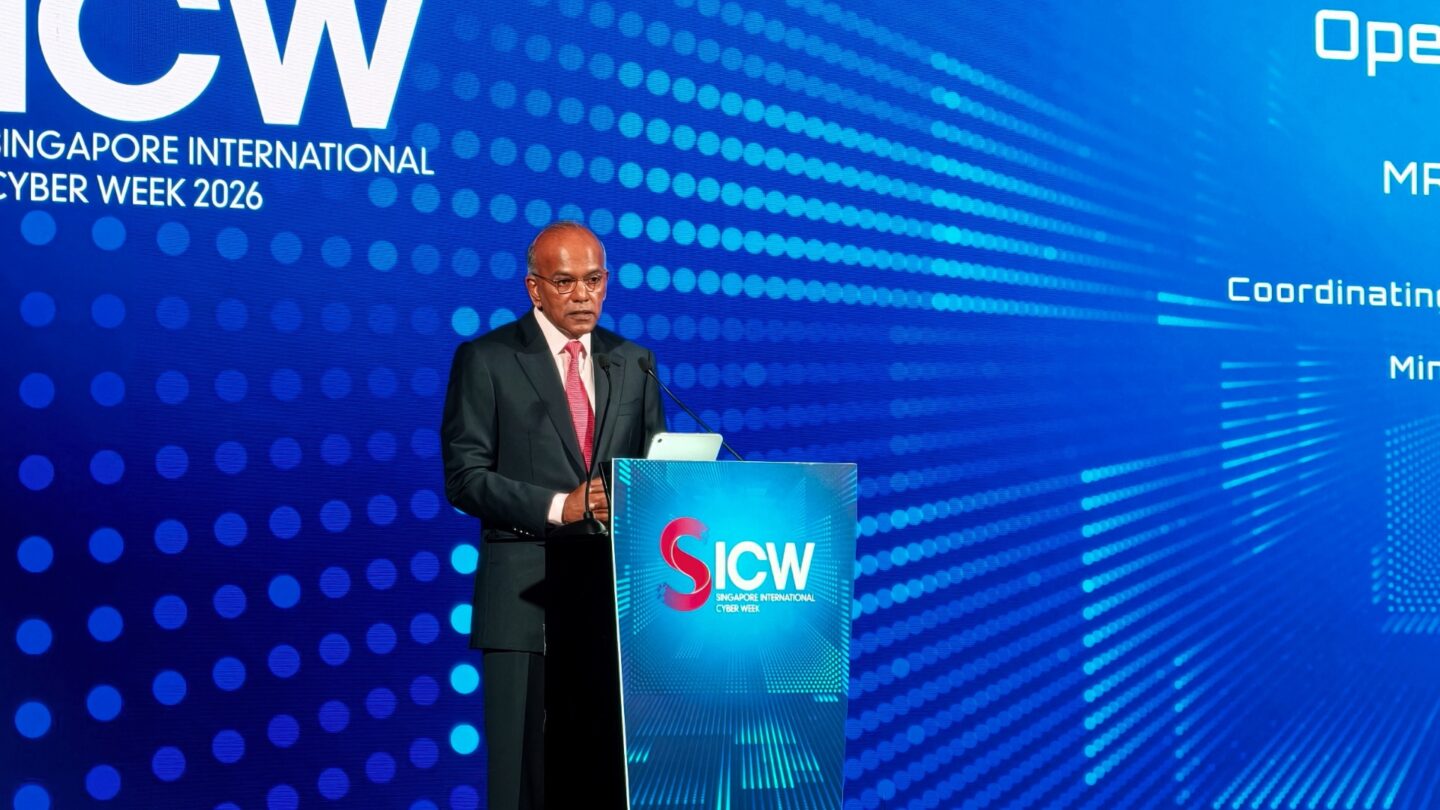
Senior Minister, Coordinating Minister for National Security, and Minister for Home Affairs K Shanmugam launched the strategy at the opening ceremony of the 11th Singapore International Cyber Week on 13 October at the Sands Expo and Convention Centre. First introduced in 2016 and refreshed in 2021, the strategy now comprises four strategic pillars supported by two foundational enablers. Implementation is planned over the next five years.
The updated strategy addresses increasingly sophisticated cyberattacks against essential services, the use of AI to accelerate attacks and the potential threat that quantum computing could eventually pose to existing encryption. It also recognises that growing connections between digital systems can allow disruptions to spread across organisations, sectors and national borders.
National cyber defence to strengthen protection of critical infrastructure
Protecting Singapore’s Critical Information Infrastructure (CII) remains a central priority. These systems support essential services such as power, transport, banking and financial services, making them targets for sophisticated cyberattacks where a successful attack could disrupt essential services or expose sensitive information that could be used to undermine national security or public order. To counter these threats, the Government intends to strengthen national capabilities for anticipating, detecting and responding to threats while helping infrastructure operators defend against advanced and AI-enabled attacks. Coordinated national defence has become increasingly pressing as Advanced Persistent Threat (APT) actors target critical infrastructure and prepare for potential disruption.
The Cyber Security Agency of Singapore (CSA) is enhancing the NC3 to support these operational efforts. As CSA’s national cyber defence operations hub, the command centre will combine threat intelligence from multiple sources to provide a more comprehensive picture of cyber risks facing Singapore, helping defenders anticipate emerging threats and coordinate action across government agencies and infrastructure operators.
One of the planned capabilities is a national Protective Domain Name Service that will block access to known malicious domains, including phishing and malware websites, to reduce the risk of compromise. These measures will operate under the Online Criminal Harms Act (OCHA), which provides the legal framework for such actions. Safeguards under OCHA include assessment and validation before domains are blocked to reduce the risk of incorrect decisions, while individuals and organisations affected by website blocking can seek reconsideration or appeal through existing processes.
The NC3 will also support more systematic monitoring of vulnerabilities affecting critical infrastructure. Through attack surface management, CSA will identify exposed Internet-facing assets and work with relevant government agencies and CII owners to address potential entry points for attackers. In parallel, vulnerability management will help operators identify systems affected by new, severe or actively exploited security weaknesses and prioritise urgent fixes.
Threat detection capabilities are being strengthened through technology developed by the Centre for Strategic Infocomm Technologies (CSIT). CSA and CSIT are progressively equipping selected CII owners with proprietary detection systems and integrating them with the NC3. Supported by privileged threat intelligence, these capabilities are intended to improve the detection of malicious activity, particularly attacks involving APT actors. When major incidents occur, AI-enabled systems will help cyber defenders track ongoing incidents, prepare operational assessments and plan their next actions, supporting faster coordination among infrastructure owners and government agencies during incidents requiring a national response.
Operation CYBER GUARDIAN provided an example of coordination between government agencies and telecommunications operators. Announced in February 2026, it was described as Singapore’s largest coordinated cyber incident response effort to date, involving more than 100 cyber defenders from government agencies working with telecommunications operators to respond to a sophisticated campaign by APT actor UNC3886 targeting Singapore’s telecommunications sector.
Other national defence measures identified in the strategy include establishing a Digital Defence Hub, reviewing national cyber operational arrangements and legislation, and strengthening preparedness through cybersecurity exercises. In addition, the framework calls for stronger threat intelligence sharing and wider adoption of AI-enabled cyber defence capabilities. It also seeks improved leadership and workforce capabilities among CII owners.
Wider protection to address cybercrime and organisational risks
The strategy’s second pillar focuses on improving cybersecurity across the wider digital ecosystem, including businesses, organisations and individuals outside the critical infrastructure framework. The Government intends to combine preventive measures with higher security standards, public education and initiatives addressing scams and cybercrime. Planned measures include minimum cybersecurity requirements for higher-risk Internet of Things (IoT) devices and stronger security standards for organisations facing elevated cyber risks, alongside exploratory cyber insurance pilots to encourage organisations to improve their cybersecurity practices.
Cybercrime prevention is another priority under this pillar. The strategy identifies plans to establish the SPF Cyber Command and develop a National Scams List, alongside measures intended to reduce exposure to online threats before they affect users or organisations. These initiatives will be supported by stronger public-private partnerships and continued cybersecurity education: public outreach will focus on equipping individuals with the knowledge needed to protect themselves online, while organisations will be encouraged to strengthen their security practices.
AI security and quantum-safe migration become national priorities
The third pillar covers the use of AI to strengthen cyber defence, secure adoption of AI systems and preparations for the potential impact of quantum computing on encryption. As attackers can use AI to strike faster and at greater scale, including by exploiting weaknesses in software and supply chains, the Government plans to strengthen its in-house capabilities in applying AI models to cybersecurity and encourage wider adoption of AI-enabled defence tools. Alongside these defensive applications, the strategy addresses the security of AI systems deployed by organisations, with the Government intending to develop implementation guidance to help organisations adopt AI securely and lead by example in applying appropriate safeguards.
Quantum computing presents a longer-term concern because future advances could undermine encryption methods currently used to protect digital systems and information. Although the impact may be further away, the Government intends to accelerate Singapore’s transition towards quantum-safe systems. This will involve working with public agencies and industry to plan, prioritise and carry out migration activities, while resources will also be developed and updated to support organisations preparing for quantum-related security risks.
International cooperation, cybersecurity research and workforce development
The fourth pillar focuses on international cybersecurity cooperation, including work with other governments and major technology companies, which Singapore intends to deepen despite the difficulties that geopolitical tensions and technological competition create for cross-border collaboration. The strategy identifies continued support for rules-based cooperation through ASEAN cybersecurity initiatives and the Counter Ransomware Initiative. Singapore will also continue organising Singapore International Cyber Week and establish a Digital Defence Symposium as platforms for international cybersecurity dialogue. In parallel, partnerships with major technology companies will focus on jointly developing solutions for priority areas such as AI-enabled cybersecurity, operational technology (OT) security and quantum-safe migration, while the Government also intends to provide a trusted testbed for experimenting with cybersecurity solutions.
The Government aims to establish Singapore as Asia’s leading cybersecurity innovation hub, with an emphasis on developing, validating and deploying trusted cybersecurity technologies for critical infrastructure. Under the first foundational enabler, programmes including CyberBoost, CyberCall and CyberGrowth will focus on developing priority cybersecurity capabilities, and the Government will explore a bridging programme to help move early-stage research towards product development and commercialisation. Research and development will also receive attention through two planned Signature Programmes covering AI and OT security under the National Cyber R&D Programme, alongside measures to enhance national testbeds and research infrastructure, strengthen industry-academia collaboration through the CyberSG Consortium, and attract international cybersecurity companies to Singapore.
The second foundational enabler addresses the cybersecurity workforce. To deepen technical expertise and strengthen professional standards as cybersecurity requirements become more demanding, the Government plans to establish a Cybersecurity Professional Accreditation Framework, align skills frameworks and support leadership development through the Cybersecurity Strategic Leadership Programme. Efforts to broaden the talent pipeline will include cybersecurity education and recruitment through the SG Cyber Talent programme and Sentinel programme, with Full-time National Servicemen offered opportunities to develop cybersecurity skills and experience through the Cyber Work Learn Scheme. The strategy further identifies plans to mobilise civilian cybersecurity expertise through Sectoral Cyber Defence Teams, providing additional specialist capabilities to support Singapore’s national cyber defence efforts.