



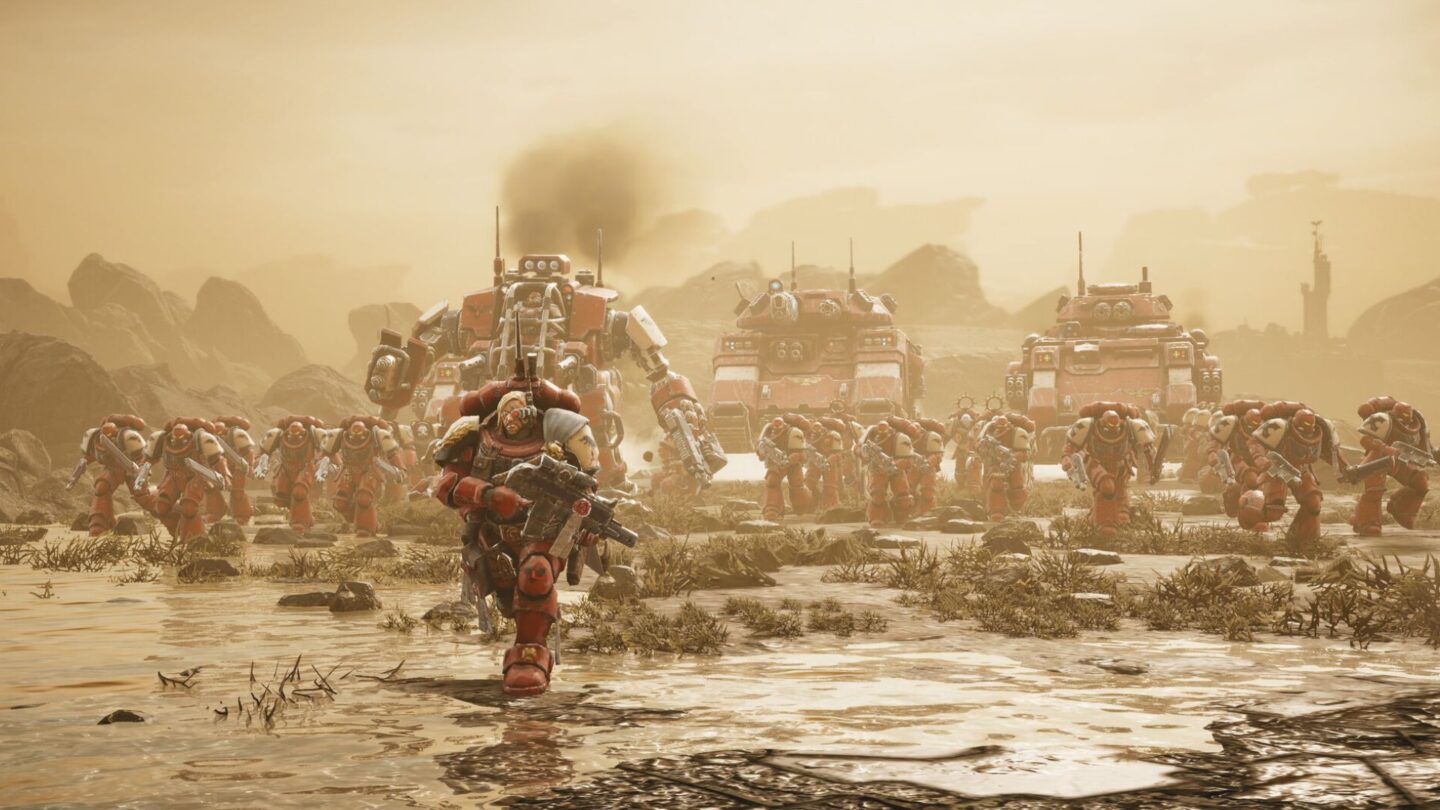
Warhammer 40,000: Dawn of War 4 is shaping up to be an ambitious real-time strategy game, with four faction-specific campaigns, branching storylines and around 70 missions. Developer King Art Games initially decided to give each playable faction its own campaign, but the idea gradually grew into a much larger project.
In an interview, King Art co-founder and creative director Jan Theysen explained how the team’s enthusiasm for the Warhammer 40,000 universe influenced the game’s scope. The developer wanted players to explore the motivations, personalities, and histories of the different factions rather than experience the conflict exclusively from the Space Marines’ perspective.
The game will feature campaigns centred on the Space Marines, Orks, Necrons and Adeptus Mechanicus. Each faction will have its own narrative progression, while branching paths and alternative mission choices will allow the story to develop in different ways. Theysen said the project expanded considerably as the team explored additional possibilities, eventually resulting in four substantial campaigns.
Four faction campaigns form the foundation of the story
King Art Games decided early in development to create four separate faction campaigns. According to Theysen, the team saw the different factions as fundamental to what makes both Dawn of War and the wider Warhammer universe distinctive.
“You don’t really learn too much or everything you want to learn about Necrons or AdMech if you play just the Space Marines and fight them in a handful of missions,” Theysen explained.
The creative director said the team wanted players to understand each faction through its own perspective. Rather than introducing the Necrons and Adeptus Mechanicus solely as opponents in another faction’s campaign, King Art wanted to give them dedicated stories that explored their identities and roles in the wider conflict.
“And so we always said, ‘Okay, no, no, if we have four factions, we definitely want one campaign for each of the factions.'”
This approach places the four campaigns at the centre of Dawn of War 4’s single-player experience. Each faction will have an opportunity to take a leading role in the narrative, giving players a broader view of the setting and its competing interests.
The decision also reflects the importance of faction identity in Warhammer 40,000. The Space Marines, Orks, Necrons and Adeptus Mechanicus have different histories, beliefs, technologies and approaches to warfare. Giving each one a dedicated campaign allows the developer to explore those differences through individual missions and character-driven stories.
King Art also considered the strengths of established real-time strategy games while developing the campaign structure. Theysen highlighted Warcraft 3 as an example of a title that demonstrated the importance of combining strategic gameplay with a compelling narrative.
The team wanted Dawn of War 4 to offer more than a sequence of battles. Cinematic cutscenes, memorable heroes, and an engaging story were key elements of the experience, helping connect individual missions and giving players a reason to continue through each campaign.
Branching narratives and player choices expanded the scope
Once the four faction campaigns were established, King Art began exploring ways to vary the stories. The team considered branching narratives, mutually exclusive missions and alternative ways for players to experience events. These ideas gradually expanded the original plan into a much larger campaign structure.
Theysen explained that the team wanted to give players greater influence over how certain parts of the story unfolded. One idea was to let players choose which hero to control, potentially creating different experiences based on their choice.
The developer also explored presenting different sides of the same events. By letting players experience the conflict from different perspectives, the campaigns could reveal more about the factions and their motivations. Branching progression would further distinguish the experience from a more linear strategy campaign.
These additional features increased the amount of content required for the game. Rather than creating four relatively straightforward storylines, King Art found itself developing four substantial campaigns with individual progression systems and a range of missions shaped by the team’s expanding ideas.
“It snowballed basically,” Theysen said.
He continued: “I mean, we like art, and we like campaigns a lot, and so for us it was like a little bit like kids in a candy shop, right?”
Theysen explained that the team kept adding ideas as development progressed, including different hero choices and ways to change the narrative direction.
“And we said, basically, you know what, also, it would be nice if you could choose which hero to play. Then you have two different sides of the same story, or you can actually change how the story progresses, and in the end, we ended up with four really big campaigns and like 70 missions or something; it’s insane.”
The project’s scale reflects the developer’s interest in narrative-driven strategy games. Although additional branching paths and alternative missions require more development work, they can also give players reasons to revisit campaigns and explore outcomes they did not encounter during their first playthrough.
Theysen added that the team had discussed its plans for four faction campaigns with Games Workshop, the company behind Warhammer 40,000. He said the team made the decision very early in development and worked with Games Workshop on the setting’s lore.
Games Workshop collaboration and release plans
Games Workshop’s involvement is an important part of developing a game set within the established Warhammer 40,000 universe. The setting has an extensive history, with established factions, characters and events that developers must consider when creating new stories.
By discussing the campaign concept with Games Workshop and collaborating on the lore, King Art sought to develop its ambitious narrative within the wider fictional universe. The four-campaign structure gives the studio room to explore several perspectives while maintaining a connection to the setting’s established identity.
Theysen’s comments also suggest the team’s creative priorities shaped the final scope rather than a fixed mission count set at the beginning. The initial commitment to giving each faction its own campaign laid the foundation, while adding branching stories, hero choices, and alternative missions expanded the experience.
For players, the planned structure could provide a more comprehensive look at the four factions than a campaign focused on a single army. It also creates opportunities to experience the same conflict from different viewpoints, with individual storylines offering their own progression and objectives.
However, the developer’s comments don’t say how long each campaign will take to complete or exactly how many missions will have meaningful branching choices. Theysen described the total as around 70 missions, suggesting the figure is approximate rather than a final, confirmed count.
Warhammer 40,000: Dawn of War 4 is scheduled to launch on PC on 3 December. Its four-campaign structure, cinematic storytelling, and branching missions suggest King Art is placing considerable emphasis on single-player content alongside the strategic battles that define the series.
With four factions receiving dedicated campaigns, the game aims to give players a broader perspective on the Warhammer 40,000 universe. The developer’s challenge will be to bring its expanded ideas together into a cohesive experience that balances narrative depth, player choice and real-time strategy gameplay.