


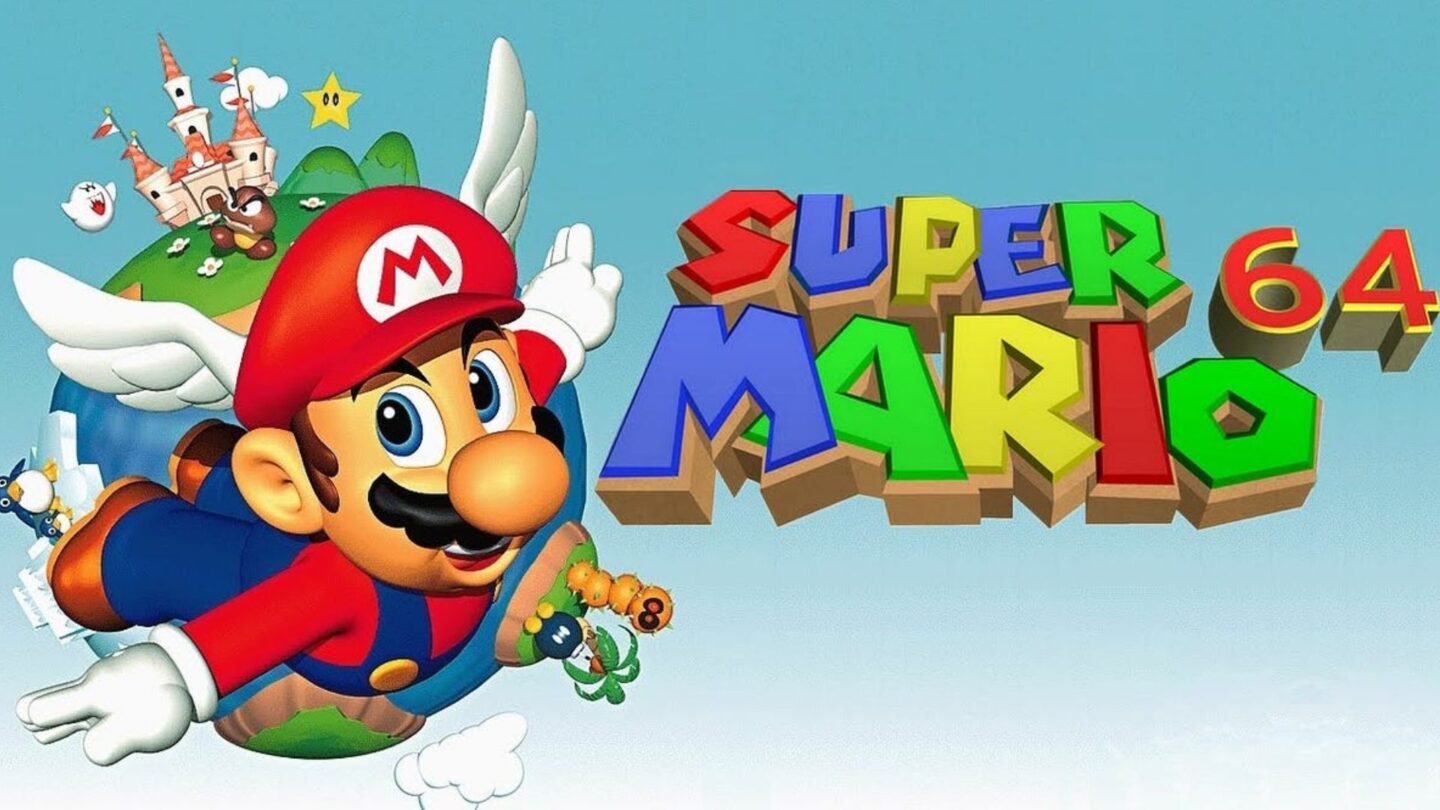
More than 30 years after Super Mario 64’s release, fans may finally have a clearer idea of what a mysterious plaque in Princess Peach’s castle courtyard says. A programmer has used computational analysis to identify a possible message hidden in the game’s notoriously blurry text.
According to a report by Video Games Chronicle, programmer Mochi64 used open-source analysis software to compare millions of word and font combinations against the original image. The results suggest that the plaque may read “Eternal Star” on the top line and “We hope so” on the bottom.
Although the discovery offers a potential explanation for one of the game’s longest-running mysteries, it is not definitive. The software found the closest match it could, but the original text remains difficult to read, and Nintendo has not confirmed the findings.
Computational analysis offers a possible answer
The plaque in Super Mario 64 has puzzled players for decades because its lettering is too blurred to read clearly. Despite the game’s many re-releases, the text has remained largely unchanged, leaving fans without a reliable way to determine what the developers originally intended to write.
Traditional image enhancement and graphical upscaling have not provided a satisfactory solution. The problem is that the available image contains too little clearly distinguishable detail to reconstruct the original lettering with confidence. Simply increasing the resolution cannot recover information missing from the source.
Mochi64 approached the problem differently by using computational analysis rather than relying on visual enhancement alone. The software examined a wide range of potential words and font combinations, comparing their rendered appearance with the pixels visible on the in-game plaque.
After millions of comparisons, the analysis identified “Eternal Star” and “We hope so” as the closest matches. The proposed wording also fits the setting, as the plaque sits beneath a large star statue in the castle courtyard.
However, treat the results as a theory rather than a confirmed translation. A close match between generated text and a blurry image does not necessarily prove that the original developers used those exact words. Other phrases could potentially produce similar patterns, particularly when the available image contains limited visual information.
Even so, the experiment offers a more systematic way to investigate the mystery than relying entirely on guesses or traditional image editing. It also offers a possible explanation that fits the plaque’s location, although further evidence would be needed to establish its authenticity.
The famous L is Real 2401 rumour
The plaque has attracted attention for years, partly because of a much more elaborate theory involving Luigi, Mario’s younger brother. During the 1990s, players circulated rumours that the blurred inscription contained the phrase “L is Real 2401”, supposedly hinting that Luigi could be unlocked and played in Super Mario 64.
The theory became a significant part of the game’s early fan culture. Players searched the castle, experimented with different actions and attempted to discover hidden requirements that might reveal the character. The uncertainty around the plaque kept speculation alive, even though the original game offered no reliable way to unlock Luigi.
The mystery also attracted attention beyond ordinary fan discussions. IGN reportedly offered a US$100 reward to anyone who could work out how to unlock Luigi, while Nintendo Power referenced the “L is Real 2401” theory in an April Fool’s Day issue. These developments helped turn an obscure visual detail into one of the game’s most recognisable legends.
Interest in the rumour increased further after Super Mario 64 director Shigeru Miyamoto revealed that the development team had experimented with a two-player mode. According to Miyamoto, the team eventually abandoned the idea to conserve memory. Still, the revelation gave fans another reason to wonder whether the finished game was ever meant to include Luigi.
An early build showing Mario and Luigi moving around a basic, unfinished room fueled speculation. Although the footage showed the characters were considered together during development, it did not establish that Luigi could be unlocked in the released version.
The proposed reading of “Eternal Star” and “We hope so” offers a different explanation for the plaque, one that does not require a hidden character or secret gameplay feature. Nevertheless, the computational findings do not independently disprove every aspect of the Luigi theory. They suggest the visible inscription may convey a simpler message than fans originally imagined.
What the proposed message could mean
If the suggested wording is accurate, “Eternal Star” would fit as an inscription on a plaque beneath a giant star statue. Stars are central to Super Mario 64, serving as the main collectables that let players progress through the castle and unlock additional areas.
The second line, “We hope so”, is more ambiguous. One possible interpretation is that it reflects the developers’ hope that players would collect all the stars in the game. However, no confirmed evidence establishes this as the intended meaning, so it remains an interpretation rather than a Nintendo-supported explanation.
The wording could also have been intended as a simple decorative message, a small joke or an atmospheric detail that most players would never notice. Without access to the original development materials or a statement from the people responsible for the design, it is difficult to determine the precise intention behind the inscription.
The findings nevertheless show how computational techniques can help investigate questions that conventional methods have struggled with for years. By testing an enormous number of possible text combinations, the approach narrows the field of plausible explanations. It offers a candidate reading for other researchers and fans to examine.
An official answer, however, may remain out of reach. Nintendo has not confirmed the proposed interpretation, and the available evidence does not establish with certainty that the software recovered the original text. Unless additional development documents, original artwork, or reliable testimony emerge, the plaque may remain an uncertain part of the game’s history.
For now, “Eternal Star” and “We hope so” represent a promising possibility rather than a final resolution. The discovery gives Super Mario 64 fans a fresh lead in a mystery that has endured for more than three decades, while leaving enough uncertainty for further investigation.