



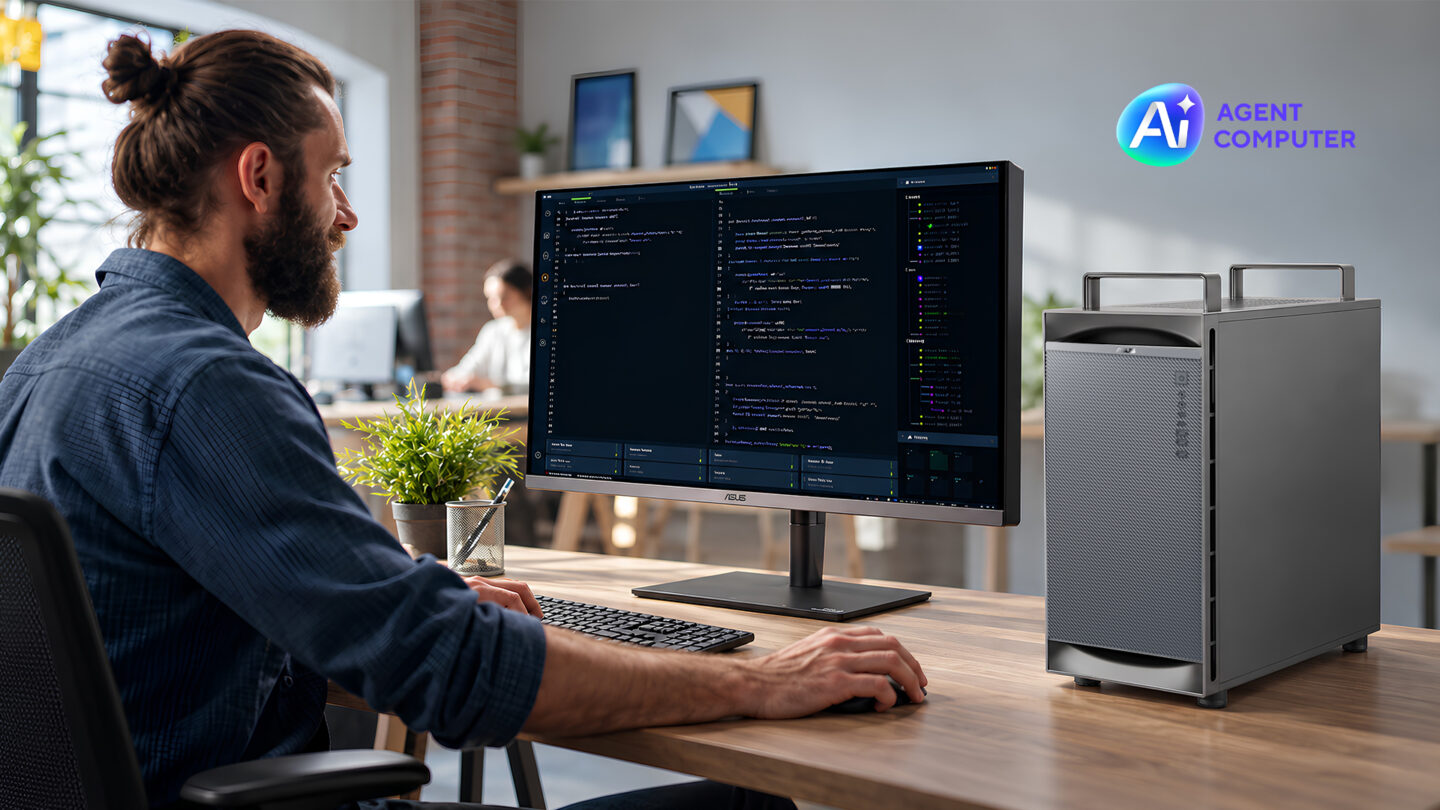
As enterprises expand their use of AI agents, recurring inference costs are becoming harder to predict. Investing in on-premises infrastructure offers an alternative, with more predictable computing costs, greater control over confidential data and the ability to run suitable workloads offline.
Table of contents
AI agents can perform multistep tasks involving repeated model interactions. An agent tasked with drafting a market analysis or auditing code might search documents, consult internal business applications, evaluate intermediate findings, and retry unsuccessful steps before producing an output. A single assignment can involve dozens of model requests, each consuming computing resources. Across multiple teams and departments, those interactions can drive substantial recurring AI spending.
The financial pressure is already evident. Reuters reported in June 2026 that French telecommunications company Orange had cited Uber’s exhaustion of its annual AI token budget within four months as an example of rising enterprise AI costs. Research from Stanford Digital Economy Lab highlights another complication. Across eight frontier models performing agentic coding tasks, repeated runs of the same task varied by up to 30 times in token consumption, without higher consumption necessarily improving accuracy.
Cloud services let enterprises access computing resources without substantial upfront investment, but sustained AI workloads can make buying and running dedicated infrastructure more cost-effective. For organisations running AI applications consistently across multiple teams, dedicated hardware offers an opportunity to distribute infrastructure costs across a larger volume of work.
Why sustained AI workloads change the calculation
Cloud AI generally involves two billing models. Commercial APIs typically charge by input and output tokens, while cloud GPU providers charge for access to computing resources over time. Both allow companies to scale without substantial upfront investment, although running GPU instances may continue incurring charges even when utilisation is low. Any comparison with on-premises hardware must first establish which expenses a local deployment could replace.
Agent workloads can vary considerably. Document processing, coding assistance and internal search may involve repeated model requests, large amounts of contextual information or interactions between multiple agents. However, the number of active agents reveals little about actual computing demand. An agent waiting for instructions may consume minimal resources, while another processing large document collections could generate sustained inference workloads.
Effective capacity planning relies instead on request frequency, model size, concurrent demand, and actual hardware utilisation. Where demand is steady and predictable, dedicated hardware changes the cost structure. The organisation makes an upfront investment and spreads that cost across internal workloads, rather than paying recurring external inference charges. Operating expenses such as electricity, cooling and systems administration still apply, even when the hardware is underused. Enterprises therefore need sufficient recurring workloads to justify the investment.
Bringing enterprise AI computing into the workplace
ASUS positions its Agent Computer portfolio around locally deployed AI agents and automated workflows, with hardware options ranging from personal computing to departmental infrastructure. At the enterprise end of the portfolio sits the ExpertCenter Pro ET900N G3, a desk-side system built on NVIDIA DGX Station architecture for demanding model development, fine-tuning, and inference.
Powered by the NVIDIA GB300 Grace Blackwell Ultra Desktop Superchip, the ET900N provides up to 20 PFLOPS of AI performance and 748GB of coherent CPU-GPU memory. Its coherent memory architecture gives the CPU and GPU access to a large shared memory pool, reducing the constraints of conventional GPU memory limits. ASUS says the system supports models containing up to one trillion parameters.
The larger memory pool expands the range of AI models that can run locally, but accommodating a model in memory does not guarantee sufficient performance for multiple users. Inference speed also depends on model architecture, software configuration, quantisation and the number of concurrent requests.
To support multiple departments on a single machine, NVIDIA Multi-Instance GPU technology can partition the physical accelerator into up to seven isolated instances. On top of this, ASUS Zenni AI Hub provides tools for model deployment, request routing, resource monitoring and multi-agent coordination. It also supports managing multiple ET900N systems through a cluster. These management tools allow IT teams to make locally deployed models available across departments through centrally managed infrastructure.
What could three years of ownership potentially cost?
ASUS has provided a starting price of US$114,556 for the ExpertCenter Pro ET900N G3. For an illustrative three-year ownership calculation, assume US$500 in monthly electricity, cooling and maintenance expenses. This amounts to US$18,000 over three years and represents a modelling assumption rather than measured ET900N operating costs.
For comparison, cloud provider Lambda lists an NVIDIA B200 GPU instance at US$6.99 per GPU-hour, equivalent to approximately US$5,033 for 30 days of continuous rental. This illustrates the cost of sustained cloud GPU usage, not the performance equivalence between the B200 and ET900N.
Consider an enterprise spending US$5,000 monthly on AI workloads that could be handled locally with comparable performance and output quality.
Under this scenario, replacing US$5,000 in monthly cloud expenditure would reduce recurring costs by US$4,500 after accounting for the estimated US$500 in monthly electricity, cooling and maintenance expenses. Once the US$114,556 purchase price is included, the model produces a potential three-year saving of US$47,444 and a payback period of approximately 25.5 months.
When local AI ownership reaches payback
Illustrative cumulative expenditure at US$5,000 in replaceable cloud costs per month, versus a US$114,556 ET900N purchase and US$500 in assumed monthly operating expenses.
At US$2,000 in monthly replaceable cloud expenditure, the three-year total would be US$72,000. By comparison, purchasing the ET900N for US$114,556 and accounting for an additional US$18,000 in estimated operating expenses would bring its three-year cost to US$132,556. Under this scenario, local ownership would break even with cloud expenditure of approximately US$3,682 per month. Below that threshold, cloud services would remain the more economical option.
What three years of local AI could cost
The hardware purchase price and assumed operating expenses are separated to show how the illustrative three-year ownership total is calculated.
ET900N starting price provided by ASUS
US$114,556 hardware + US$18,000 assumed operations
US$5,000/month in replaceable expenditure
US$180,000 minus US$132,556
The comparison assumes equivalent workload performance, fully replaceable cloud expenditure and monthly local operating costs of US$500. Operating expenses can materially affect the outcome. If those costs increased to US$1,500 per month, the projected three-year saving would fall from US$47,444 to US$11,444 under the same assumptions. For enterprises considering the ET900N, the financial case therefore depends on how much existing cloud expenditure can be replaced and the cost of operating the system locally.
How operating costs change potential savings
All scenarios use a US$114,556 hardware price and US$180,000 in replaceable cloud expenditure over three years. Only the hypothetical monthly local operating cost changes.
Keeping confidential information under enterprise control
Cost is only one consideration. For organisations handling proprietary code, intellectual property or confidential financial records, on-premises processing offers greater control over data handling. Locally deployed AI models can process sensitive information within an organisation's own computing environment, without sending it to third-party AI providers.
Legal teams could use local models to analyse commercial contracts, while engineering and finance departments could process proprietary code or internal audit records within their own computing environment. In each case, the organisation determines which records are exposed to a model, how long prompts and outputs are retained, and which internal systems an agent can access.
At the software layer, the ET900N supports NVIDIA NemoClaw, which uses NVIDIA OpenShell to apply policy-based privacy and security controls to agentic workflows. ASUS Zenni AI Hub also supports connections between locally deployed models and internal knowledge bases, alongside model management and agent coordination. Even when AI models run locally, agents connected to external applications or services may still transmit information outside the organisation. Enterprises therefore need to control which external services their agents can access and what information they are permitted to share.
Operating AI without continuous internet access
Local AI infrastructure also benefits organisations operating in environments with restricted or unreliable internet access. Once the necessary models, software and dependencies are installed, supported AI workloads can run without connecting to external AI providers. NVIDIA supports air-gapped deployment of its NIM inference software for environments without outbound internet connectivity.
In practical terms, an internal assistant can summarise internal documents or analyse operational logs during an external network outage or within a physically restricted facility. Tasks requiring live web searches, remote database lookups, or third-party APIs still depend on active connectivity, but critical internal processes can be designed to run without external endpoints. Achieving this resilience requires deliberate preparation. Model files, retrieval systems and other required software components must remain accessible within the isolated environment, without relying on external authentication or cloud-based services for essential operations.
Sharing capacity across departments
Different departments may have workloads that peak at different times. Software developers might require coding assistance during the working day, while finance teams could schedule batch processing overnight. Consolidating suitable workloads onto shared hardware can improve utilisation and reduce the need for separate systems.
How departments can share local AI compute
Conceptual enterprise deployment showing shared AI infrastructure, internal data and optional connections to outside applications and services.
The ET900N combines GPU partitioning with Zenni AI Hub's model management, request routing and resource monitoring capabilities, allowing administrators to allocate computing resources across suitable workloads and multiple systems. Performance remains governed by concurrent load, since simultaneous applications share the same underlying compute and memory bandwidth.
Organisations can improve utilisation by scheduling workloads according to demand. User-facing assistants could receive priority during business hours, while document processing, indexing and model fine-tuning could run during quieter periods.
Choosing the right balance between local and cloud AI
Cloud services remain useful for handling unpredictable demand, short-term projects and proprietary models unavailable for local deployment. A practical enterprise strategy often combines both models, running predictable, high-volume inference and privacy-sensitive tasks on owned hardware, while routing irregular bursts or specialist requests to external cloud endpoints.
Workload efficiency remains important regardless of deployment location. Smaller models, prompt caching and more efficient agent workflows can reduce unnecessary computing demand. Moving inefficient workloads onto dedicated hardware may increase resource consumption without improving productivity. Before investing in physical infrastructure, organisations should audit their highest-volume workflows, verify that locally runnable models meet output-quality requirements, and calculate realistic concurrency on a shared machine. That evaluation also identifies which workloads are best left in the cloud.
For enterprises with sustained AI workloads across multiple departments, the ET900N offers an opportunity to combine more predictable infrastructure expenditure with local data processing and shared computing capacity. Its economic value lies in how effectively those resources support the organisation's applications over time.