


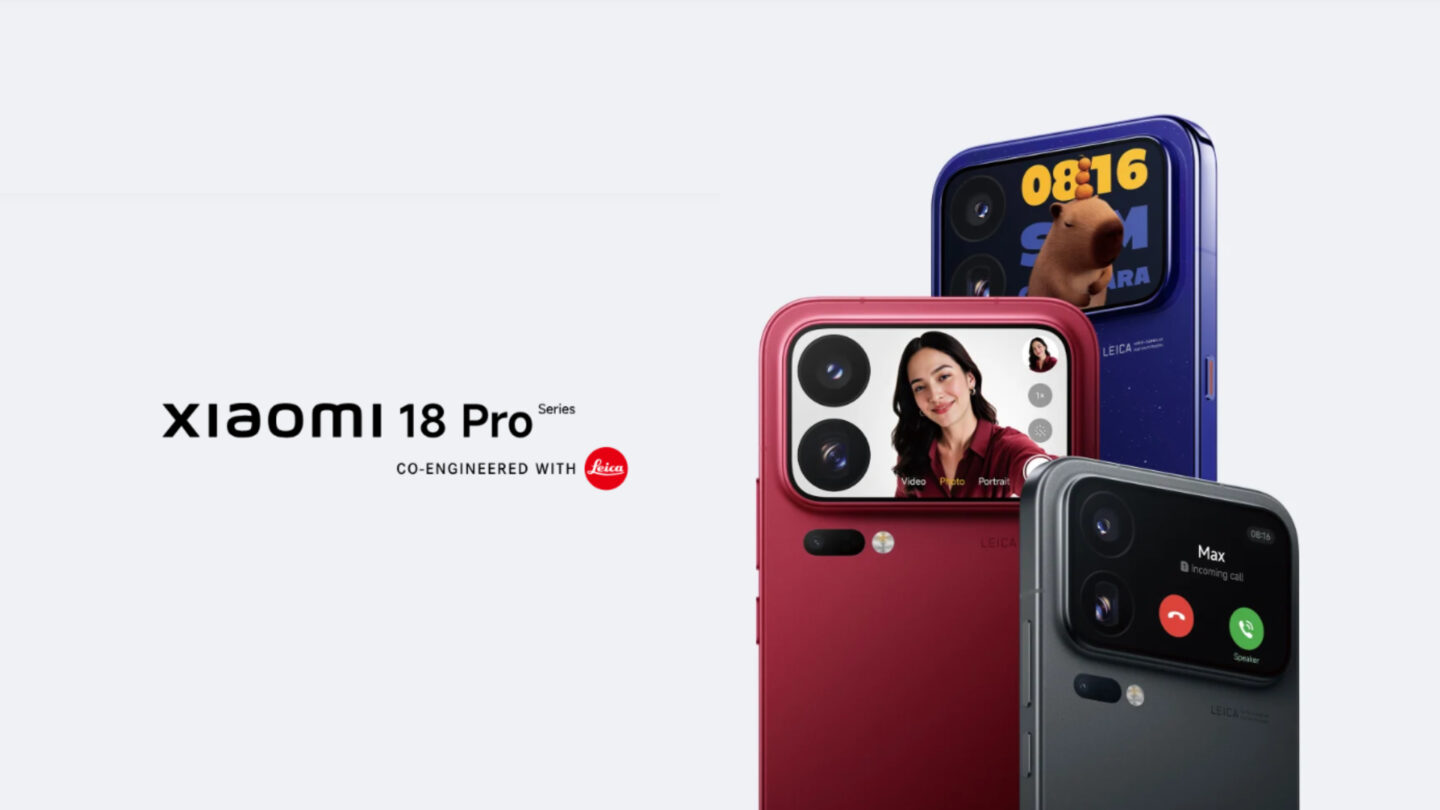
Xiaomi has introduced the Xiaomi 18 Pro and Xiaomi 18 Pro Max in Singapore, featuring secondary rear displays that work as camera viewfinders and provide access to notifications, translation tools and other functions. Both smartphones also feature dual 200MP Leica cameras, hardware-based screen privacy and Xiaomi HyperOS 4.
Table of contents
The two models share most of their photography and software capabilities, but differ in processing power, screen size, battery capacity and selected camera features. Prices start at S$1,799 for the Xiaomi 18 Pro and S$2,099 for the Pro Max, with pre-orders beginning on 18 November.
Rear displays extend photography and everyday functions
The Back Display sits alongside the rear cameras, measuring 2.7 inches on the Xiaomi 18 Pro and 2.9 inches on the Pro Max. Both use LTPO AMOLED panels with adaptive refresh rates of 1Hz to 120Hz and up to 4,000 nits of multi-scenario peak brightness. Xiaomi’s Unified Underglass design places the cameras and display beneath a single surface protected by Corning Gorilla Glass Victus 2.
Its main application is photography, allowing users to frame selfies and videos using the rear cameras instead of relying on the front-facing camera. The system automatically switches to an ultra-wide view when more than three people are detected in a group selfie, and supports live previews during 8K video recording at 30fps.
The screen also provides access to navigation information, incoming calls and delivery updates. Pin to Back Display keeps items such as boarding passes and QR codes visible for quick reference, while AI Interpreter uses the front and rear screens to display translated conversations in 29 languages.
Xiaomi has extended this functionality through GenAI Apps, which lets users create small applications using natural-language prompts, with more than 50 presets available. Personalisation features include dynamic wallpapers and AI-generated group portraits, although AI Group Photo Wallpapers is scheduled for an update starting in December 2026. AI availability varies by region, language and software version, with some functions requiring internet access.
Leica cameras and differences between the two models
The rear display’s camera function is supported by Xiaomi’s Leica Dual-200MP Camera System. Both phones combine a 200MP main camera with a 200MP periscope telephoto camera, alongside 50MP ultra-wide and front-facing cameras.
Their main cameras share a 1/1.28-inch sensor size, an f/1.67 Leica Summilux lens and optical image stabilisation. The Pro Max, however, uses the Light Fusion 960L sensor with LOFIC HDR and a claimed 16.2EV dynamic range, compared with the Light Fusion 960 on the standard Pro.
The shared periscope camera supports 75mm portraits, 150mm optical-level zoom and close-up photography from 12cm. Video recording reaches 4K at 120fps with Dolby Vision or 8K at 30fps. Xiaomi also includes AI-assisted lighting, framing and cropping tools, alongside photographic styles and lens simulations.
The larger Pro Max adds a more powerful processor, bigger battery and faster wired charging, as shown in the comparison.
| Specification | Xiaomi 18 Pro | Xiaomi 18 Pro Max |
|---|---|---|
| Main display | 6.4-inch AMOLED | 6.9-inch AMOLED |
| Rear display | 2.7-inch | 2.9-inch |
| Processor | Snapdragon 8 Elite Gen 6 | Snapdragon 8 Elite Extreme Gen 6 |
| Main camera sensor | Light Fusion 960 | Light Fusion 960L |
| Battery | 6,000mAh | 7,050mAh |
| Wired charging | 90W | 100W |
| Wireless charging | 50W | 50W |
Both Snapdragon processors use TSMC’s 2nm manufacturing process. Qualcomm claims the Extreme version delivers up to 13% higher CPU performance, up to 44% higher GPU performance and a 35% faster neural processing unit than the previous generation.
Xiaomi has also equipped the Pro Max with a direct copper thermal connection and its 3D IceLoop cooling system, claiming up to 50% higher cooling efficiency compared with the Xiaomi 17. Both phones use silicon-carbon batteries and support wired and wireless reverse charging.
Screen privacy and HyperOS 4
Privacy Display is another shared feature, using dedicated pixels with narrower viewing angles to reduce the visibility of content from the sides. Users can apply Privacy Mode to selected applications and notifications, while Privacy Notice detects nearby onlookers within approximately one metre and alerts the user.
Both displays carry TÜV Rheinland Effective Screen Privacy Protection certification. Xiaomi cautions that content may still be visible under certain conditions, so the technology does not guarantee complete privacy.
Xiaomi HyperOS 4 brings device management through Xiaomi Smart Hub, alongside Google Gemini integration and Circle to Search with Google. Xiaomi HyperAI adds voice notes and meeting summaries, subject to regional and language availability. Cross-device functions also support compatible Apple devices through the Xiaomi Interconnectivity app.
The Pro Max adds triple speakers, a CyberEngine haptic motor and Xiaomi Privacy Call, which reduces voice leakage during conversations. Both phones include ultrasonic fingerprint sensors, AI face unlocking and IP68 dust and water resistance.
Singapore pricing and availability
Both models come in Black, White, Cosmic Blue and Velvet Red, with 12GB of RAM and either 256GB or 512GB of storage. Pre-orders run from 18 to 23 November 2026, followed by revised promotional prices until 27 December.
| Model and configuration | Retail price | 18–23 Nov | 24 Nov–27 Dec |
|---|---|---|---|
| Xiaomi 18 Pro 12GB + 256GB | S$1,799 | S$1,599 | S$1,699 |
| Xiaomi 18 Pro 12GB + 512GB | S$1,999 | S$1,799 | S$1,899 |
| Xiaomi 18 Pro Max 12GB + 256GB | S$2,099 | S$1,899 | S$1,999 |
| Xiaomi 18 Pro Max 12GB + 512GB | S$2,299 | S$2,099 | S$2,199 |
Sales channels include mi.com, Xiaomi Stores, Shopee, Lazada and participating retailers. The Xiaomi 18 Pro 12GB + 256GB configuration is exclusive to mi.com and Xiaomi Stores.
During the promotional period, Xiaomi Store customers can choose an additional trade-in rebate of up to S$200 or a gift, including a magnetic power bank and case, portable photo printer or Xiaomi Watch S5. Participating online and partner retailers also offer the gift options.
Eligible purchases include 50% off Xiaomi Care, one free screen replacement within 12 months, international warranty service and two years of quality assurance. Three-month trials of Google AI Pro and YouTube Premium are also offered, subject to eligibility and renewal conditions.