



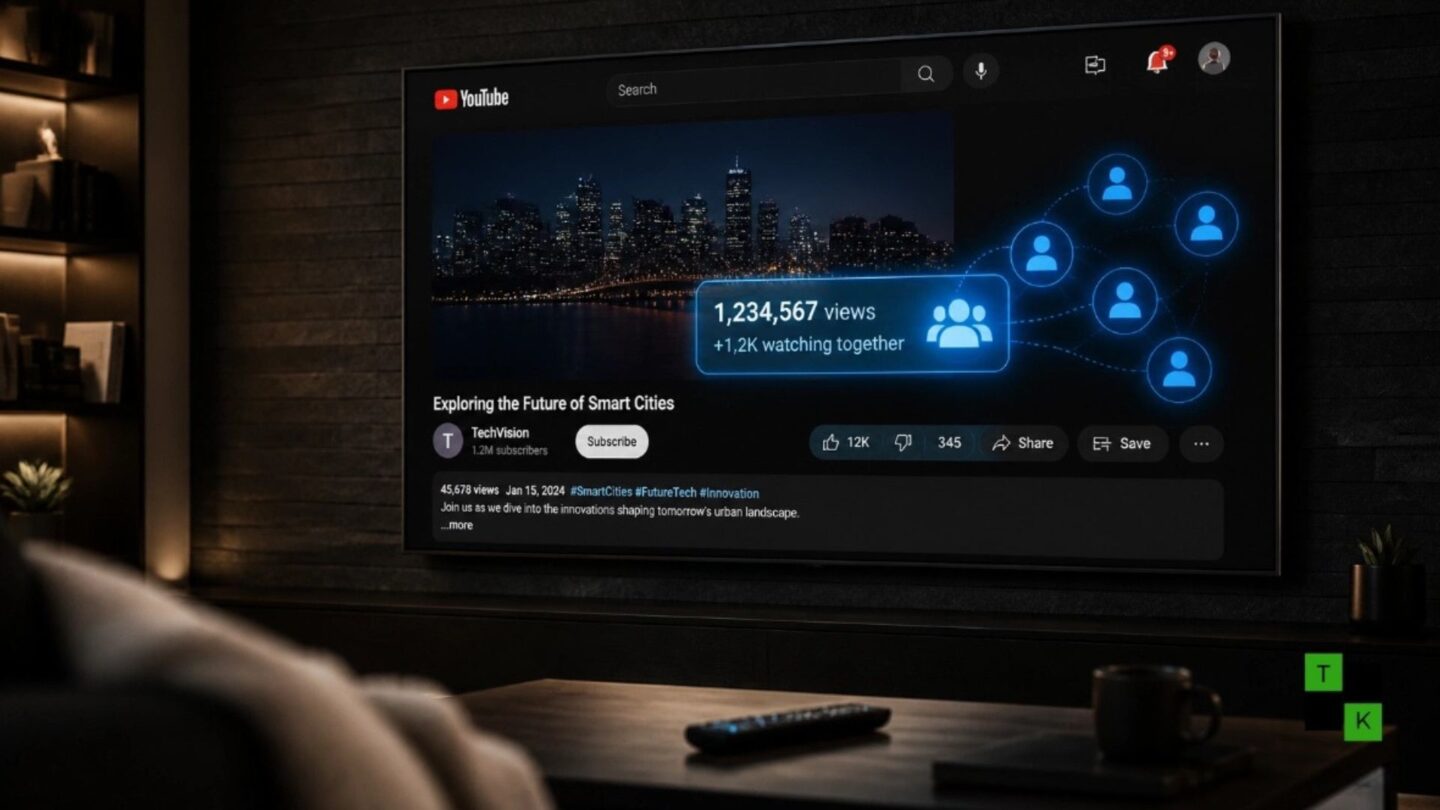
Google is updating how YouTube calculates public view counts to reflect multiple people watching content together on a single television screen. The change, announced via an X post from YouTube Creator Insider, means that a single playback on a television can now register as more than one view on public watch pages. The adjustment takes effect in mid-November 2026 and applies only to television viewing, not playback on smartphones, tablets, or personal computers.
New! Co-views included in the public YouTube viewcount https://t.co/AoYu2WRMU1
— YouTube Creator Insider (@YouTubeInsider) November 16, 2026
Under the new system, these additional figures are called co-views. The updated counting method spans all major video formats on the platform, including standard long-form uploads, YouTube Shorts, and live streams. Previously, any stream played on a television counted as a single view, regardless of how many family members or friends were in the room watching at the same time.
Aligning digital metrics with television industry standards
Executives at the video streaming giant believe that traditional device-based counting has long underestimated the true reach of content consumed in living rooms. Because television has become one of the platform’s fastest-growing screens, with viewers watching more than one billion hours daily on connected sets, single-account tracking often fails to capture shared viewing habits. By factoring in group audiences, the company hopes to give content creators a more accurate picture of how widely their videos are seen.
In its official announcement, the company said the metric’s primary objective is to “[align] with TV industry standards — including how traditional broadcast and streaming networks estimate the total number of people exposed to content.” Traditional television measurement agencies have relied on household and audience estimation models for decades to determine programme popularity. Adopting a similar framework lets digital creators present audience numbers directly comparable to conventional broadcast figures when pitching to external advertisers and sponsors.
Privacy-safe statistical modelling replaces hardware tracking
Audience estimation naturally raises questions about how a digital platform can determine how many people are watching on a television. To address potential privacy concerns, the company explicitly confirmed that it will not use “devices, cameras, microphones or anything like that” to monitor living rooms or detect physical viewers. Instead of relying on invasive hardware sensors, the platform estimates group sizes behind the scenes without identifying individual bystanders.
According to the announcement, the calculations rely on a “privacy-safe statistical model” that evaluates broad contextual signals. These signals include aggregated demographic patterns, regional trends, content genres, and specific times of day when viewing occurs. The algorithm is calibrated against real-world testing data to predict the likelihood of shared viewing during any given session. While the platform declined to publish granular technical details regarding the exact weighting of its formulas, it confirmed that creators can inspect a private co-view rate ratio inside YouTube Studio Insights to separate primary playbacks from estimated co-views.
Impact on creator analytics and advertising payouts
For content creators, the immediate consequence of the rollout will be a noticeable rise in public view counts and overall watch time figures for videos that perform well on television screens. The company clarified that the co-view parameter will apply only to new television views going forward and will not be added retroactively to historical video totals. These expanded reach metrics are designed to help channels refine their programming strategies and negotiate sponsorship deals with greater confidence.
Despite the visible boost to public popularity metrics, the update will not translate into higher direct advertising payouts from Google. Addressing financial expectations directly, YouTube Creator Insider noted that “Co-views don’t impact ad revenue or YPP thresholds.” The statement further confirmed that “Creator earnings, AdSense payouts and YouTube Partner Program eligibility remain based on Qualified Views and Watch Hours.” As a result, while a channel may appear significantly more popular to the general public and prospective brand partners, its underlying monetisation requirements and standard revenue splits remain completely unchanged.


