



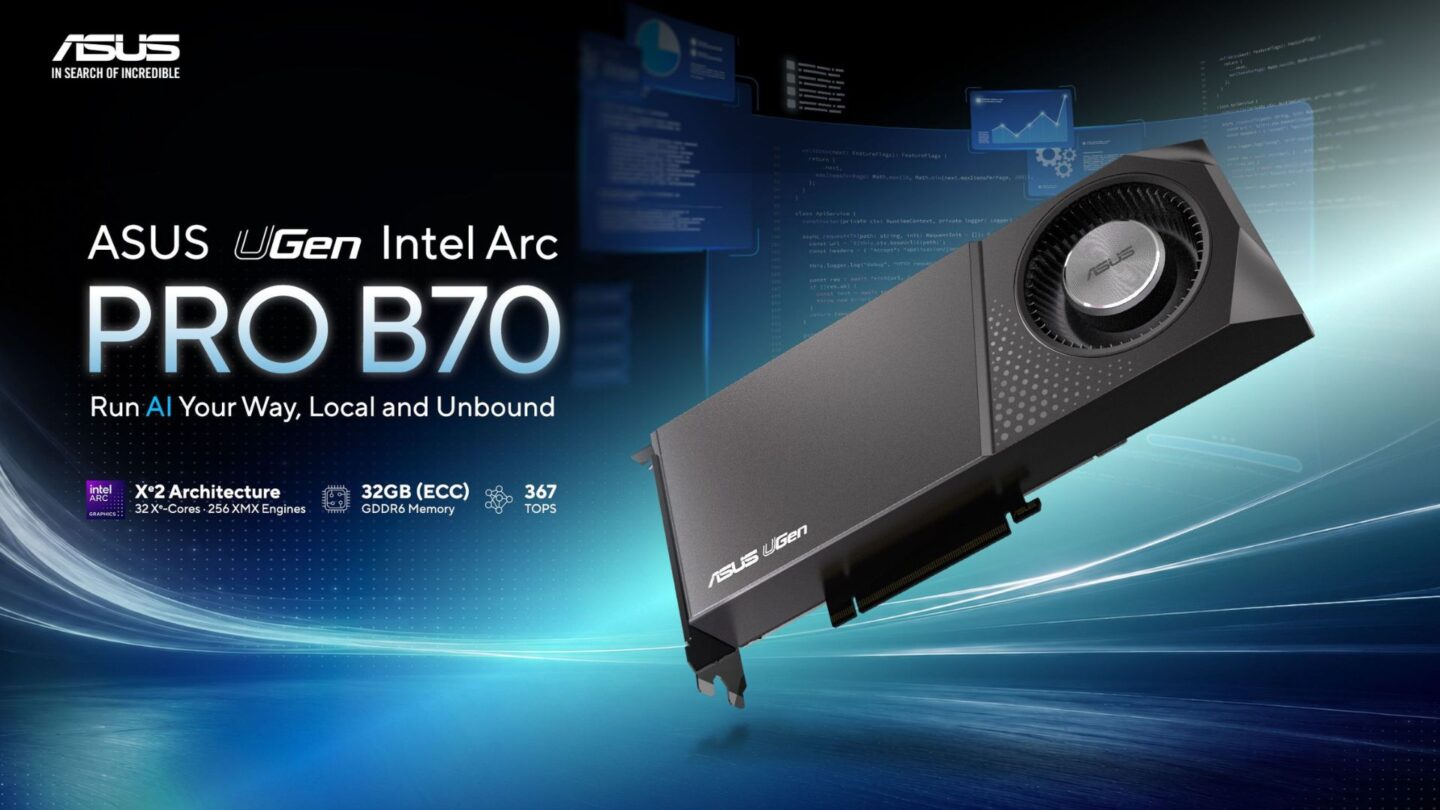
ASUS has begun selling its UGen Intel Arc Pro B70 graphics card in parts of Europe, setting a recommended price of €1,799 in Germany and Austria and CHF 1,799 in Switzerland. The pricing places the workstation GPU in a premium category, despite using Intel graphics technology rather than the more expensive offerings typically associated with high-end professional computing.
The card is designed for developers, businesses and professionals running artificial intelligence (AI) workloads locally. Its 32GB of video memory and dedicated AI acceleration hardware support model inference and other demanding computing tasks without requiring constant access to cloud-based services.
Intel introduced its own Arc Pro B70 model in March 2026, starting at US$949. ASUS’s version retains the same underlying GPU architecture but features a different cooling system and a higher rated power consumption. The price difference is substantial, though the European price includes value-added tax (VAT), making a direct comparison with Intel’s original US price less straightforward.
At €1,799, ASUS’s card enters the price range of high-end consumer graphics hardware, including NVIDIA’s GeForce RTX 5090, which launched in the US at US$1,999. However, the two products serve different purposes, and their suitability depends on the applications and workloads involved. ASUS has not yet announced US pricing or availability for its UGen model.
32GB of memory targets local AI processing and professional computing
The ASUS UGen Arc Pro B70 is based on Intel’s Xe2 graphics architecture and combines 32GB of error-correcting code (ECC) GDDR6 memory with 32 Xe2 cores and 256 XMX engines for AI acceleration. ECC memory detects and corrects certain types of data errors, making it useful in professional environments where computing reliability matters.
The card uses a dual-slot blower-style cooling system and has a rated board power of 310W. This is higher than Intel’s reference design rating of 230W, so prospective buyers should consider their workstation’s power supply, airflow, and cooling capacity before installing the ASUS model.
Its 32GB memory capacity is a key selling point. AI models can require substantial video memory, especially when developers run inference locally or experiment with larger models. More memory can let certain workloads run without splitting operations across multiple devices or relying on external computing resources. Actual performance, however, depends on model size, software optimisation, and the specific workload.
ASUS is also promoting configurations that combine multiple cards in a single workstation. A system equipped with four UGen Arc Pro B70 GPUs would provide 128GB of video memory across the cards. At the recommended European price, the graphics hardware alone would cost €7,196, excluding the rest of the workstation and any additional infrastructure required.
Multi-GPU configurations may appeal to developers and organisations that need additional memory capacity or want to distribute workloads across several devices. However, combining graphics cards does not automatically create a single memory pool that every application can access seamlessly. Software compatibility, workload distribution and the ability of the relevant AI frameworks to use multiple GPUs will affect the practical benefits.
For professionals handling sensitive information, local AI processing can also reduce the need to transfer data to external cloud services. This may provide greater control over information and help organisations manage their computing resources. Nevertheless, these advantages must be weighed against the initial hardware cost, electricity consumption and ongoing software support.
Premium pricing raises questions about performance and value
Intel’s original Arc Pro B70 launched with a starting price of US$949, making ASUS’s European recommendation notably higher. The difference does not necessarily reflect a direct markup on an identical retail product, as the models have different designs and power specifications, and regional taxes and distribution costs also affect pricing.
The broader Arc Pro B70 market has also seen retail prices exceed Intel’s original launch figure. The report states that Newegg listed an Intel-branded model for US$1,945.99, although retail prices vary by seller, stock availability, and individual listing. This suggests that Intel’s original price may not reflect what every customer can currently expect to pay.
The comparison with NVIDIA’s GeForce RTX 5090 is particularly striking because the two graphics cards occupy a similar price range in the markets discussed. However, their specifications and intended uses differ. The RTX 5090 is a high-end consumer GPU, while the Arc Pro B70 targets professional workloads, including local AI inference. Buyers should therefore consider application compatibility, memory requirements, driver support and performance in their intended software rather than relying on price or memory capacity alone.
For businesses and developers, the key question is whether ASUS’s implementation delivers sufficient benefits to justify its higher cost. A workstation GPU may offer advantages in particular professional applications, but those benefits depend on the software ecosystem and the level of optimisation available. Independent benchmarks covering common AI models, inference speeds, memory utilisation and sustained workloads would help buyers assess its competitiveness.
Power consumption is another consideration. With a rated board power of 310W, the ASUS card requires appropriate power delivery and cooling. Organisations planning multi-GPU systems will need to account for the combined electrical demand, heat output and physical space required to operate the cards reliably.
ASUS has confirmed European pricing for its UGen Arc Pro B70, with sales beginning in Germany, Austria and Switzerland. However, the company has not announced a US price or an availability date for the American market. Buyers there will need to wait for more details before deciding how the card compares with local alternatives.
Ultimately, the UGen Arc Pro B70 enters a competitive market where large memory capacity can be valuable, particularly for developers running AI workloads on their own hardware. Its success will depend on whether real-world performance, software compatibility and workstation features can justify its premium price compared with competing GPUs and cloud-based computing services.