


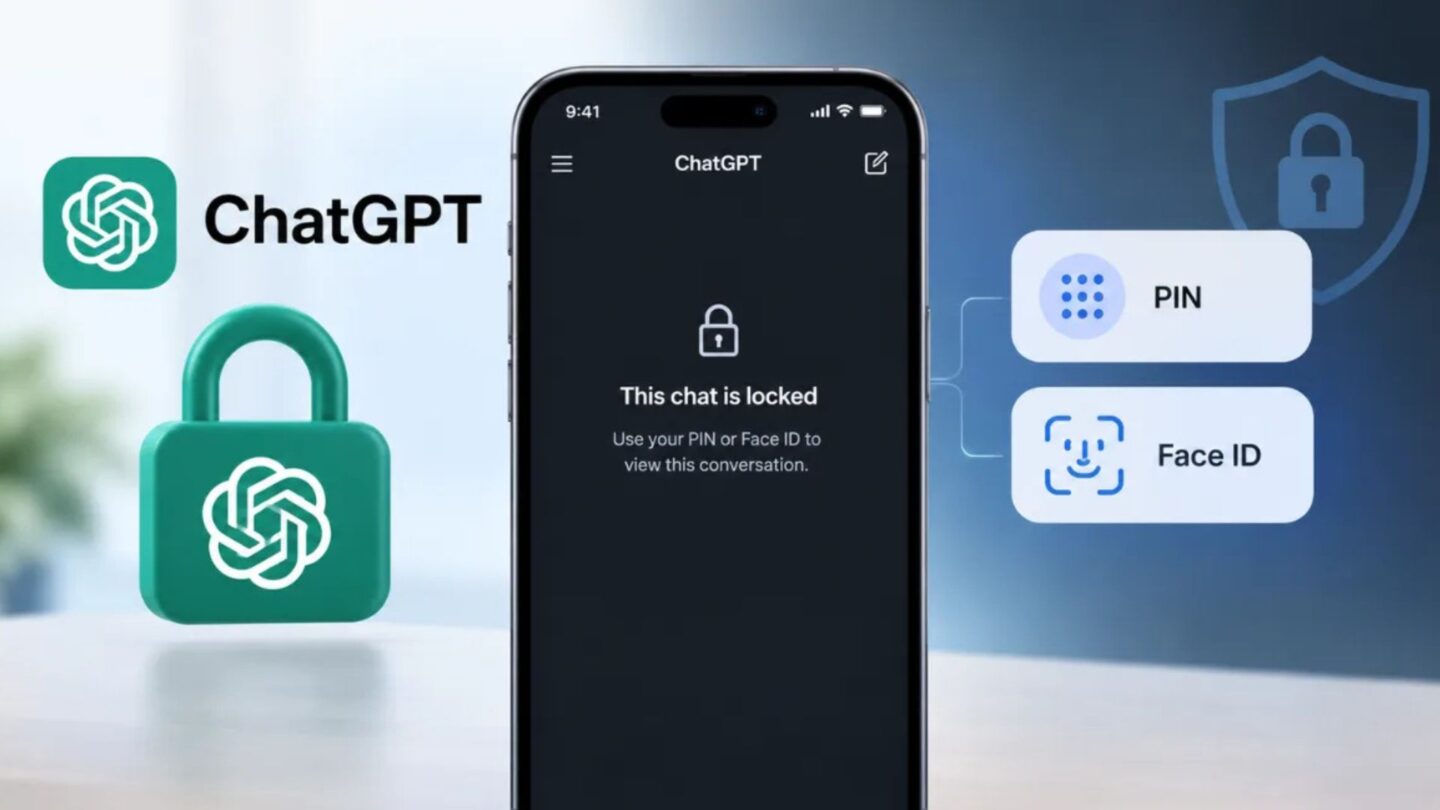
OpenAI has introduced a new privacy feature for ChatGPT that lets users protect sensitive conversations with an extra layer of security. Called Locked Chats, the feature lets users separate private discussions from their regular chat history and limit access through authentication.
The addition expands the platform’s existing privacy options, particularly for people who use the chatbot to discuss personal matters or handle information they would prefer to keep private. It also distinguishes between protecting access to conversations and controlling how information from those conversations influences future interactions.
Locked Chats adds an extra layer of security
Locked Chats lets users move existing conversations into a dedicated section that requires authentication to access. On the web version of ChatGPT and its desktop application, users can protect these conversations with a PIN. This adds an extra barrier for anyone trying to open private discussions on the same computer.
Keep sensitive conversations out of view with Locked Chats in ChatGPT. Move chats out of your regular history and search into a protected space you can unlock with a PIN on web and desktop, or a PIN, Face ID, Touch ID, or device unlock on supported mobile devices. New messages sent in locked chats won’t update the memory used in your regular chats. Rolling out starting today to Free, Go, Plus, Pro, Business, Enterprise, and Edu plans.
— ChatGPT (@ChatGPT) October 20, 2026
Mobile devices offer further authentication options. Depending on the device, users can unlock protected conversations using the device’s passcode or biometric security features, such as Face ID on compatible iPhones or a fingerprint sensor on supported Android devices. These options provide a more convenient way to access private chats without relying solely on a separate password.
The feature helps users manage conversations they don’t want readily accessible in their standard chat history. For example, someone discussing personal circumstances, private plans, or other sensitive subjects may prefer to keep those exchanges separate from everyday questions and work-related discussions.
However, Locked Chats should be understood primarily as an access-control feature rather than a complete privacy guarantee. Requiring authentication can make it harder for other people using the same device to access conversations. However, users should still consider their account security, device access and other privacy settings when handling confidential information.
The introduction also reflects a broader effort to give ChatGPT users more control over how they organise and access their conversations. As people increasingly use AI assistants for both professional and personal purposes, tools that separate different types of discussions can make the experience more manageable.
Private conversations remain separate from ChatGPT memory
One key aspect of the feature concerns ChatGPT’s memory system. Memory allows the chatbot to retain selected information from previous interactions and use it to provide more relevant responses in later conversations. This can reduce the need for users to repeat personal preferences, background information or details about ongoing projects.
For instance, when a user returns to a topic discussed previously, ChatGPT may use relevant remembered details to maintain continuity. While this can make conversations more useful, some users may not want information from a particularly sensitive discussion to influence future responses.
Locked Chats addresses this concern by preventing new conversations started in Locked Chats mode from updating ChatGPT’s memory. This separates those discussions from the information the chatbot may retain to personalise subsequent interactions.
The distinction is important because protecting a conversation from unauthorised access and preventing it from influencing memory are two different privacy considerations. Depending on the settings and features involved, a chat may be secured against casual access while still contributing information to a personalisation system. By separating locked conversations from memory updates, OpenAI is giving users an additional way to manage this aspect of their interactions.
Nevertheless, the memory restriction should not be interpreted as meaning that all data processing or retention is disabled. Users who need stronger privacy protections should review ChatGPT’s available data controls and privacy policies to understand how conversations are handled.
The feature also complements existing personalisation controls. ChatGPT memory is intended to make the assistant more consistent across conversations, but not every interaction benefits from that continuity. A dedicated space for sensitive discussions gives users another way to distinguish between conversations they want to keep accessible and those they would rather keep separate from their usual experience.
Locked Chats joins ChatGPT’s existing privacy options
Locked Chats builds on privacy features OpenAI already offers, including Temporary Chats. The latter provides a separate way to start conversations without adding them to the regular chat history. It is intended for situations where users do not want an interaction to become part of their ongoing conversational experience.
Temporary Chats also let you interact with ChatGPT without using existing memory, unlike ordinary personalised conversations. When a temporary conversation is configured to operate without personalisation, it can disregard saved memories, custom instructions and connected applications, providing a more limited starting point for the interaction.
The two features therefore serve related but different purposes. Locked Chats restricts access to selected conversations and prevents new discussions started in that mode from updating memory. Temporary Chats, meanwhile, is designed for conversations users do not want to keep in their normal chat history.
Availability is another important part of the announcement. According to the report, Locked Chats is rolling out across ChatGPT plans, including Free, Go, Plus, Pro, Business, Enterprise, and Education. Users who cannot see the feature immediately may need to update their application or wait for the rollout to reach their account.
Wider availability means the additional privacy option isn’t limited to subscribers on higher-priced plans. It is intended to serve people using ChatGPT for a variety of purposes, from everyday assistance to professional work and personal discussions.
Ultimately, Locked Chats gives users another tool for managing sensitive conversations within ChatGPT. Its combination of authentication controls and separation from memory updates addresses two common concerns, though it doesn’t replace the need to understand the platform’s broader privacy settings. Alongside Temporary Chats and other data controls, the feature gives users more flexibility in deciding how they access, organise and personalise their AI conversations.