


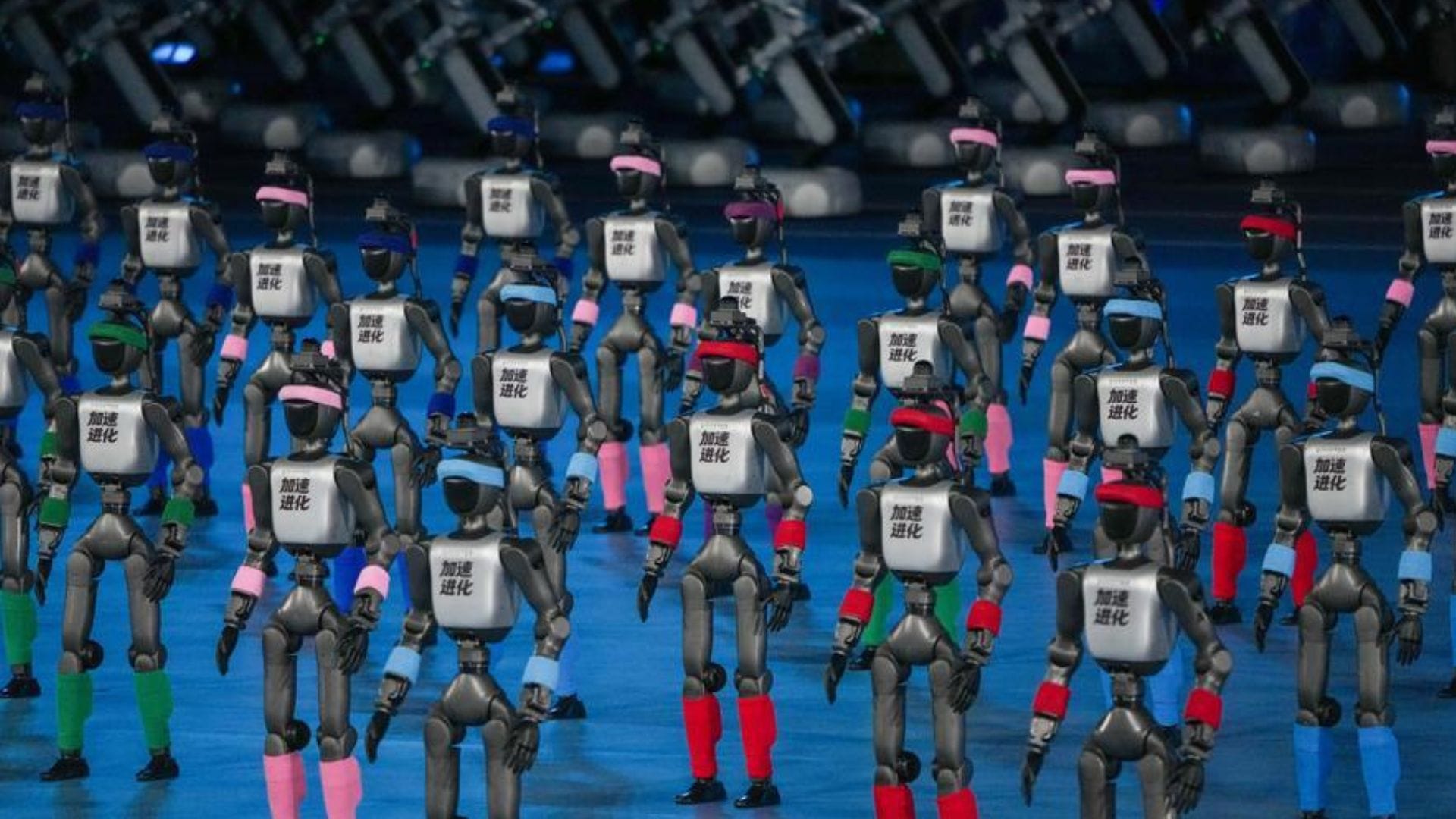
Chinese humanoid robots are demonstrating increasingly advanced physical and artificial intelligence capabilities at the second World Humanoid Robot Games in Beijing, with machines taking on tennis matches, sprint races and a growing range of real-world tasks.
The five-day event began on 22 August at Beijing’s National Speed Skating Oval, the venue used for speed skating during the 2022 Winter Olympics. More than 2,000 humanoid robots from hundreds of teams are taking part in 51 events, highlighting China’s growing focus on robotics and embodied artificial intelligence.
Humanoid robot takes on human players in tennis
One of the opening demonstrations featured a humanoid robot developed by Beijing-based Galbot playing tennis against human opponents. The machine tracked the ball as it crossed the net, moved into position and returned shots using a racquet during singles and mixed-doubles demonstrations.
The robot also showed some of the limitations that still affect humanoid machines. While chasing a shot, it lost its balance and fell backwards, prompting a reaction from spectators. It then rolled over, pushed itself upright and returned to the match. Galbot described the demonstration as the world’s first human-robot tennis match.
Tennis is particularly demanding for a humanoid robot because the machine must complete several tasks almost simultaneously. It needs to identify the incoming ball, estimate where it will land, move its body into the correct position and coordinate its arms and torso to make a controlled return. Official information about this year’s games also highlights table tennis as a new challenge designed to test rapid hand-eye coordination and autonomous decision-making.
The wider competition has expanded significantly since the inaugural games in 2025. Organisers say this year’s event involves 666 teams and 2,056 robots across 51 events, compared with 280 teams in the first edition. The programme includes sports such as football, track and field, table tennis, martial arts and dance, alongside scenario-based competitions that place robots in environments resembling factories, hotels, homes and logistics operations.
Robots break human sprint records
The robots have also produced striking results on the athletics track. A Tien Kung robot won the 400-metre large-robot race in 38.15 seconds, faster than the human men’s world record of 43.03 seconds. The second- and third-placed robots also completed the distance in under 40 seconds, recording times of 39.45 and 39.66 seconds.
The result represented a major improvement over last year, when the winning robot completed the same event in 88.03 seconds. The acceleration in performance shows how quickly developers are improving the mechanical systems, control software and balance required for humanoid robots to move at higher speeds.
Another machine made headlines in the 100 metres. A Tien Kung Ultra robot recorded a time of 9.39 seconds, beating Usain Bolt’s human world record of 9.58 seconds. The performance was reported during the opening of this year’s games, while other robots have also produced major improvements in jumping events.
The results nevertheless need to be viewed in the context of robot competition rather than conventional human athletics. Robots have different physical characteristics, power systems and operating constraints, meaning comparisons with human sporting records are primarily demonstrations of engineering performance rather than conventional sporting achievements.
The games have also shown that higher speed does not necessarily mean greater reliability. During football matches, robots have collided with teammates, while machines that fell during running events sometimes had to be removed from the track by staff using stretchers or wheelchairs. Such incidents illustrate the gap between achieving a fast movement and maintaining stable, reliable control throughout an entire activity.
Network and battery limits remain major challenges
The growing emphasis on autonomous robots is also changing the role of communications networks. Yang Lifan, deputy general manager of China Unicom’s Beijing branch, said robots at the previous games depended more heavily on remote control, placing fewer demands on network infrastructure.
As robots have become more autonomous, however, competitions increasingly require them to process sensor information and make decisions while operating independently. Yang pointed to Beijing’s humanoid robot half-marathon in April as an example of how outdoor events can create greater connectivity requirements than indoor competitions, where Wi-Fi may be sufficient.
“Now the network has become an indispensable part of it, and its importance will only continue to grow,” Yang said.
This year, more robots are equipped with 5G-Advanced modules capable of sending information from on-board sensors to embodied-intelligence systems for processing before receiving instructions in return. The approach lets robots draw on more computing power without necessarily placing the full processing burden on their own hardware.
Battery capacity remains another significant obstacle. David Li, an executive at Huawei Technologies, said much of a humanoid robot’s available power is already consumed by the motors needed to move its body.
“If AI computing is also put on the robot, battery consumption will increase further,” he said.
Some developers are therefore shifting more artificial intelligence processing to cloud-based systems, allowing the robot’s battery to focus primarily on movement. This approach could extend operating time, but it also makes stable, fast network connections more important.
The event is consequently serving as more than a showcase for robots that can run quickly or play sports. Its scenario-based competitions are intended to test whether humanoid machines can perform useful tasks in environments that resemble real workplaces and homes. Beijing’s government has said the expanded events are designed to move robots beyond demonstrations and towards practical applications.
The combination of sporting challenges and practical tasks highlights the current state of humanoid robotics: machines are becoming faster, more capable and increasingly autonomous, but still face fundamental challenges involving balance, energy use, computing and reliable operation. The World Humanoid Robot Games provide developers with a highly visible setting in which to test those limitations while showing how quickly the technology is evolving.