

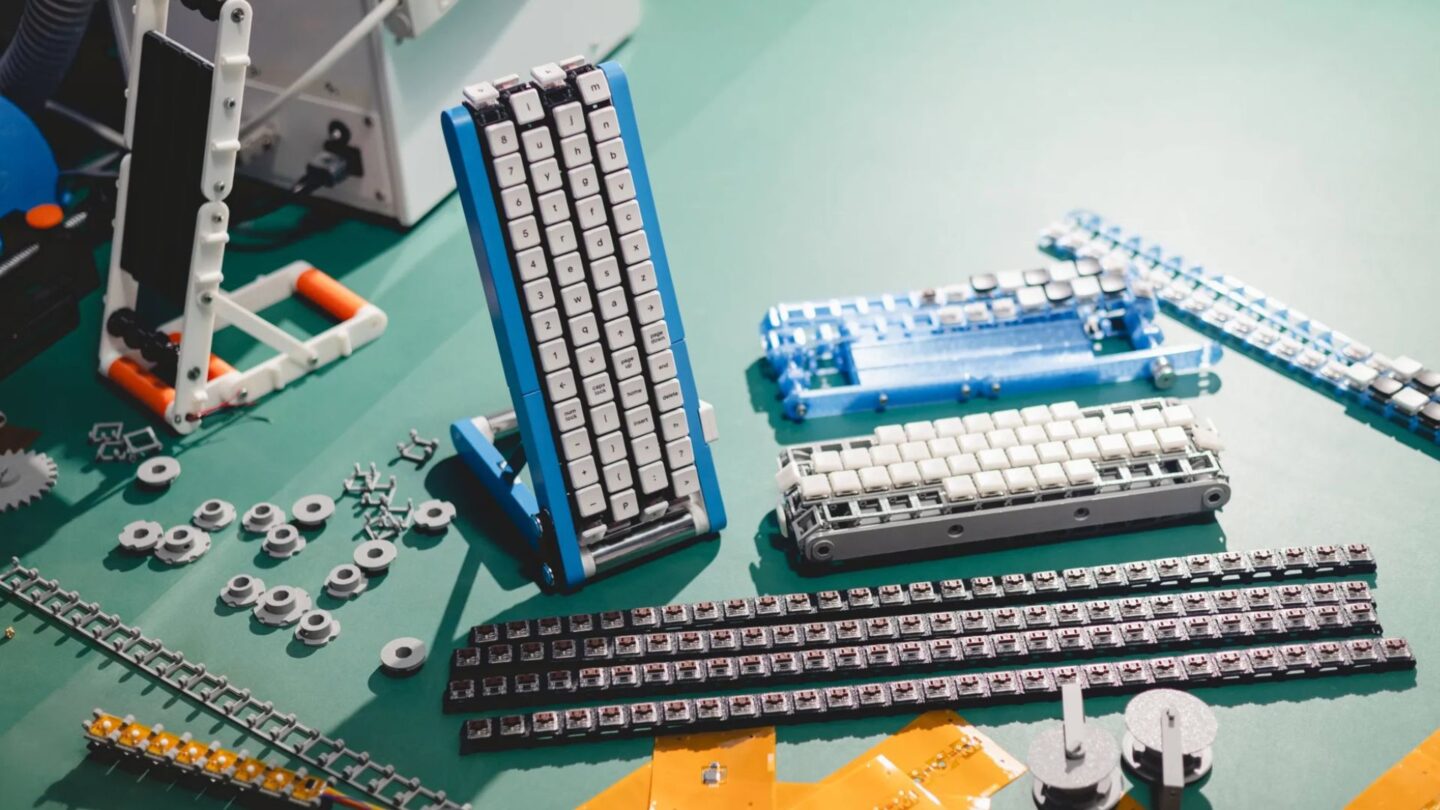
Google Japan has unveiled a highly unusual physical keyboard that replaces a conventional keyboard’s fixed layout with rotating belts covered in keycaps. Called the Gboard Kurukuru Version, the experimental device is designed around the idea that the keys should move towards the user rather than forcing the user’s fingers to move around the keyboard.
The concept is the latest in Google Japan’s series of unconventional Gboard projects, which often combine practical ideas with deliberately playful hardware designs. While the Kurukuru Version is unlikely to replace standard keyboards, Google has published the project as an open-source DIY design for people who want to build the unusual device themselves.
ユーザーのみなさまへ Gboard チームからの新しいご提案です。 キーが指先まで流れてくるキーボード 『Gboard くるくるバージョン』を開発しました。 フルバージョンはリプライでご確認ください↓ https://t.co/OHyPNKTF5G
— Google Japan (@googlejapan) October 1, 2026
A keyboard where the keys come to the user
Traditional keyboards require users to move their hands and fingers between different keys across a fixed surface. Google Japan’s Gboard team approached the problem from the opposite direction, asking what would happen if the keys themselves moved into position.
The Kurukuru Version uses four continuously rotating conveyor belts, each carrying 29 keys. Together, the four belts provide 116 keys. As the belts move, individual characters travel towards the typing position, allowing the user to press the required key when it reaches the appropriate spot.
The design focuses on one-handed typing. Google Japan says conventional keyboards can become difficult to use when someone is typing with only one hand, and the challenge becomes even greater when using a single finger. By moving the keys instead of requiring the user to reach across the keyboard, the company aims to reduce hand movement.
The experimental keyboard also takes a different approach to capitalisation. Rather than requiring users to hold the Shift key, it represents uppercase and lowercase letters with separate keys. This lets users select both forms of a character directly from the moving belts.
The result is a keyboard that looks more like a small piece of industrial machinery than a conventional computer accessory. The rotating belts give it an appearance reminiscent of miniature excavator tracks, while the moving keycaps turn typing into something closer to a physical timing exercise.
Google imagines a free hand for other tasks
Google Japan says the unusual design could allow users to keep one hand occupied with another activity while typing. The company has jokingly suggested that the free hand could operate a mouse or even hold a cup of tea.
The concept also leaves room for further experimentation. Google Japan has suggested that people could use two Kurukuru keyboards together, although doing so would add even more moving machinery to a desktop setup.
The project is less about creating a practical replacement for today’s keyboards and more about exploring how familiar computer interfaces could be redesigned. Its unusual mechanism turns a simple action such as pressing a letter into an interaction involving continuously moving physical components.
The project also continues Google Japan’s long-running tradition of producing unconventional Gboard concepts. Previous experiments have included the Gboard Bar, an extremely long keyboard, a wearable Gboard Caps design and a double-sided keyboard. The company also previously created the Gboard Dial, which drew inspiration from the rotary telephone.
These projects typically combine functional concepts with humour, allowing Google Japan to explore alternative approaches to typing without presenting them as mainstream hardware products.
The Kurukuru Version is a DIY project
Despite its elaborate appearance, Google is not releasing the Kurukuru Version as a commercial keyboard. Google Japan has instead published the project as an open-source DIY design, allowing enthusiasts to examine the concept and attempt to construct their own version.
That approach means the project targets makers and hardware enthusiasts more than ordinary computer users. Building a keyboard with multiple continuously moving conveyor belts and dozens of individual keycaps is considerably more complicated than assembling a conventional mechanical keyboard.
Google Japan also chose 1 October as the project’s launch date for a specific reason. The date, written as 10/1, references the traditional 101-key keyboard layout. The choice fits the project’s broader theme of taking a familiar keyboard concept and turning it into something considerably more unusual.
The company has already hinted at possible variations that people developing the design could explore. These include faster-moving belts, longer versions that can carry additional characters, shorter portable models, and versions available in different colours.
While the Kurukuru Version is unlikely to become a mainstream keyboard, its open-source nature allows enthusiasts to experiment with the concept. For Google Japan, it represents another playful attempt to rethink one of the most familiar pieces of computer hardware.