

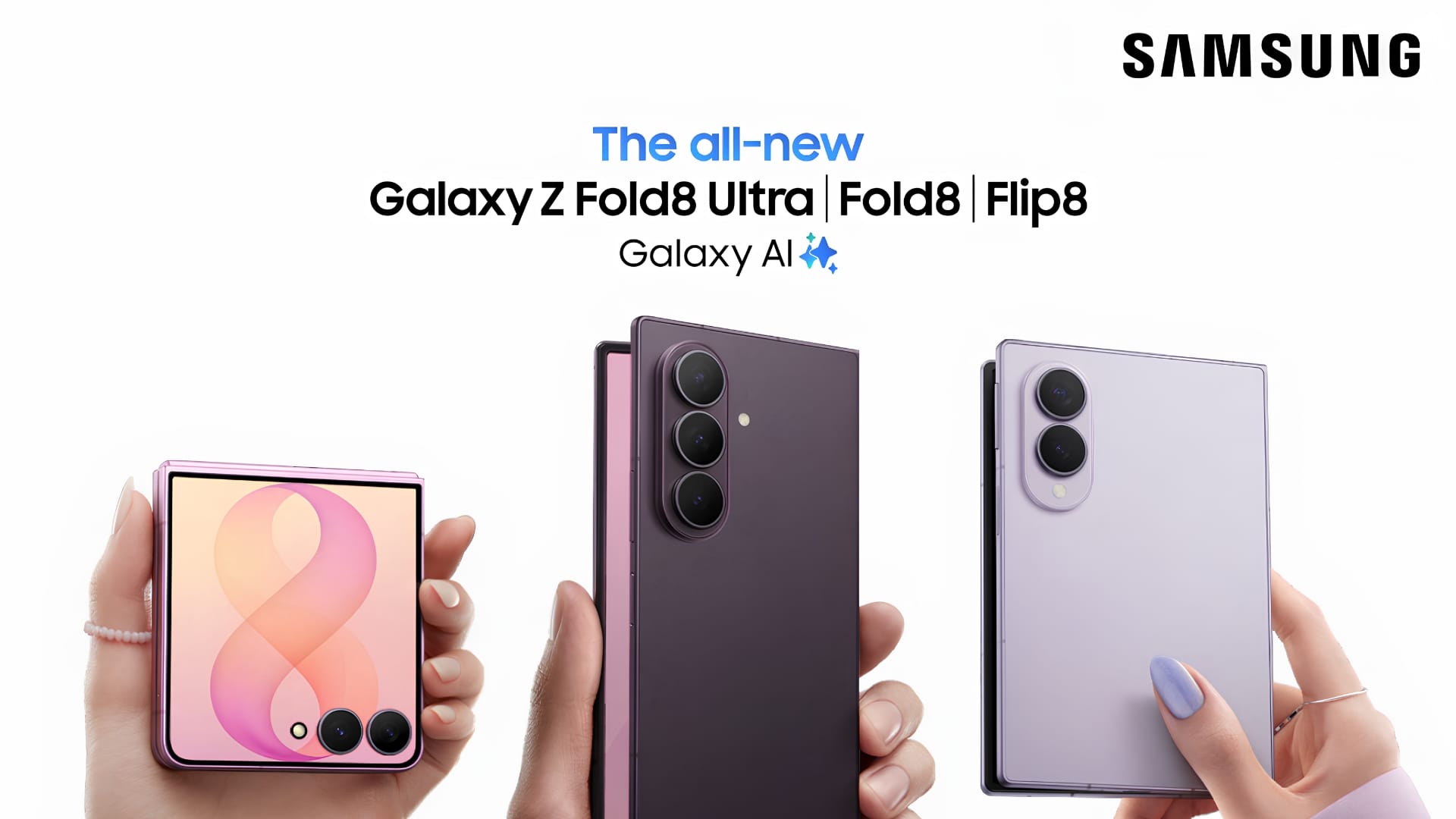
Samsung has expanded its foldable smartphone range to three devices, segmenting the Galaxy Z8 line-up across large-screen productivity, media consumption, and compact cover-screen interaction. Within this updated range, the Galaxy Z Fold8 Ultra carries the largest display alongside the most advanced camera system, whereas the Galaxy Z Fold8 features a lighter and more compact design. Meanwhile, the Galaxy Z Flip8 retains the familiar clamshell format while placing a wider selection of applications and artificial intelligence controls directly on its external screen.
Ronnie Ng, Vice President and Head of Mobile eXperience at Samsung Electronics Singapore, attributed this expanded lineup to distinct differences in how consumers use foldable devices. Rather than positioning the Fold8 Ultra as a simple specification upgrade over the standard Fold8, Samsung is treating all three models as distinct, standalone products.
All three smartphones are available for pre-order in Singapore from 22 July.
Fold8 adopts a lighter design for reading and entertainment
Weighing 201g, the Galaxy Z Fold8 is Samsung’s lightest Fold model to date. Its 5.5-inch external screen features a shape well suited for messaging, social media updates, and short videos, whereas the 7.6-inch internal display opens into a four-by-three layout designed for films and gaming. When the unfolded phone is rotated, it provides an orientation that is better tailored for reading articles and e-books.
Under the hood, the device is powered by the Snapdragon 8 Elite Gen 5 for Galaxy processor and carries a 4,800mAh battery. Storage configurations extend up to 1TB alongside up to 16GB of memory, while charging capabilities support 45W wired charging and 20W wireless charging.
Samsung has also revised the underlying structure beneath the folding display. Known as Flex Titanium, this architecture combines a titanium-alloy film with an enhanced titanium plate, which the company claims strengthens display support, absorbs pressure, and reduces crease visibility over time. Additionally, the main screen achieves up to 3,000 nits of peak brightness and includes a low-reflection finish to improve outdoor visibility.
The camera setup includes two 50MP rear sensors covering wide and ultra-wide perspectives. A Dual Recording feature allows users to capture footage from both sides of a scene simultaneously while displaying a live preview on the external screen. Furthermore, the My FanCam tool automatically follows a selected subject and reframes the footage to suit a chosen video format, though Samsung notes that tracking accuracy is not guaranteed and may vary depending on the video.
Fold8 Ultra adds a larger screen and stronger camera hardware
The Galaxy Z Fold8 Ultra expands the internal display to 8 inches and increases the external screen to 6.5 inches. Weighing 215g and measuring just 4.1mm when unfolded, it stands as Samsung’s thinnest Z Fold design to date.
This larger chassis accommodates a 5,000mAh battery and features an expanded graphite cooling structure designed to dissipate heat during heavier workloads. Samsung has also introduced a dual-path charging architecture that distributes power across the battery system, supporting 45W wired charging. Like the standard Fold8, the Ultra runs on the same Snapdragon 8 Elite Gen 5 for Galaxy processor.
Camera hardware marks the clearest distinction between the two Fold models. The Fold8 Ultra combines a 200MP main camera, a 50MP ultra-wide camera, and a 10MP telephoto lens featuring 3x optical zoom. High dynamic range capture remains available even when shooting at full 200MP resolution, while the ultra-wide sensor doubles as a macro camera. In addition, Samsung has incorporated enhanced low-light processing for both still photography and video recording.
Video capabilities include 8K recording using the APV codec alongside Cine LUT controls for adjusting colour and tone. These features are targeted at users who wish to capture and edit higher-resolution footage directly on the device, although the press release provides no performance comparisons against dedicated cameras or professional editing equipment.
Flip8 moves more functions to the external screen
The Galaxy Z Flip8 weighs 180g and measures 6.1mm when unfolded. It features a 4.1-inch FlexWindow designed to display apps, information cards, and suggested actions, thereby reducing the need to unfold the main 6.9-inch internal display.
Powering the Flip8 is Samsung’s Exynos 2600 processor, paired with 12GB of memory and a choice of 256GB or 512GB of internal storage. Its 4,300mAh battery supports 25W wired charging and 15W wireless charging, both of which fall below the charging speeds offered on the Fold models.
Photography on the Flip8 remains closely integrated with its folding design. Flex Mode enables the handset to stand partially open for hands-free capture, while the Camcorder Grip feature adds dedicated zoom controls for video. Furthermore, the Super Steady stabilisation suite includes a Horizontal Lock setting designed to maintain level footage during motion.
The rear camera array pairs a 50MP main sensor with a 12MP ultra-wide camera. The external display can show a live selfie preview, while tools such as FlipShot and Mirror view offer additional controls for framing and appearance checks prior to snapping a photograph.
AI tools connect information with follow-up actions
One UI 9 introduces a shared suite of artificial intelligence features across all three devices, each adapted to fit their respective screen sizes. Now Brief delivers personalised updates alongside security and privacy details, while Now Nudge analyses conversations to suggest relevant actions, such as reviewing a schedule, searching for a venue, or saving a location.
Gemini Intelligence can process written instructions, images, or on-screen content to execute tasks across more than 40 supported applications and services. Examples highlighted by Samsung include searching for event tickets, locating nearby restaurants, and completing dining reservations.
Gemini Notebook consolidates notes, audio recordings, images, files, and documents into a unified workspace. On the Fold models, content can be dragged directly into the notebook while running two applications side by side, allowing users to convert material into formatted reports, meeting recaps, audio summaries, or infographics.
Feature availability varies depending on the market, language, and specific application. Automated tasks executed via the Flip8’s external screen initially support the United States and South Korea in English and Korean, with expanded regional and language support planned for later in 2026.
One UI 9 adds a record of automated actions
To keep track of automated tasks executed across multiple applications, One UI 9 introduces an AI Assistant Activity dashboard that consolidates eligible actions in one central location. From this dashboard, users can access individual services to review details or adjust settings, while Privacy Alerts highlight unnecessary requests for background permissions.
On-device personalisation relies on Samsung’s Personal Data Engine to process user information. Knox Enhanced Encrypted Protection isolates this data into encrypted storage partitioned for individual applications, while Knox Vault provides hardware-based security for sensitive credentials. Samsung states that all analysed information is permanently deleted whenever the Personal Data Intelligence setting is turned off.
Samsung has also streamlined the process of migrating from an iPhone. The updated Smart Switch utility can initiate wireless transfers via a QR code, transferring data such as passwords, passkeys, call history, accessibility preferences, and eSIM profile details on compatible devices. Additionally, Quick Share enables file exchanges with supported Apple devices through AirDrop compatibility, though specific software and hardware requirements apply.
All three smartphones ship with Android 17 and One UI 9, backed by an IP48 water-resistance rating. Furthermore, buyers receive a complimentary six-month trial of Google AI Pro accompanied by 5TB of cloud storage.