


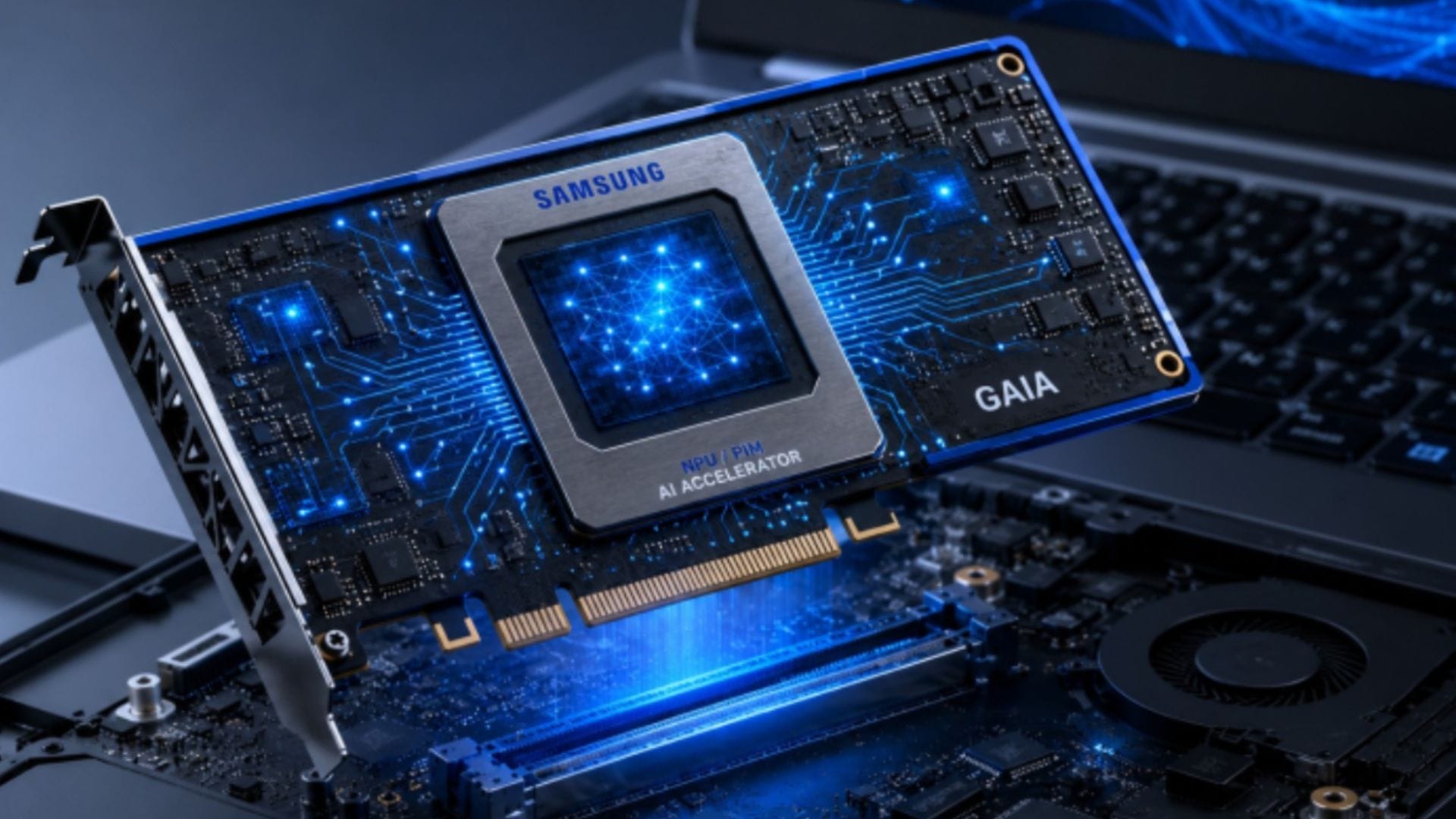
Samsung is reportedly developing a new artificial intelligence chip that could eventually improve the performance and efficiency of future Exynos processors used in Galaxy smartphones. Although the technology is currently aimed at AI-powered laptops, its underlying design has sparked speculation that it may later find its way into Samsung’s mobile chips.
The chip, codenamed GAIA, is being developed by Samsung’s System LSI division, the same business unit responsible for Exynos processors. Early reports suggest the company has already supplied prototype chips to PC manufacturers including HP and Lenovo for testing ahead of a possible commercial launch in 2027.
Samsung focuses on AI processing with GAIA
GAIA is designed as a dedicated neural processing unit (NPU) built using Samsung’s 4nm manufacturing process. Rather than replacing a processor, the chip is intended to work alongside existing CPUs and GPUs to accelerate artificial intelligence workloads directly on a device.
According to reports, GAIA uses a memory-centric architecture that places computing functions close to dedicated memory. This approach is designed to reduce the distance between processing and memory access, improving efficiency while lowering power consumption during AI tasks. It could allow laptops to perform functions such as chatbot responses, image editing and language processing locally instead of relying on cloud-based services.
The architecture has drawn comparisons with Apple’s unified memory approach because both designs aim to minimise data movement between memory and processing units. However, GAIA appears to be specifically optimised for artificial intelligence workloads rather than serving as a general-purpose memory system. Samsung has not publicly confirmed detailed technical specifications, including performance figures or power efficiency, but industry reports indicate the company is exploring advanced memory technologies alongside the new AI accelerator.
Potential benefits for future Exynos processors
Although GAIA is currently intended for AI PCs, its development within Samsung’s System LSI division has fuelled speculation that similar technology could eventually be incorporated into future Exynos mobile processors.
Users have often criticised Exynos-powered Galaxy smartphones for generating more heat and consuming more battery power during demanding tasks such as gaming, prolonged photography and video rendering. These issues have frequently led to comparisons with Snapdragon-powered Galaxy models, which have generally been regarded as offering better sustained performance and thermal management.
If Samsung adapts GAIA’s memory-centric design for smartphones, future Exynos chips could process AI features more efficiently while reducing heat generation. Many modern smartphone functions, including image enhancement, live translation, voice assistants and generative AI tools, increasingly rely on local AI processing rather than cloud-based services. A more efficient AI architecture could therefore improve both responsiveness and battery life.
However, there is currently no confirmation that Samsung plans to integrate GAIA technology into Exynos processors. The reports only suggest that the laptop chip could provide a technical foundation for future mobile designs once it has been validated in larger computing devices.
Laptop testing could reduce risks before mobile adoption
Testing GAIA in laptops before bringing similar technology to smartphones could allow Samsung to refine the architecture under demanding workloads before deploying it in devices used daily by millions of consumers.
Early reports indicate that prototype chips have already been sent to HP and Lenovo for evaluation, with mass production potentially beginning in 2027 if development progresses as planned. Running extensive validation in PCs would allow Samsung to assess reliability, software compatibility and real-world AI performance before considering broader applications.
Even if the architecture eventually reaches Galaxy smartphones, it is unlikely to solve every issue associated with Exynos processors. Other components, including cellular modems and radio systems, play a significant role in overall device performance, battery life and connectivity. Improvements in AI processing would not directly address those areas.
For now, GAIA remains an unannounced project, and Samsung has yet to reveal official specifications or confirm plans beyond the reported laptop programme. Nevertheless, the development signals the company’s continued investment in on-device AI hardware. It suggests that future generations of Exynos processors could benefit from technologies first proven in the AI PC market. If successful, GAIA may become an important stepping stone in Samsung’s effort to narrow the performance and efficiency gap between its own mobile processors and competing chipsets.