


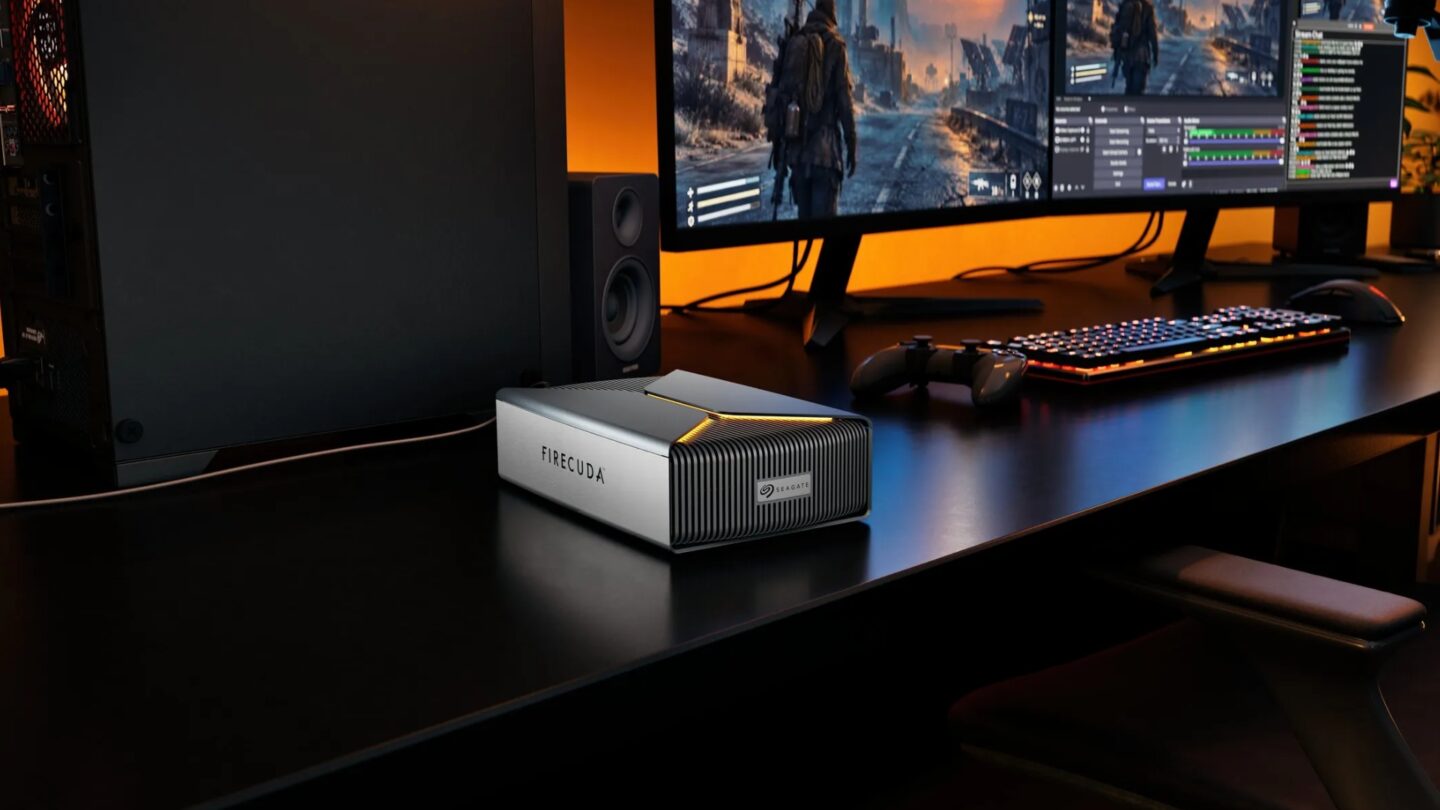
Seagate has introduced the FireCuda Forge, an external storage system that combines a user-supplied NVMe solid-state drive (SSD) with a high-capacity hard disk drive (HDD). It marks the company’s first hard drive powered by Alkemi, a new intelligent storage platform that automatically prioritises frequently accessed data on the SSD while keeping larger collections on the HDD.
Available in 8TB and 20TB configurations, the FireCuda Forge targets gamers and content creators managing large game libraries, 4K video and other media. Connectivity is handled via USB4 for compatible computers, with Seagate claiming read speeds of up to 2,500MB/s and write speeds of up to 2,000MB/s.
How Alkemi manages SSD and HDD storage
Through dynamic caching, Alkemi monitors how data is accessed and automatically prioritises recent and frequently used content on the SSD, while the HDD provides capacity for larger collections. As usage patterns change, the platform adjusts which data receives priority, which Seagate says reduces the need for users to manage files manually between the two storage technologies.
The approach applies intelligent data tiering, a technique used in data centres, to desktop storage. Within a single enclosure with onboard processing, the FireCuda Forge combines the user’s NVMe SSD and its high-capacity HDD, allowing Alkemi to manage data placement as one storage drive.
Seagate designed the system for workloads involving growing volumes of digital content, including gaming, streaming, video production and AI-powered animation. Over time, Alkemi learns from activity patterns, adjusting its caching decisions as users access different content.
The company also cites IDC’s Global DataSphere Forecast, 2026–2030, which projects annual global data generation increasing from 218 zettabytes in 2025 to more than 718 zettabytes by 2030. Covering worldwide data generation, the forecast provides context for the increasing volumes of content being created and stored.
Hardware, performance and compatibility
For everyday operation, the FireCuda Forge requires users to select and provide their own NVMe SSD. Because this solid-state drive is an essential component of the storage system, buyers are responsible for choosing a compatible drive in addition to the FireCuda Forge itself. The included HDD is also upgradeable, allowing storage capacity to be expanded as requirements change and giving buyers flexibility in configuring the two storage components alongside the user-selected SSD.
High-bandwidth USB4 connectivity supports gaming and content-creation workflows on compatible systems. For operating system compatibility, Seagate designed the storage system to support Windows 11 and macOS 26 and above.
The combination of SSD caching and HDD capacity is intended for users who regularly access large games, video files and other digital collections. By managing data placement automatically, Alkemi allows the system to adapt to different usage patterns without manual file management.
Pricing and availability
The Seagate FireCuda Forge is available through the company’s official stores on Lazada and Shopee, with two storage configurations offered. Suggested retail pricing is set at S$1,209 for the 8TB model and S$1,569 for the 20TB version, with both prices including GST. Because buyers must supply their own NVMe SSD, the total cost of a working storage system will depend on the SSD selected in addition to the FireCuda Forge configuration. The upgradeable HDD also provides an option to increase capacity after purchase.