

AMD has rolled out a new graphics driver update that introduces FSR Redstone, a fresh suite of artificial intelligence-driven upscaling technologies designed for the Radeon RX 9000 Series. The update is available through the company’s Adrenalin software and builds on the existing FSR 4 technology, expanding its capabilities rather than replacing it outright. Like FSR 4, Redstone is limited to GPUs based on AMD’s RDNA 4 architecture.
FSR, or FidelityFX Super Resolution, is AMD’s answer to the growing demand for performance-boosting technologies in modern games. It competes directly with Nvidia’s DLSS and Intel’s XeSS, both of which aim to improve frame rates and image quality through advanced upscaling. First revealed at Computex 2025, FSR Redstone marks AMD’s most significant step yet towards deeper machine learning integration into its graphics stack.
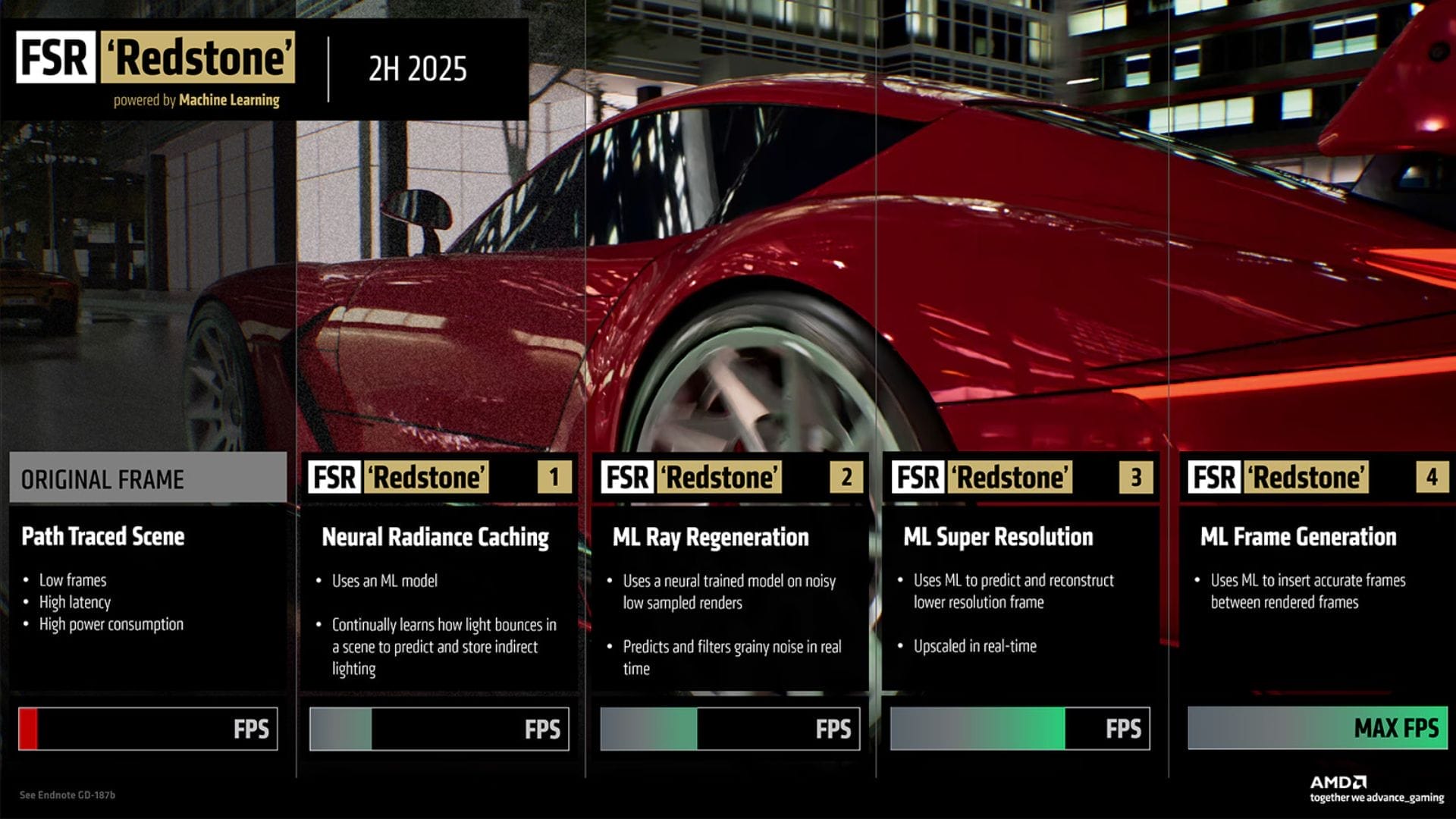
At its core, Redstone introduces several new features that rely on neural networks and real-time learning. These additions are designed to tackle some of the biggest challenges in modern graphics, including ray tracing noise, lighting accuracy and motion artefacts during fast-paced gameplay.
New AI-powered features expand FSR’s capabilities
FSR Redstone introduces three new technologies that sit alongside what was previously known as FSR 4. The first is FSR Radiance Caching, a system that learns how light behaves within a scene and predicts how it will move and interact with surfaces. By analysing lighting patterns in real time, the technology aims to deliver more realistic illumination without the heavy performance cost usually associated with complex lighting calculations.
Another major addition is FSR Ray Regeneration. Ray tracing, while visually impressive, often suffers from visible noise, especially when games rely on fewer light samples to maintain performance. Ray Regeneration addresses this issue by analysing low-sample frames and cleaning them up in real time, reducing grainy artefacts on surfaces affected by ray-traced lighting.
The third feature is FSR Frame Generation (ML), which represents an evolution of frame generation techniques already present in earlier versions of FSR. This new approach uses a neural network that examines two consecutive frames and generates additional frames between them. The goal is to smooth motion and reduce ghosting, which can occur when objects move quickly across the screen.
Alongside these additions, AMD has rebranded FSR 4 as FSR Upscaling (ML). This change reflects the company’s broader push towards machine learning-based solutions and positions Redstone as a more comprehensive platform rather than a single feature update.
AMD has highlighted ambitious performance gains made possible by Redstone. In demonstrations with a Radeon RX 9070 XT, the company claims frame rates can increase by up to 4x in demanding titles such as Call of Duty: Black Ops 7 and Cyberpunk 2077. In F1 25, AMD reports performance gains of up to 3x compared with running the game without the new technology enabled. These figures underline AMD’s intention to close the performance gap with its main rival in AI-driven graphics.
Game support promises a wide reach, but with caveats
Support from game developers is a crucial factor in the success of any upscaling technology, and AMD has made bold claims in this area. According to the company, more than 200 games are expected to support FSR Redstone by the end of this year. This list includes well-known titles such as Arc Raiders, Battlefield 6, Black Myth: Wukong, GTA V Enhanced and Silent Hill f.
However, a closer look reveals that this figure refers to support for at least one Redstone feature, rather than full support for the entire suite. Only a small portion of the announced titles will take advantage of the most advanced features in the near term. For example, AMD has indicated that just 32 games will support FSR Frame Generation (ML) within the next month.
Some games are included in the overall count simply because they already support FSR 4, now renamed FSR Upscaling (ML). This means that while the headline number suggests broad adoption, actual use of the newest technologies will roll out more gradually.
The two newest features, Radiance Caching and Ray Regeneration, currently have the least real-world support. Radiance Caching is not yet available in any released game. AMD has demonstrated it running in Warhammer 40,000 Darktide, but the game’s developer, Fatshark, has confirmed that the feature is still in development and not ready for public use.
Ray Regeneration has seen slightly more progress, but its reach remains limited. At present, Call of Duty: Black Ops 7 is the only game confirmed to support it. Notably, this title effectively served as a soft launch for FSR Redstone, as it included Ray Regeneration at release.
Hardware limits and competition from Nvidia
One of the most contentious aspects of FSR Redstone is its hardware restriction. The technology only works on RDNA 4-based GPUs, which means it is limited to the Radeon RX 9000 Series. For users with older Radeon cards, this will likely be a disappointment, especially for those who had hoped AMD would extend FSR 4 or its successors to earlier hardware generations.
This limitation stands in contrast to Nvidia’s approach. Some DLSS 4 features are available on graphics cards dating back to the RTX 20 Series, giving Nvidia a broader installed base that can benefit from its latest technologies. As a result, AMD’s decision to restrict Redstone to newer hardware may slow adoption among gamers who are not yet ready to upgrade.
Despite this, AMD does have one area where it is competitive with Nvidia, at least in the short term. In terms of game adoption for the latest version of its technology, AMD’s claim of over 200 supported titles compares favourably with Nvidia’s statement that more than 175 games currently support DLSS 4.
That said, the wider picture still favours Nvidia. Across all versions of DLSS, Nvidia reports support in more than 800 games. By comparison, before the launch of Redstone, FSR was supported in around 300 titles, according to figures cited by Tom’s Hardware. This highlights the scale of the challenge AMD faces if it wants to match Nvidia’s long-term market presence.
FSR Redstone represents a clear statement of intent from AMD. By doubling down on machine learning and introducing features that address real-world graphical challenges, the company aims to strengthen its position in a highly competitive space. While hardware limitations and uneven feature support may temper initial enthusiasm, Redstone lays the groundwork for a more advanced and unified upscaling platform on future Radeon GPUs.