

Western Digital has outlined a broad storage roadmap aimed at supporting the rapid growth of artificial intelligence workloads, positioning itself as a long-term storage infrastructure partner for the AI-driven data economy. Announced at the company’s Innovation Day 2026 in Singapore, the updates mark a major step in its transformation into a hard-drive-focused business operating under the WD brand, with renewed emphasis on capacity, performance, power efficiency and faster customer deployment.
The company said demand for AI training and inference is driving unprecedented data growth, intensifying the need for reliable, high-capacity storage with predictable economics. WD’s roadmap reflects a customer-centric approach that prioritises proven reliability, cost efficiency, performance gains and smooth qualification cycles without forcing disruptive technology transitions. These priorities are shaping a new generation of hard-drive technologies designed to scale alongside AI infrastructure.
The announcements also build on a broader business reset completed over the past year. WD highlighted its shift towards multi-year customer partnerships, operational discipline that more than doubled gross profit year on year, and leadership changes that accelerated decision-making. These factors contributed to its inclusion in the Nasdaq 100 and its ranking among the top S&P 500 performers in 2025. Alongside the technology roadmap, the company shared a new financial model covering the next three to five years and introduced refreshed branding that reflects its focus on data-centre-centric storage infrastructure.
A dual-path approach to scaling capacity to 100TB
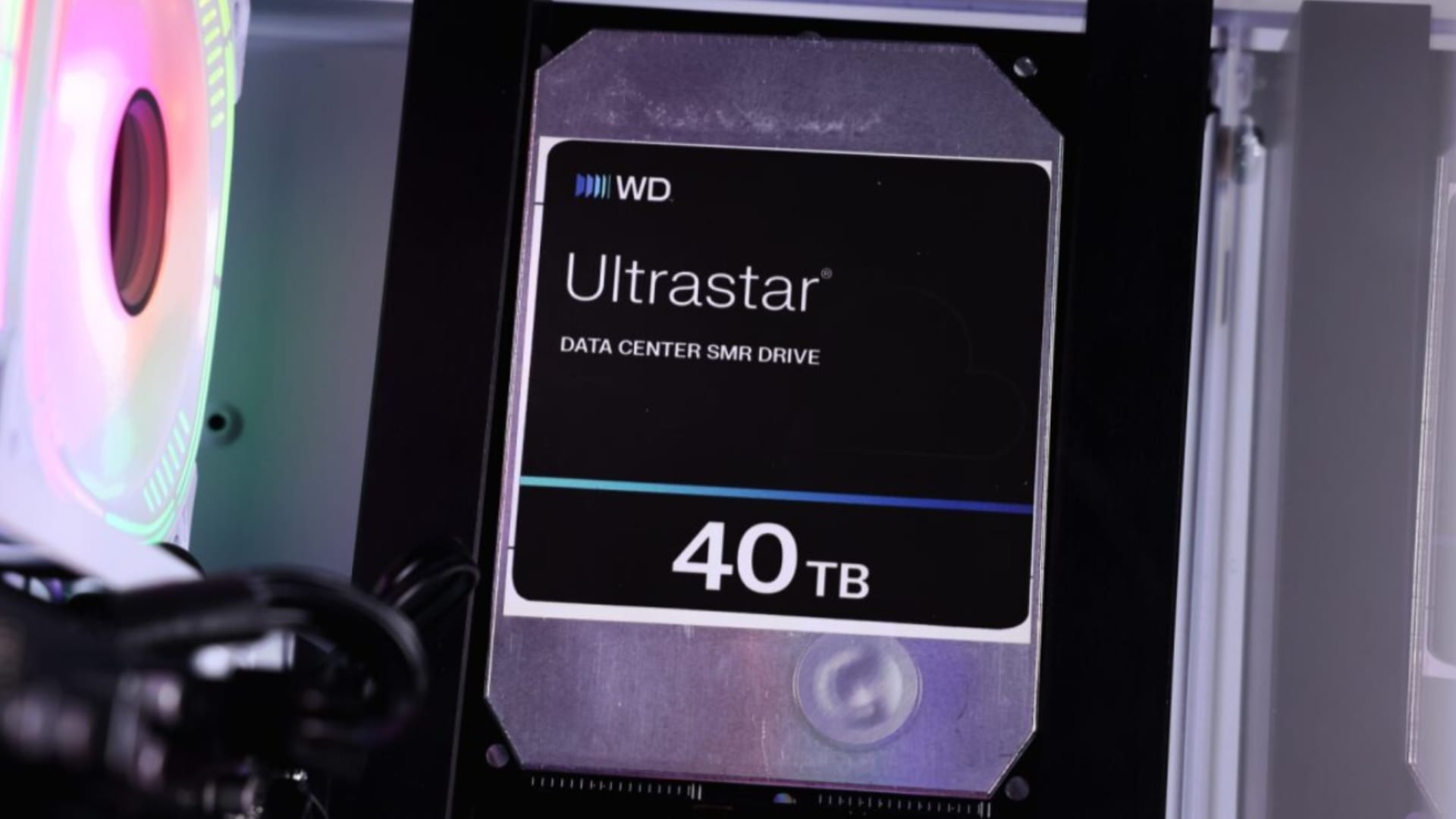
At the centre of WD’s roadmap is a dual technology strategy built on energy-assisted perpendicular magnetic recording and heat-assisted magnetic recording. The company confirmed that the world’s highest-capacity 40TB UltraSMR ePMR hard drive is currently in customer qualification with two hyperscale operators, with volume production planned for the second half of 2026. In parallel, HAMR-based drives are undergoing qualification with two hyperscale customers, with ramp production expected in 2027.
WD plans to extend ePMR technology to 60TB by incorporating HAMR innovations without increasing power consumption. At the same time, HAMR is expected to scale to capacities to 100TB by 2029. Both technologies share a common architecture, which WD said improves manufacturing efficiency and yields while enabling smoother customer transitions between capacity tiers.
This overlapping roadmap is designed to give hyperscalers and enterprises greater flexibility. Customers can adopt either ePMR or HAMR on their own timelines, enabling predictable capacity planning without forced migrations or infrastructure disruption. According to WD, this approach supports continuous capacity growth while preserving compatibility with existing platforms already deployed at scale.
Re-engineering HDD performance for AI workloads
Beyond capacity, WD is targeting performance gains that bring hard drives closer to workloads traditionally reserved for flash storage. The company introduced two new technologies aimed at narrowing the gap with quad-level cell flash, which continues to face higher costs and endurance constraints. WD estimates flash storage remains six to ten times more expensive than hard drives for comparable capacity.
High Bandwidth Drive technology enables simultaneous read and write operations across multiple heads and tracks, delivering up to double the bandwidth of conventional hard drives without additional power draw. WD said the design has a roadmap to scale bandwidth gains up to eight times over time, and early versions are already in customer hands for validation.
The second innovation, Dual Pivot technology, adds a separate set of independently operating actuators within a standard 3.5-inch drive. This approach is expected to deliver up to double the sequential input and output performance without sacrificing capacity or requiring extensive customer software changes. By allowing reduced spacing between disks, Dual Pivot designs support more platters per drive and higher overall capacity. Combined with High Bandwidth Drive technology, WD expects to deliver up to four times the sequential I/O performance required to support 100TB hard drives while maintaining consistent I/O per terabyte.
Power efficiency and platforms to improve time-to-value
AI workloads are also reshaping storage tiering, with growing volumes of cold data that must still be accessed quickly. WD introduced power-optimised hard drives designed to reduce energy consumption by around 20 per cent, narrowing the gap between warm and cold storage tiers. These drives trade minimal random I/O capability for higher capacity and lower power draw, making them suitable for large AI datasets that need sub-second access without the cost of flash.
The company said these power-optimised drives will enable customers to lower total cost of ownership, build lower-cost storage tiers and improve sustainability across AI-scale deployments. Customer qualification for these drives is expected to begin in 2027.
Alongside hardware, WD announced an expansion of its Platforms business to address the operational challenges faced by mid-scale AI customers. An intelligent software layer, built around an open API and targeted for launch in 2027, is intended to extend hyperscale storage economics to organisations operating at 200 petabytes and above. The platform aims to accelerate deployment across WD’s UltraSMR, ePMR, HAMR and flash products while reducing qualification risk and time-to-production without requiring architectural changes.
WD executives said the combined focus on capacity, performance, power efficiency and platforms reflects a deliberate effort to remove complexity and cost barriers that limit AI-driven growth. Industry analysts said early customer deployments suggest the strategy is resonating in a market where reliable capacity, predictable economics and scalable performance are increasingly critical.