

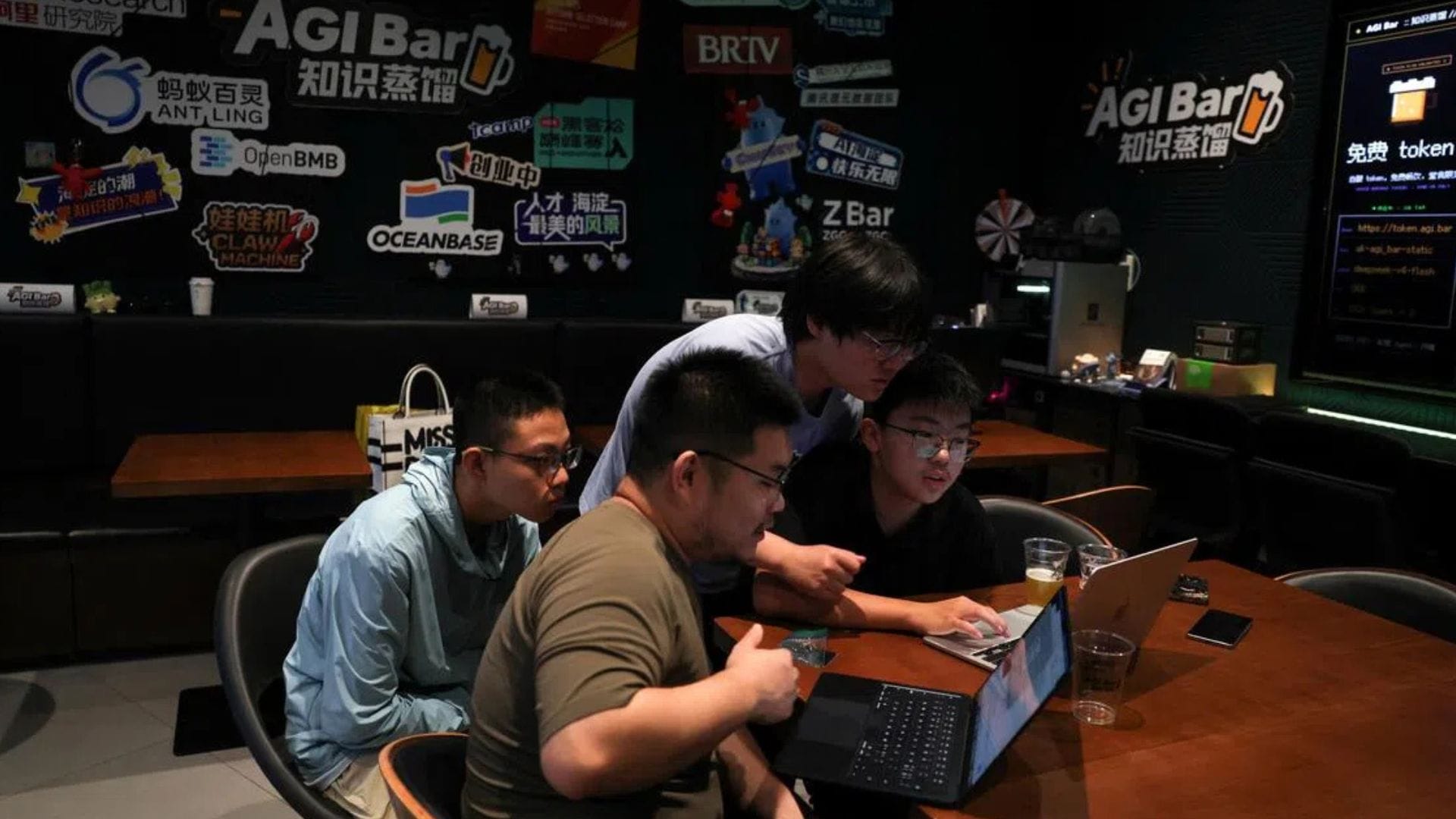
A dumpling restaurant in Beijing is combining a traditional dining experience with one of China’s most prominent technology trends by giving customers AI computing credits and allowing AI agents to help them navigate its services.
Jinguyuan, a dumpling shop near the Beijing University of Posts and Telecommunications, has attracted attention for developing an AI “skill” that lets customers check the menu, receive recommendations, and join the restaurant’s queue through compatible personal AI agents. The experiment highlights how agentic AI is moving beyond technology companies and into everyday businesses.
AI moves from technology offices to the dining table
The restaurant’s AI system was developed by its 41-year-old owner, Li Bo, who studied telecommunications engineering at the Beijing University of Posts and Telecommunications. After completing a master’s degree in 2010, Li did not pursue a conventional engineering career. Instead, he worked in hostels, sold homemade desserts and eventually entered the dumpling business.
A dumpling restaurant in Beijing now gives you AI compute with your meal.
— Poe Zhao (@poezhao0605) August 5, 2026
Finish your dumplings, report your table number at the counter, and claim free tokens for your AI agent.
The card on every table reads: "You're full. Now feed your agent some compute."
This is Jingu… pic.twitter.com/HhavocDtUt
Li became increasingly interested in AI as agentic tools gained popularity in China. He created the Jinguyuan AI skill in April, allowing customers to interact with the restaurant through their own AI assistants. The system can provide menu information, recommend dishes and help customers check or join the queue without requiring them to communicate directly with restaurant staff.
The restaurant has also used AI to support its own operations. Li created a website that displays queue information for Jinguyuan’s two branches, using Alibaba’s Qoder coding tool for much of the development. The restaurant’s official website also presents the business as an AI experiment and allows users with compatible AI tools to ask about queue conditions and menu recommendations.
The experiment goes beyond software. In July, Jinguyuan partnered with an AI cloud provider to give customers a 10-yuan voucher, worth about US$1.50, that can be used towards AI model subscriptions. The unusual promotion effectively gives diners a small amount of computing credit alongside their meal.
A small restaurant reflects China’s enthusiasm for AI
Jinguyuan’s approach comes as AI adoption continues to spread across different parts of Chinese society. The restaurant is located near universities and technology companies, meaning many of its customers are students, software engineers and technology workers who are already familiar with AI tools. That environment has made the restaurant a natural place to experiment with AI agents.
Li has described his approach as an attempt to prepare the business for a future in which AI assistants become a normal part of everyday life. Rather than viewing an AI agent solely as a chatbot, his concept treats it as an intermediary between customers and businesses. A customer could ask an assistant to find a restaurant, check its queue, understand its menu or make recommendations without having to interact with each service separately.
The idea reflects a broader enthusiasm for AI in China. Rest of World reported that people across the country have been experimenting with new AI tools, while interest in agentic systems has extended well beyond technology professionals. When OpenClaw became popular, people reportedly queued to have the agentic software installed on their computers, illustrating how quickly new AI applications can attract public interest.
Chinese businesses are also increasingly using AI to reduce the barriers to developing software and digital services. Li’s restaurant is an example of how these tools can allow a small business owner with an engineering background to build systems that might previously have required a dedicated development team.
Li said China’s long-standing emphasis on technological development partly influenced his motivation. “Science and technology are a primary productive force,” he told Rest of World, quoting former Chinese leader Deng Xiaoping. He added: “You always need to surround yourself with the most advanced productive force.”
The experiment shows where AI adoption could go next
For now, Jinguyuan’s AI system remains more of an experiment than a major operational transformation. Li acknowledged that the AI skill has generated more media attention than actual usage. Still, he sees value in introducing the technology to customers and demonstrating how it could eventually become part of ordinary services.
The restaurant’s approach also illustrates the difference between building an AI feature and finding a practical reason for customers to use it. A diner may not need an AI agent to order dumplings. Still, an assistant that remembers preferences, checks queue times and recommends suitable dishes could become more useful as businesses connect their services to agentic platforms.
Li believes businesses should begin experimenting even if the technology is not yet perfect. “Someone needs to start using it, even when it’s not that good,” he said. “When steam engines just came out, people joked that they were not as good as horses. But in the end, cars won out.”
The example also shows how AI is becoming increasingly visible outside traditional technology sectors in China. From education and software development to restaurants and other consumer services, businesses are exploring ways to incorporate AI into routine activities. Jinguyuan’s combination of dumplings, AI agents and computing credits may be unusual today, but it demonstrates how quickly artificial intelligence can move from specialist technology into everyday commercial experiences.
For customers, the concept offers a novel incentive: after finishing a plate of dumplings, they can leave with not only a meal but also a small amount of AI computing power. For Li, however, the larger goal is to understand how businesses and AI agents might interact as the technology becomes more widespread.