


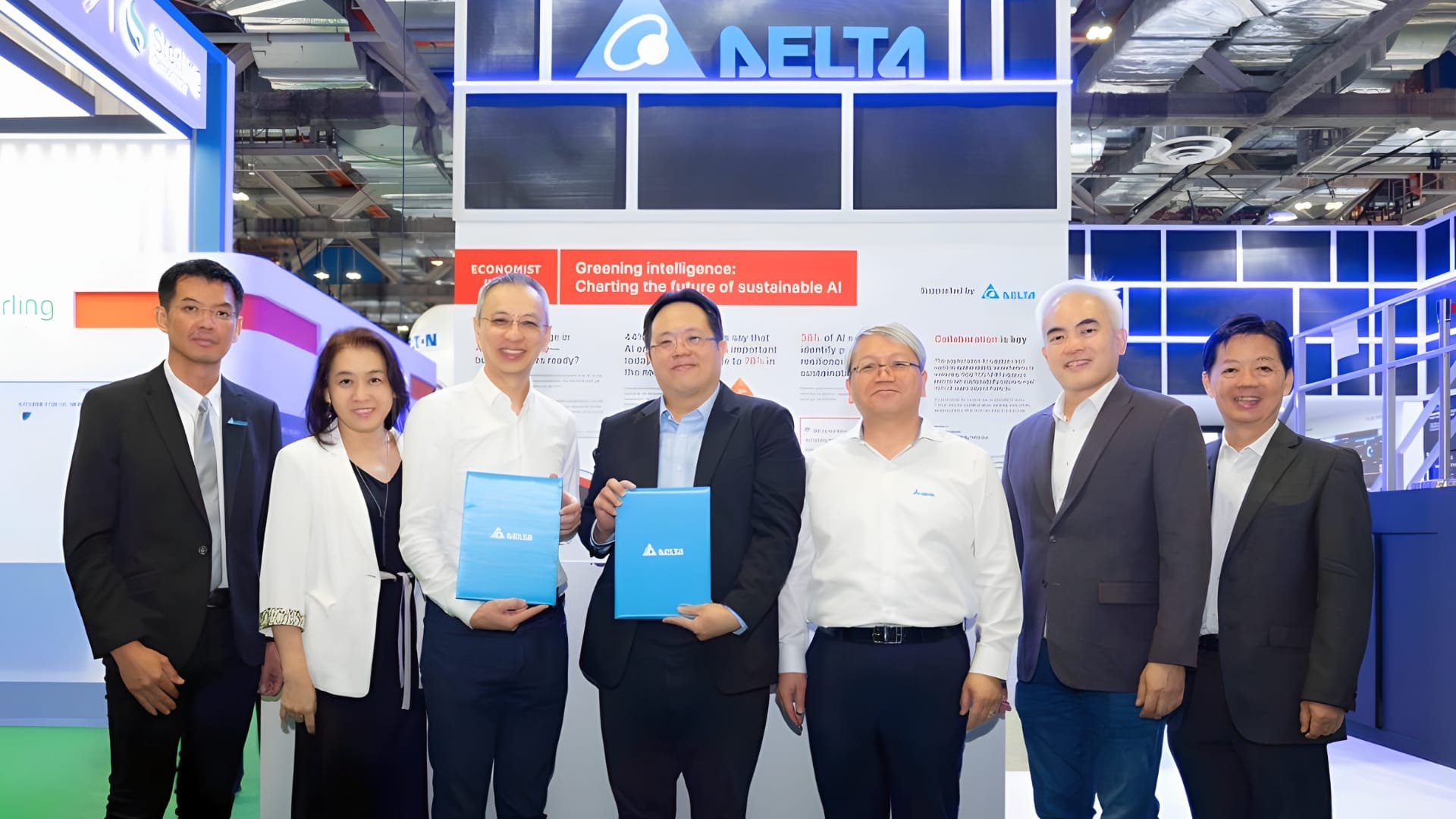
Delta Electronics Singapore has entered into a three-year Memorandum of Understanding with the College of Design and Engineering at the National University of Singapore to support the development of next-generation sustainable data centre technologies. The agreement brings together industry and academia to address the growing energy and sustainability challenges associated with modern digital infrastructure, particularly in tropical environments where heat and humidity place added strain on data centre operations.
The collaboration will be anchored on the Sustainable Tropical Data Centre Testbed 2.0, a research platform led by NUS that is designed to test and validate advanced data centre technologies under real-world tropical conditions. Through this partnership, both parties aim to explore practical solutions that can be scaled and deployed across the region, as demand for cloud computing, artificial intelligence workloads, and digital services continues to rise.
The signing reflects a shared recognition that data centres are now a critical backbone of the digital economy. At the same time, they are among the most energy-intensive facilities, raising concerns around carbon emissions, power consumption, and long-term resilience. By combining Delta’s engineering expertise with NUS’ research capabilities, the partnership seeks to close the gap between academic research and real-world implementation.
Focus on energy systems, cooling and modular infrastructure
A core focus of the collaboration will be smart energy systems integration, advanced thermal management, and modular infrastructure design tailored for tropical climates. These areas have become increasingly important as data centres evolve to support high-density computing, including AI and machine learning workloads that generate significantly more heat than traditional servers.
Delta Electronics Singapore General Manager PS Tang described data centres as having evolved into “AI factories” that underpin innovation and connectivity, while also presenting major energy challenges. He said the collaboration with NUS aims to push the boundaries of design and technology for sustainable, modular, and intelligent data centres, reflecting Delta’s long-term commitment to innovation and its vision for a greener future.
From the academic perspective, the partnership is positioned as an opportunity to translate research into practical outcomes. Professor Silvija Gradecak, Vice Dean for Research and Technology at the College of Design and Engineering, highlighted the value of working closely with industry to ensure that academic discoveries lead to impactful industrial applications. She noted that such collaborations also provide students and researchers with exposure to real-world challenges and deployment considerations.
Professor Lee Poh Seng, Head of Mechanical Engineering at CDE and Programme Director of STDCT 2.0, emphasised the role of NUS’ expertise in thermal systems, energy technologies, and digital design. He said the collaboration is expected to result in scalable solutions that align with Singapore’s broader sustainability objectives, particularly as the nation continues to expand its digital infrastructure footprint.
Robotics, national goals and a broader sustainability agenda
Beyond energy and cooling technologies, the collaboration will also explore the integration of Delta’s autonomous inspection robots within data centre environments. These robots are intended to enhance operational safety, enable real-time monitoring, and support predictive maintenance by identifying potential issues before they escalate into failures or downtime.
Autonomous inspection and monitoring are becoming increasingly relevant as data centres grow in size and complexity. By reducing the need for manual inspections in high-risk or high-temperature environments, robotics can improve worker safety while also supporting more efficient and reliable operations. The inclusion of this technology underscores the partnership’s emphasis on intelligent, data-driven infrastructure management.
The agreement also aligns with Singapore’s national priorities, including the Green Plan 2030 and Smart Nation initiatives. Both programmes emphasise sustainable development, digital resilience, and the responsible use of technology to support long-term economic growth. By focusing on low-carbon energy pathways, advanced cooling solutions, and AI-ready systems, the collaboration positions itself within a broader national and regional push towards greener digital infrastructure.
Delta’s involvement builds on its wider global focus on energy efficiency and sustainability. Founded in 1971 and listed on the Taiwan Stock Exchange, the company has established itself as a global provider of power and thermal management solutions across sectors such as industrial automation, building automation, telecommunications, data centres, electric vehicle charging, and renewable energy. Its emphasis on high-efficiency power electronics and ESG-led business practices has been recognised through various international sustainability indices and awards.
For NUS, the Sustainable Tropical Data Centre Testbed represents a long-term effort to shape how data centres are designed and operated in hot and humid climates. As STDCT enters its second phase, the programme is working with global partners to pioneer AI-ready, high-density systems, integrate low-carbon energy sources, and deploy advanced cooling technologies. The collaboration with Delta is expected to contribute directly to these objectives, while reinforcing Singapore’s role as a testbed and reference point for sustainable data centre innovation in the tropics.