


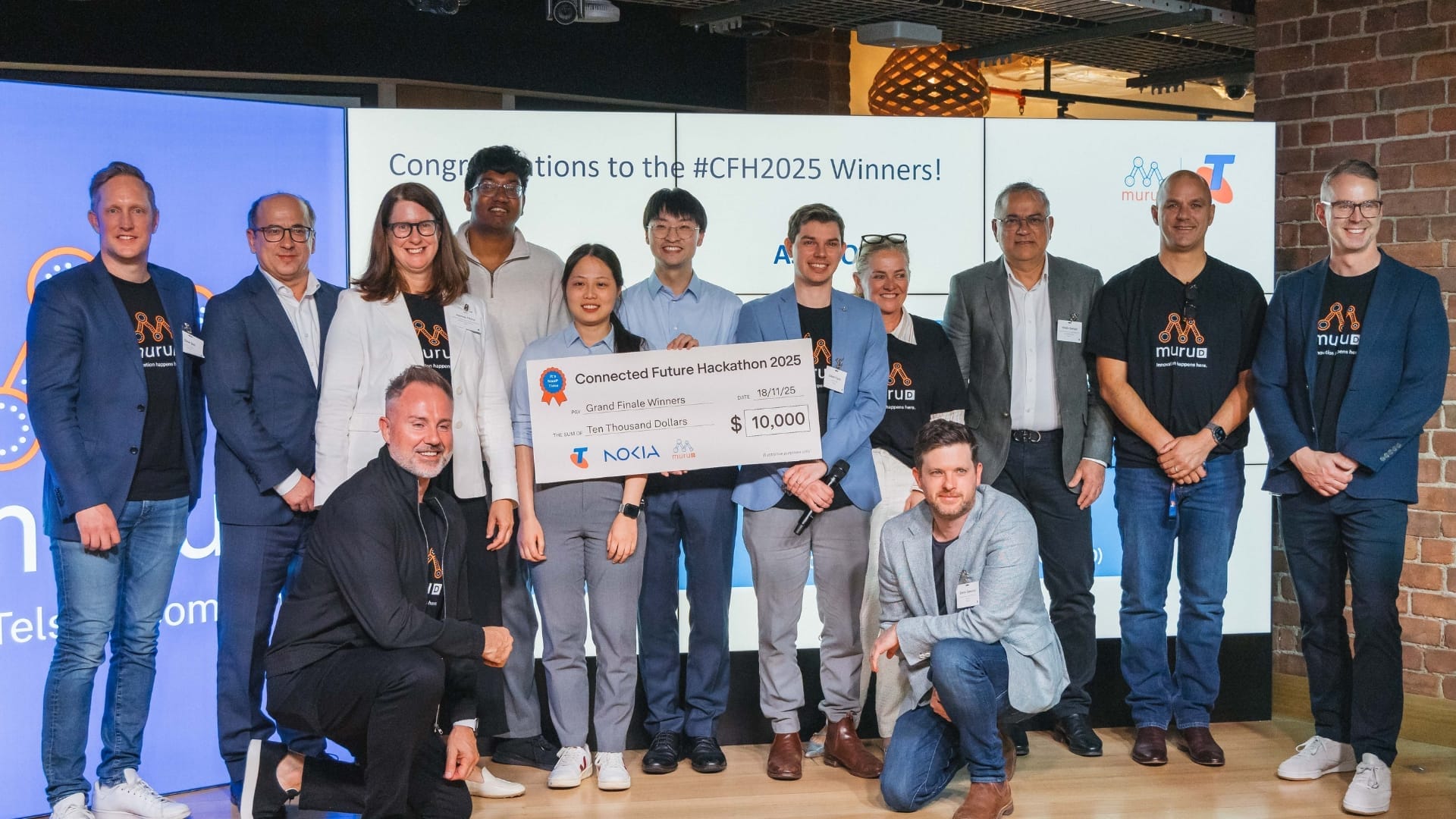
Nokia and Telstra have completed the Connected Future Hackathon 2025 in Melbourne, bringing together developers from Australia and India to explore new applications for programmable connectivity. Held through Telstra’s muru-D innovation hub, the event gathered more than 200 participants across 60 teams, all working with Nokia’s Network as Code platform and Telstra’s network APIs in a secure sandbox environment.
Across the event, teams produced more than 30 prototypes that demonstrated how real-time network insights can be used to build next-generation applications for industries such as healthcare, banking, automotive and entertainment. The organisers positioned the hackathon as an opportunity for developers to experiment with capabilities including device connectivity, identity and number verification, and location proximity, reflecting the growing momentum around network programmability.
Prototypes built on real-time network intelligence
Participants worked with a curated set of developer-ready APIs designed to make advanced network functions accessible through simple interfaces. The resulting prototypes showed how network data can enable more intelligent and responsive services, from fraud prevention tools to location-aware applications that adapt to users’ immediate surroundings.
The winning team, Advanced Software Engineering COE, focused on the long-standing challenge of phone number recycling. Their prototype identifies and manages the reassignment of deactivated numbers, helping organisations avoid misrouted messages and reduce the security issues that arise when authentication codes are delivered to the wrong person. The three-member team described their project as “a smarter way for businesses to verify SIM ownership before sending SMS codes.”
Nokia said the event demonstrated the value of lowering barriers for developers looking to integrate network insights into their applications. Shkumbin Hamiti, Head of Network Monetization Platform, Cloud and Network Services at Nokia, said the results showed “the remarkable creativity that emerges when developers gain simple, secure access to advanced network capabilities through Nokia’s Network as Code platform.” He added that the hackathon reflected how “programmable connectivity stimulates meaningful innovation, as developer ecosystems use network intelligence to solve real-world challenges.”
Telstra highlights role of APIs in developer ecosystem
Telstra said the hackathon aligned with its wider shift towards programmable networks and the company’s Network as a Product vision. Simon Osmond, Group Owner Product and Technology at Telstra, said it was “fantastic to work with the developer community and give them the tools to build and innovate on our network.”
He noted that the event demonstrated how opening network functions through APIs can drive new business models and deliver smarter, more secure digital experiences for customers. “With partners like Nokia, we want to build an ecosystem where innovation thrives, new business models emerge and our customers benefit from smarter, more secure digital experiences,” he said.
Nokia also noted ongoing expansion of its Network as Code ecosystem, which now includes more than 65 partners spanning telecommunications providers, cloud and AI companies, CPaaS platforms, systems integrators and industry software vendors.
The hackathon forms part of Telstra muru-D’s broader focus on emerging technologies, rapid prototyping and real-world experimentation. The programme supports a portfolio of about 80 startup investments and works across areas such as 5G, IoT, edge computing and applied AI, in collaboration with universities, industry groups and technology partners.