


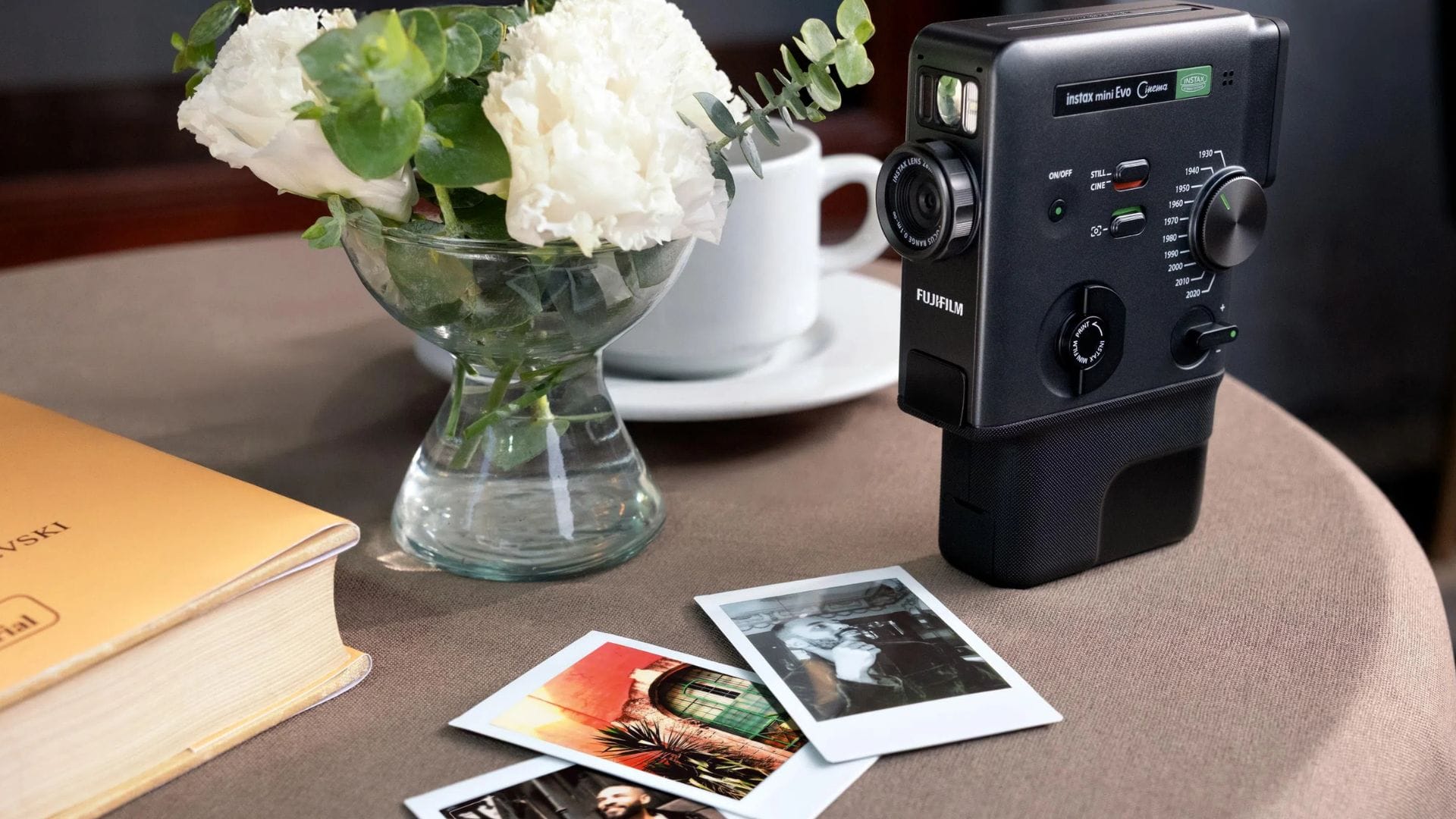
Fujifilm has introduced the Instax Mini Evo Cinema, a hybrid instant camera that combines still photography, short video capture and instant printing in a single device. The company is targeting users who enjoy sharing visual content across social platforms, drawing inspiration from both early digital camera design and modern short-form video trends.
Positioned as a three-in-one product, the Instax Mini Evo Cinema is designed to shoot still images, record video clips of up to 15 seconds, and print Instax mini photos directly from the camera. Fujifilm says this combination is intended to meet the everyday creative needs of users who want both physical prints and digital content for platforms such as Instagram, TikTok, and XHS (formerly Rednote).
The camera continues Fujifilm’s focus on nostalgia-driven design, with controls and effects that reference different photographic eras. Its overall look leans into a retro aesthetic, while its features are built around contemporary habits such as quick sharing, casual video creation and personalised visual styles. The result is a product that blends old and new, appealing to both younger users and those drawn to familiar camera designs.
As a hybrid device, the Instax Mini Evo Cinema aims to reduce the need for multiple gadgets. Users can capture images, adjust their look, print selected shots and manage basic video creation without switching devices, while still retaining the option to move content to a smartphone for further sharing.
Creative controls and app-based features
At the heart of the Instax Mini Evo Cinema is a set of physical dials designed to give users hands-on creative control. The Gen Dial allows users to choose from 10 different filters, each representing a distinct photographic era from the 1930s through to the 2020s. These filters are intended to recreate the visual feel of different periods of photography.
Complementing this is the Degree Control Dial, which adjusts colour, contrast and noise levels. By rotating the dial, users can fine-tune each filter to create up to 10 variations per era. This results in 10 intensity levels for each time period, offering a high degree of personalisation without complex menus.
The camera also includes a Frame Switch, which lets users add era-specific frames to both photos and videos. These frames are designed to match the selected filter, further reinforcing the retro look and mimicking the appearance of cameras from different decades. For zooming, a Zoom Lever controls digital zoom strength, keeping the operation simple and familiar.
Other built-in features include a selfie mirror, a self-portrait timer, and a 1.54-inch LCD screen that lets users preview images before printing. The camera supports remote shooting via a smartphone app that can serve as a shutter button, making it easier to capture group shots or record self-recorded videos.
Users can switch between Cine mode and Still mode to record video or take photos. The camera can also automatically stitch video clips and stills into a single piece of content. Through the free Instax Mini Evo smartphone app, which connects via Bluetooth, users can reorder clips, extend video length to up to 30 seconds, and send images for printing.
For video content, the system offers an unusual feature: printed QR codes. These can be shared physically, allowing others to scan and watch the associated video on their phones. Videos and audio are stored for up to 24 months. File transfers and storage expansion are supported through a USB-C port and a MicroSD card slot.
Additional printing options and Singapore availability
Alongside the Instax Mini Evo Cinema, Fujifilm has also launched the Instax Mini Link+ smartphone printer in Singapore. This separate device is designed for users who prefer to print photos directly from their phones rather than from a camera. It works with the Instax Mini Link app, available on both iOS and Android.
Through the app, users can customise and preview their images before printing. The printer connects via Bluetooth 5.1 and supports common file formats including JPEG, PNG, HEIF and DNG. It uses Fujifilm Instax Mini Instant Film to produce square prints measuring 46 x 46mm, with a resolution of 800 x 600 pixels and a pixel density of 318 dpi.
The Instax Mini Link+ weighs 240g, making it easy to carry in a bag. Fujifilm says it can produce up to 100 prints on a full charge, with charging taking between two and three hours. A 30cm USB-C cable is included for charging.
In Singapore, the Instax Mini Evo Cinema is priced at S$529, while the Instax Mini Link+ smartphone printer is available for S$229. With these launches, Fujifilm is continuing to expand its Instax range, focusing on products that merge physical photo prints with the digital sharing habits of today’s social media users.